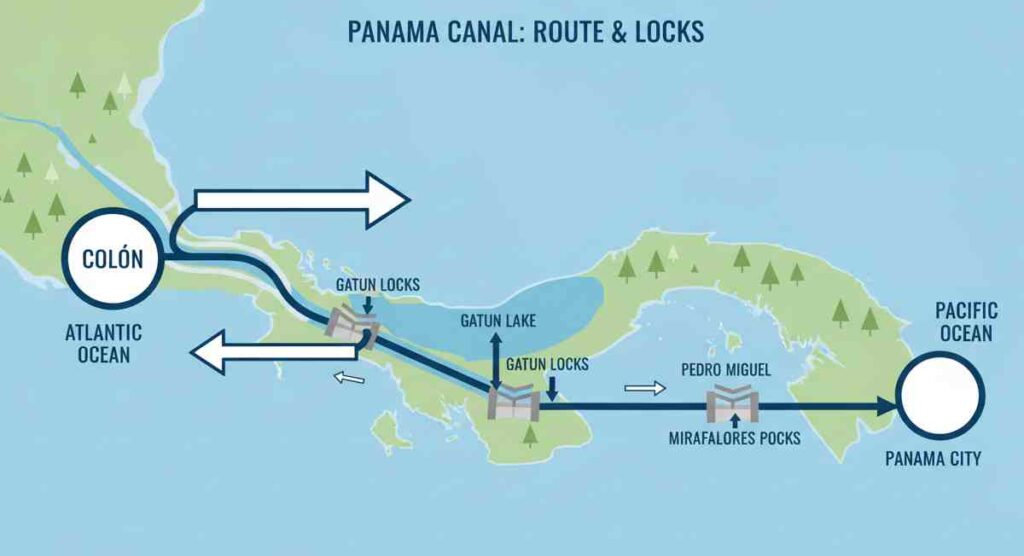
How long does it take to cross the Panama Canal? In most cases, a full transit takes about 8 to 10 hours from one ocean to the other. This is the actual time a ship spends moving through the canal system, not counting any waiting time before entry. The journey covers roughly 50 miles and includes a series of locks, lakes, and narrow channels that carefully lift and lower vessels between sea levels.
Many people feel confused when they see much longer time estimates online. That’s usually because waiting times can add hours or even days before a ship is allowed to begin its crossing. Once inside Panama Canal, however, the transit itself is tightly controlled and surprisingly efficient.
The exact duration depends on several factors, including how long a ship spends in the locks, the size and type of vessel, and current traffic levels. Cruise ships, cargo ships, and larger modern vessels can all experience the crossing a bit differently. Understanding these factors helps explain why the average stays steady, even when individual journeys vary.
Average Time to Cross the Panama Canal
When planning a journey or researching shipping routes, it helps to set clear expectations about timing. On average, crossing the Panama Canal is much faster than many people assume. The key is understanding the difference between actual transit time and the total time involved in the journey.
Standard Commercial Ship Transit
For most commercial cargo ships, the average time to cross the Panama Canal is 8 to 10 hours. This is the time spent actively moving through the canal system from the Atlantic side to the Pacific side, or the other way around. During this period, ships travel about 50 miles (80 kilometers), passing through a series of locks, Gatun Lake, and narrow channels where speeds are carefully controlled.
The process is highly organized. Canal pilots guide vessels through each stage, and operations run around the clock. Because of this tight coordination, the transit time itself stays fairly consistent, regardless of the ship’s destination after leaving the canal.
Why Some Sources Mention 11–18 Hours
You may see longer time estimates, such as 11 to 18 hours, in official documents or planning guides. These numbers often include buffer time used for scheduling, safety planning, or traffic management. In other words, they are averages or planning windows not the actual time spent crossing.
Another common source of confusion is waiting time. Ships may wait at anchor for hours or days before entering the canal, but that delay happens outside the canal. Once the transit begins, the crossing time is usually predictable and efficient.
Step-by-Step Breakdown of a Panama Canal Crossing
Understanding each stage of the journey makes it easier to see why a full transit is both efficient and carefully timed. A typical crossing of the Panama Canal follows a clear sequence, with every section managed by strict rules and expert coordination.
Passing Through the Panama Canal Locks
The most complex part of the crossing is moving through the lock system. Ships pass through Miraflores, Pedro Miguel, and Gatun locks, depending on the direction of travel. Altogether, this stage usually takes about 4 to 5 hours.
Inside the locks, vessels are raised or lowered using gravity-fed water. From sea level, ships are lifted up to 85 feet above the ocean before being lowered again on the opposite side. Each lock chamber must be entered slowly and precisely, guided by canal pilots and tugboats. Although this process looks slow from the outside, it is highly efficient and follows a strict schedule.
Crossing Gatun Lake
After clearing the initial locks, ships enter Gatun Lake, one of the largest artificial lakes in the world. This stretch typically takes around 3 hours. Here, vessels cruise at controlled speeds while sharing the lake with other traffic moving in both directions.
The pace is steady, not rushed. Speed limits are enforced to maintain safety, prevent shoreline damage, and keep traffic flowing smoothly. While this section feels more relaxed than the locks, it still requires careful navigation and constant communication.
Navigating the Gaillard (Culebra) Cut
The final major challenge is the Gaillard Cut, also known as the Culebra Cut. This is a narrow, winding channel carved through rock and hills. Because space is limited, ships must follow strict speed limits and traffic controls.
Only certain vessels can pass through at the same time, and timing is closely managed to avoid congestion. Once a ship clears this section, the final descent through the remaining locks brings the crossing to an end.
Together, these stages explain how a complex 50-mile journey can stay so predictable.
Factors That Affect How Long It Takes to Cross the Panama Canal
While the average crossing time stays fairly consistent, not every vessel moves through the Panama Canal in exactly the same way. Several key factors can influence how long a transit takes, especially when planning schedules or comparing different journeys.
Ship Size and Canal Type
One major factor is ship size. Traditional Panamax vessels are designed to fit the canal’s original locks, while larger Neopanamax ships use the expanded locks introduced after the canal upgrade. Despite the size difference, transit times are often similar because both lock systems are highly automated and carefully managed.
However, larger ships require more precise maneuvering and tug assistance, which can add small increments of time. The type of locks used original or expanded also affects traffic flow, especially during busy periods.
Traffic, Scheduling, and Wait Times
Traffic volume plays a big role, but mostly before the transit begins. Ships may wait at anchor for several hours to several days before entering the canal, depending on demand, scheduling priority, and seasonal shipping peaks.
During high-traffic seasons, such as major global trade cycles or periods of drought-related restrictions, congestion can increase. These delays are often mistaken for longer crossing times, even though the actual transit inside the canal remains efficient and controlled.
Cruise Ships vs Cargo Ships
Cruise ships experience the canal differently than cargo vessels. Many cruises offer partial transits, where ships pass through some locks but turn back for sightseeing purposes. These journeys often take longer due to guided commentary and viewing pauses.
Full cruise transits may also extend beyond standard cargo timelines because of daylight scheduling and sightseeing stops. The added time enhances the passenger experience but doesn’t reflect operational delays.
In short, while the crossing itself is well-regulated, these factors explain why individual journeys can feel longer or shorter than average.
How Long Does It Take to Cross the Panama Canal on a Cruise?
For cruise passengers, crossing the Panama Canal is less about speed and more about the experience. While commercial ships aim for efficiency, cruise itineraries are designed to maximize viewing time and onboard enjoyment. As a result, a cruise ship crossing often feels longer than a standard cargo transit.
Most cruise transits are scheduled during daylight hours only. This allows passengers to watch the lock operations, lake crossings, and surrounding landscapes in full view. Because of this daytime scheduling, cruise ships may move more slowly or pause between sections to align with viewing opportunities.
Another reason cruise crossings take longer is intentional viewing stops. Ships may slow down in key areas, especially near the locks, so passengers can observe the process and take photos. Onboard announcements and guided commentary also add to the overall duration.
For full transits, cruise passengers can expect an onboard experience lasting 10 hours or more. Partial transits, which are common on shorter itineraries, may still take several hours as ships pass through one set of locks before turning around.
It’s important to note that this extended time is not a delay or inefficiency. The canal is operating normally, but the pace is adjusted to enhance the passenger experience. For travelers, the longer duration is often a highlight rather than a drawback.
Historical vs Modern Panama Canal Transit Times
The time it takes to cross the Panama Canal has changed significantly over the last century. Comparing early transits with today’s operations shows just how much technology and planning have improved efficiency.
How Long It Took in 1914
When the Panama Canal officially opened in 1914, the very first full transit took around 12 hours. At the time, this was considered a major engineering success. However, operations were far more manual than they are today.
Lock gates were controlled using early mechanical systems, navigation relied heavily on human coordination, and traffic volume was low but slow-moving. Ships had fewer safety aids, and every step of the process required hands-on control. Even under ideal conditions, transits were less predictable and often took longer than planned.
Why Today’s Canal Is Faster and More Efficient
Modern canal operations are built around automation and precision. Today, advanced control systems manage water levels, lock gates, and vessel movement with far greater accuracy. This reduces delays and keeps traffic flowing smoothly.
The canal expansion, completed in the 2010s, also played a major role. New, wider locks allow larger ships to pass through while easing congestion in the original system. As a result, the canal can now handle over 14,000 ships each year more efficiently than ever before.
Despite increased traffic and larger vessels, modern transits are often faster than they were a century ago, proving how innovation has transformed one of the world’s most important waterways.
Quick Answer – How Long Does It Really Take to Cross the Panama Canal?
So, how long does it take to cross the Panama Canal? In simple terms, the actual crossing usually takes about 8 to 10 hours once a ship enters the canal. This is the standard transit time for most commercial vessels and full cruise crossings, moving from one ocean to the other through locks, lakes, and narrow channels.
The key thing to remember is that wait times are separate from the crossing itself. Ships may wait at anchor for hours or even days due to traffic, scheduling, or seasonal congestion, but that time happens before the transit begins. Factors such as ship size, canal type, and whether the vessel is a cruise ship or cargo ship can also affect how the journey feels.
When you separate waiting from movement, the answer becomes clear. The Panama Canal crossing time is efficient, controlled, and surprisingly predictable. Understanding these variables helps set realistic expectations and clears up much of the confusion surrounding canal transit times.