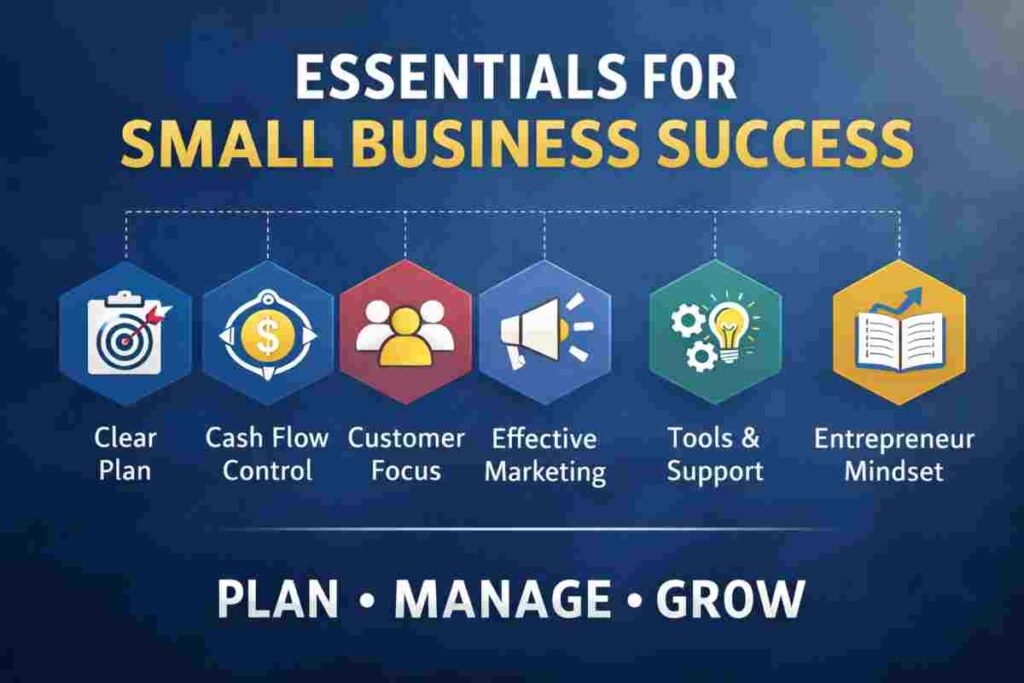
Most small businesses don’t fail because of bad ideas. They stall because the basics never lock into place. There’s effort, long hours, even early sales but no structure holding it all together.
That’s where things start to slip.
Success in business isn’t luck or timing. It’s the result of clear thinking paired with steady action. You need a plan that guides you, systems that keep things running, and the discipline to follow through when it gets tough.
Many owners focus on one piece usually sales and ignore the rest. But growth doesn’t come from a single move. It comes from a set of habits working together.
This guide breaks it down into six essentials every small business owner needs. From building a clear plan to managing money, attracting customers, and staying adaptable each part plays a role.
Get these right, and your business has something most don’t:
A real chance to last and grow.
1. A Clear Business Plan and Purpose
Why a business plan still matters
A strong business plan for small business owners is not just paperwork. It is a working guide that shapes daily decisions. Without it, choices become reactive and growth feels random. A clear plan shows where you are going, who you serve, and how you will compete.
It also helps you stay focused when new ideas pull your attention in different directions. Instead of chasing every opportunity, you can measure each move against your plan. This brings clarity to hiring, pricing, and expansion.
Defining your purpose beyond profit
Money keeps the business running, but purpose keeps you going when things get hard. A clear purpose gives meaning to your work and helps your team stay aligned. It answers a simple question: why does this business exist?
When your purpose is clear, it shapes your brand, your message, and how you treat customers. People connect with businesses that stand for something real.
How often to revisit your plan
A business plan should not sit untouched after it is written. Markets shift, customer needs change, and new challenges appear. Review your plan regularly and adjust where needed.
Keep it flexible so it grows with your business. A plan that evolves stays useful. A plan that stays frozen becomes irrelevant.
2. Financial Discipline and Cash Flow Control
The difference between profit and cash flow
Many founders think profit means the business is doing well. On paper, it might be. But cash flow tells a different story. Profit is what remains after expenses. Cash flow is the money actually moving in and out of your business.
You can be profitable and still run out of cash. This happens when payments are delayed, costs pile up, or sales do not convert into immediate income. It is one of the most common mistakes small business owners make. They focus on sales and ignore timing.
Strong cash flow management keeps your business alive. It ensures you can pay bills, cover salaries, and keep operations running without stress. Cash flow problems are one of the biggest reasons small businesses struggle during periods of growth or unexpected expenses. Even profitable companies can experience temporary gaps between incoming revenue and operational costs like payroll, inventory, marketing, or equipment purchases. Many owners use a business line of credit to maintain working capital flexibility, cover short-term expenses, and manage seasonal fluctuations without taking on a large fixed loan. Having access to revolving credit can also help businesses respond more quickly to growth opportunities while maintaining day-to-day financial stability.
Basic systems every owner needs
You do not need complex tools to stay in control. You need consistent systems. Start with simple bookkeeping. Track every sale, every expense, and every invoice. Know where your money comes from and where it goes.
Expense tracking is just as important. Small costs add up quickly and eat into your margins if ignored. Use tools or even a basic spreadsheet, but update it regularly. Clarity beats complexity every time.
Building a safety buffer
Every business faces slow periods. Sales drop, clients delay payments, or unexpected costs appear. Without a buffer, these moments can disrupt everything.
Aim to keep enough cash to cover at least three to six months of expenses. This gives you breathing room and keeps decisions calm rather than rushed. A financial cushion does not just protect your business. It protects your mindset as well.
3. A Customer First Approach
Why customers decide your growth
Your business grows when your customers come back. Not when they buy once and disappear. Many owners chase new customers while ignoring the ones they already have. That is expensive and unsustainable.
Customer satisfaction strategies shift the focus from constant chasing to building loyalty. A repeat customer costs less, spends more, and often brings others with them. Growth becomes steady instead of unpredictable.
Retention beats acquisition when done right. It creates a base you can build on instead of starting from zero every month.
Listening and responding to feedback
Customers are always telling you what works and what does not. The problem is most businesses do not listen closely enough. Feedback should not sit in inboxes or comment sections. It should shape decisions.
When you respond quickly and adjust based on what customers say, you improve in real time. Small fixes can lead to better experiences and stronger relationships.
Listening is not passive. It is an active part of running a smart business.
Turning customers into repeat buyers
Trust builds through consistency. When customers know what to expect and get it every time, they return.
Simple actions make the difference. Deliver on promises. Communicate clearly. Fix problems without delay.
Over time, satisfied customers become loyal ones. And loyal customers become the foundation of long term growth.
4. A Focused Marketing and Sales System
Visibility is everything
You might offer a great product or service, but it means nothing if people never see it. For many owners, this is where things break down. They rely on word of mouth alone or wait for customers to show up.
Marketing for small business starts with one simple truth. If people do not know you, you do not exist. Visibility creates opportunity. It puts your business in front of the right audience at the right time.
This does not require a huge budget. It requires consistency and clarity. Show up where your customers are and make it easy for them to understand what you offer.
Simple channels that work
You do not need to be everywhere. You need to be effective in a few key places. A clean website builds trust and gives people a place to learn more. Social media helps you stay visible and connected. Referrals bring in warm leads who already trust you. Email keeps your audience engaged over time.
The goal is not to chase every platform. It is to focus on channels that bring results and double down on them. For many small businesses, working with experienced advertising companies can also help identify which channels are worth investing in and which ones are wasting time.
Measuring what actually works
Guesswork wastes time and money. A strong marketing system tracks what brings real results.
Look at where your leads come from, which messages convert, and what drives sales. This is where an ROI mindset matters. Every effort should have a purpose and a measurable outcome.
When you track performance, you stop guessing and start improving. Over time, your marketing becomes more efficient and far more effective.
5. The Right Support System and Tools
Why doing everything alone slows you down
Many small business owners try to handle everything on their own. At first, it feels necessary. You want to save money and stay in control. But over time, this approach creates bottlenecks. Progress slows, decisions take longer, and burnout creeps in.
No business grows in isolation. Mentors, peer networks, and local business communities give you perspective you cannot see on your own. Some businesses also benefit from working with a fractional CFO who can provide financial guidance and strategic insight without the cost of hiring a full-time executive. A simple conversation can help you avoid mistakes that cost time and money.
Support is not a luxury. It is a growth lever. The sooner you tap into it, the faster you move.
Tools that save time and money
The right small business tools can take hours of manual work off your plate. You do not need dozens of platforms. You need a few reliable ones that handle key areas.
Accounting tools keep your finances organized and accurate. Marketing tools help you reach and stay connected with your audience. Project management tools keep tasks clear and on track. Choosing the right CRM for small business is equally important, as it helps you manage customer relationships, track leads, and streamline your sales process all in one place. For billing, a free online invoice generator lets you create professional invoices, save client details, set due dates, and send them by email or PDF. It auto-calculates totals and taxes, tracks paid vs. overdue invoices, and reduces retyping—helping you get paid faster.
These tools free up your time so you can focus on decisions that actually grow the business. Tools like The QR Code Generator (TQRCG) can help businesses improve customer engagement, simplify payments, and provide instant access to product or service information. Project management tools keep tasks clear and on track. For businesses looking to grow beyond their home market, professional translation and localization services like Milestone Localization help adapt your website, documents, and marketing materials for new audiences, removing language barriers that often slow international growth.
Learning from others’ mistakes
Experience is valuable, but learning only from your own mistakes is slow and expensive. Smart business owners learn from others.
Case studies, mentors, and shared experiences show you what to avoid and what works in practice. This gives you a faster path forward.
Growth becomes easier when you stop figuring everything out from scratch and start building on what others have already learned.
6. Resilience, Adaptability, and Continuous Learning
The reality of setbacks
Every business faces rough patches. Sales slow down, plans fall apart, and unexpected problems show up without warning. This is not a rare event. It is part of the journey.
An entrepreneur mindset accepts this reality instead of resisting it. Setbacks are not signals to quit. They are moments to adjust and move forward with better insight. The difference between those who last and those who stop often comes down to how they respond when things go wrong.
Staying flexible in changing markets
Markets shift quickly. Customer needs change, new competitors appear, and trends move fast. If you stay rigid, you fall behind.
Adaptability keeps your business relevant. This means testing new ideas, adjusting your offers, and staying open to change. The key is to act quickly without losing focus. Do not freeze when things shift. Make small, smart adjustments and keep moving.
Flexibility is not about guessing. It is about responding with awareness and speed.
Building a habit of learning
Skills drive progress. The more you learn, the better your decisions become.
Make learning part of your routine. Stay updated on marketing, finance, and tools that can improve your business. Even small improvements add up over time.
When you keep learning, you stay prepared. And in business, staying prepared often means staying alive.
Common Mistakes Small Business Owners Should Avoid
Running a business is hard enough. Avoiding a few common small business mistakes can save you time, money, and stress.
One major mistake is ignoring finances. Many owners focus on sales but lose track of expenses, margins, and cash flow. Without clear numbers, it becomes difficult to make smart decisions.
Weak marketing is another issue. A good product is not enough if no one knows about it. Inconsistent effort or unclear messaging leads to low visibility and missed opportunities.
Trying to do everything alone also slows growth. When you handle every task yourself, progress becomes limited. You lose time that could be spent on higher value work.
Finally, a lack of clear direction creates confusion. Without a plan, decisions become reactive and scattered. The business moves, but not always forward.
Avoiding these mistakes does not guarantee success, but it gives your business a much stronger foundation to build on.
Conclusion
Success in small business rarely comes from one big move. It comes from getting the basics right and making them work together. A clear plan gives direction. Strong financial habits keep you stable. A focus on customers builds loyalty. Marketing brings visibility. Support and tools create efficiency. The right mindset keeps you moving when things get tough.
These six essentials are not separate ideas. They form a system. When one is weak, the whole business feels it. When they work together, progress becomes steady and easier to manage.
You do not need perfect conditions to move forward. You need consistency. Small actions repeated over time create real results. Adjust when needed, but keep going.
Take a moment to reflect on your current setup. Identify what is missing or underdeveloped. Start with one area and improve it. Then move to the next.
Growth is not about doing everything at once. It is about doing the right things, again and again, until they start working in your favor.
FAQs
What are the most important factors for small business success?
The most important factors include a clear plan, strong financial control, and a focus on customers. Marketing also plays a key role in bringing visibility, while the right tools and support help you stay efficient. On top of that, the mindset of the owner matters. Consistency, adaptability, and a willingness to learn often make the biggest difference over time.
How can a small business grow faster?
Growth comes from doing a few things well and repeating them. Focus on channels that bring results, improve your offer based on customer feedback, and build systems that save time. Avoid spreading yourself too thin. When your efforts are focused and consistent, growth becomes more predictable and easier to manage.
Why is cash flow important for small businesses?
Cash flow keeps your business running day to day. Even if sales look strong, delays in payments or high expenses can create problems. Good cash flow management ensures you can cover costs, pay your team, and handle unexpected situations without pressure. It provides stability and allows you to plan ahead with confidence.
What is the biggest mistake small business owners make?
One of the biggest mistakes is operating without clear direction. Many owners jump between ideas without a solid plan. Others ignore finances or rely on weak marketing. These issues build up over time and slow progress. Staying focused on the basics helps avoid these problems.
Do small businesses really need a business plan?
Yes, a business plan is essential. It gives structure to your ideas and helps guide decisions. It does not have to be complex, but it should clearly outline your goals, target market, and strategy. A good plan keeps you focused and makes it easier to adjust as your business grows.