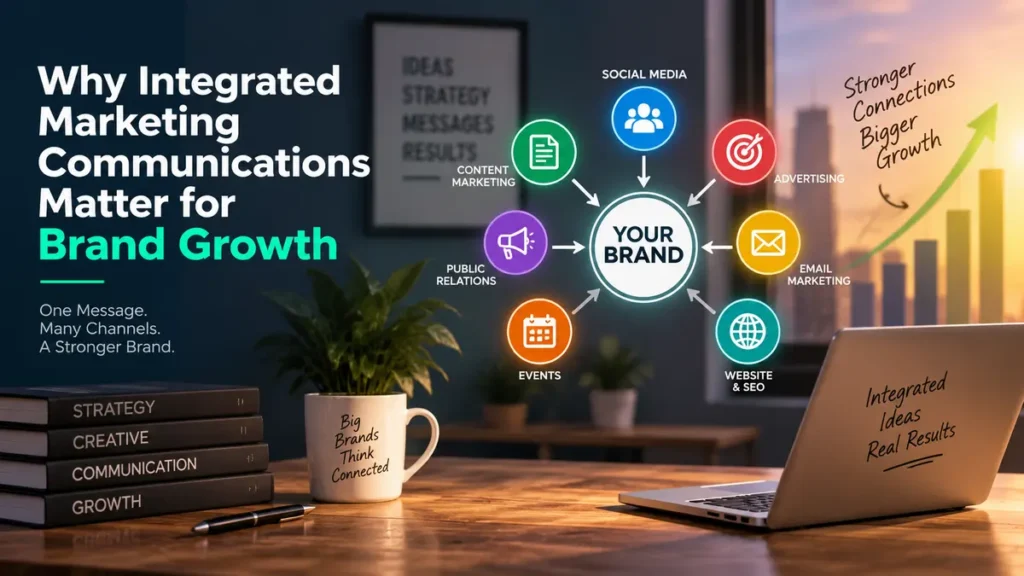
In a crowded and highly connected marketplace, building a recognizable brand requires more than a strong product or an attractive advertising campaign. Audiences interact with brands across websites, social media, search engines, news outlets, email, events, and countless other channels. When these interactions feel disconnected, a brand can struggle to establish a clear identity and maintain audience trust.
This is where Integrated Marketing Communications (IMC) becomes essential. IMC brings different communication and marketing activities together under a unified strategy, helping organizations deliver consistent messages while adapting those messages to different audiences and platforms.
For organizations operating in specialized fields such as education, combining marketing, communications, and public relations can be particularly valuable. A focused education pr strategy, for example, can complement broader marketing initiatives by helping organizations communicate their expertise, values, achievements, and reputation to important stakeholders.
What Is Integrated Marketing Communications?
Integrated Marketing Communications is a strategic approach that coordinates multiple communication channels so they work toward common business and brand objectives. Rather than allowing advertising, public relations, social media, content marketing, email, and other activities to operate independently, IMC connects them through a shared strategy and brand message.
The goal is not necessarily to repeat exactly the same content everywhere. Instead, each channel should contribute to the same overall story while using formats and messages appropriate for its audience.
For example, a company launching a new service might publish an announcement through its website, promote the launch through social media, distribute supporting content through email marketing, secure media coverage through PR, and use digital advertising to reach relevant prospects. When these activities reinforce one another, the campaign can have a much greater overall impact.
Research into higher education marketing has similarly found that integrated communications can contribute to planned brand identity, awareness, image, and reputation.
Why Consistency Matters for Brand Growth
One of the biggest advantages of integrated communications is consistency.
Every interaction gives an audience another opportunity to form an opinion about a brand. If the company’s website communicates one value proposition while its advertising, social media, and public relations efforts communicate something completely different, people may find it difficult to understand what the brand actually represents.
A consistent communication strategy helps reinforce:
- Brand identity
- Core values
- Positioning
- Tone of voice
- Visual identity
- Key messages
- Customer expectations
Consistency does not mean making every piece of content identical. Instead, it means ensuring that different communications support the same underlying brand promise.
Recent guidance from Northwestern University’s Medill School of Journalism, Media, Integrated Marketing Communications also highlights the importance of unified messaging across fragmented media channels.
IMC Builds Stronger Brand Recognition
Brand recognition develops when audiences repeatedly encounter recognizable ideas, visual elements, and messages associated with an organization.
Integrated marketing makes these repeated interactions more valuable because individual campaigns can reinforce one another.
Consider a technology company introducing a new product. Its PR team may secure coverage in industry publications, the content team may publish educational articles, social media managers may share product insights, and the advertising team may target potential customers with paid campaigns.
When all these activities communicate the same central positioning, the audience is more likely to remember the brand.
Over time, this repeated exposure can help transform a relatively unfamiliar company into a recognizable name within its market.
Public Relations Is an Important Part of IMC
Public relations has a unique role within integrated communications because it can influence how a brand is perceived through earned media, thought leadership, events, stakeholder relationships, and reputation management.
Advertising gives organizations significant control over what they say. PR, on the other hand, can help establish credibility by earning attention from journalists, industry publications, influencers, and other third parties.
When PR and marketing operate together, brands can create stronger campaigns.
For example, a company could publish research on an important industry trend. The research can become a long-form report on the company’s website, a series of social media posts, an email campaign, a media pitch, an executive interview, and material for conference presentations.
One piece of original thinking can therefore support multiple communication channels.
IMC Creates a Better Customer Experience
Modern audiences rarely follow a straight path from seeing an advertisement to making a purchase.
Someone might discover a brand through social media, visit its website several days later, read a third-party article, watch a video, subscribe to an email newsletter, and eventually contact the company.
Integrated communications help make these different interactions feel connected.
If the customer encounters a consistent message at each stage, the overall experience becomes clearer. The brand appears more organized, reliable, and professional.
This is especially important for organizations with complex buying decisions, long sales cycles, or multiple stakeholders.
Integrated Communications Can Strengthen Trust
Trust is one of the most valuable assets a brand can develop.
Audiences are exposed to enormous amounts of promotional content every day, making it increasingly difficult for businesses to stand out through advertising alone. Organizations therefore need to demonstrate expertise and credibility through multiple forms of communication.
PR, thought leadership, educational content, customer stories, social media engagement, and transparent corporate communication can all contribute to this process.
When these activities support one another, audiences receive a more complete picture of the organization.
For example, a company’s advertisement may introduce a new idea, while an expert article explains it in greater depth and independent media coverage provides additional credibility. Together, these touchpoints can be more persuasive than any single communication channel.
Why IMC Is Especially Valuable in Education
The education sector provides a strong example of why integrated communications matter.
Schools, universities, education technology companies, training providers, and educational organizations often communicate with numerous audiences. These can include students, parents, educators, administrators, policymakers, journalists, partners, alumni, and investors.
Each audience may have different priorities, but the organization still needs a coherent identity.
An educational institution might use social media to engage students, email to communicate with prospective applicants, PR to highlight achievements, content marketing to demonstrate expertise, and events to build relationships with the wider community.
Without coordination, these efforts can become fragmented. With an integrated approach, every channel can reinforce the institution’s broader positioning and reputation.
Research examining integrated marketing communications in higher education has found that elements such as public relations, brand elements, and service attributes can contribute to planned brand identity and outcomes including awareness, image, and reputation.
IMC Helps Organizations Make Better Use of Content
Content is one of the most powerful assets available to modern brands, but creating content without a clear distribution strategy can limit its impact.
Integrated marketing encourages organizations to think about how one piece of content can support several objectives.
A research report, for instance, could become:
- A downloadable resource on the website.
- A series of LinkedIn posts.
- A media pitch.
- An executive article.
- An email newsletter.
- A presentation for an industry event.
- Short educational videos.
- Supporting material for a paid advertising campaign.
This approach allows organizations to gain more value from their investment in original content while maintaining a consistent narrative.
Data Makes Integration More Effective
Successful IMC is not simply about putting every marketing channel under one umbrella. Data also plays an important role.
Organizations can analyze information from websites, social media, advertising campaigns, email marketing, customer interactions, and other channels to understand what audiences respond to.
These insights can then inform future campaigns.
For example, if a particular topic performs well across social media and generates strong website engagement, the marketing team might develop additional content around that subject. If PR coverage generates significant referral traffic, the organization can explore similar media opportunities.
Integration therefore becomes both a communication strategy and a learning process.
Measuring the Impact of Integrated Marketing
Another important advantage of IMC is the ability to evaluate marketing activities as part of a larger strategy.
Organizations can track metrics such as:
- Brand awareness
- Website traffic
- Media mentions
- Social engagement
- Search visibility
- Lead generation
- Email engagement
- Conversion rates
- Audience sentiment
- Customer retention
The most useful measurement approach depends on the organization’s goals.
A campaign designed primarily to improve reputation may prioritize media quality and sentiment, while a lead-generation campaign may focus more heavily on qualified inquiries and conversions.
The key is to connect communication activity with meaningful business outcomes rather than measuring individual channels in isolation.
Building a Successful IMC Strategy
Creating an integrated communications strategy starts with understanding the brand and its audience.
Organizations should first establish their core objectives. Are they trying to increase awareness, improve reputation, launch a product, attract customers, enter a new market, or strengthen relationships with existing stakeholders?
The next step is identifying the audiences that matter most.
Once those foundations are established, marketers can determine which channels are most appropriate. Not every organization needs to use every available platform. Effective IMC is about strategic coordination rather than simply increasing the number of channels.
The organization should then develop a clear central message and adapt it for each communication environment.
Finally, performance should be measured continuously so that successful tactics can be expanded and weaker approaches can be improved.
The Long-Term Value of Integrated Communications
Integrated Marketing Communications is more than a campaign tactic. When implemented effectively, it becomes part of how an organization manages its brand.
A coordinated approach can help organizations create stronger recognition, communicate more clearly, build trust, improve customer experiences, and make better use of their marketing resources.
In an environment where audiences move constantly between digital and traditional channels, brands cannot afford to communicate in isolated silos.
The organizations most likely to build lasting brands are those that understand how their communications work together. Advertising, content, social media, public relations, events, and other channels each have different strengths, but their combined impact can be significantly greater when they support a shared strategic direction.
Ultimately, integrated marketing communications gives brands a way to turn individual messages into a coherent brand experience—and that consistency can provide a powerful foundation for sustainable brand growth.
Read Also: Cilxarhu677 Moisturizer Product Review: Ingredients, Benefits & Is It Real?