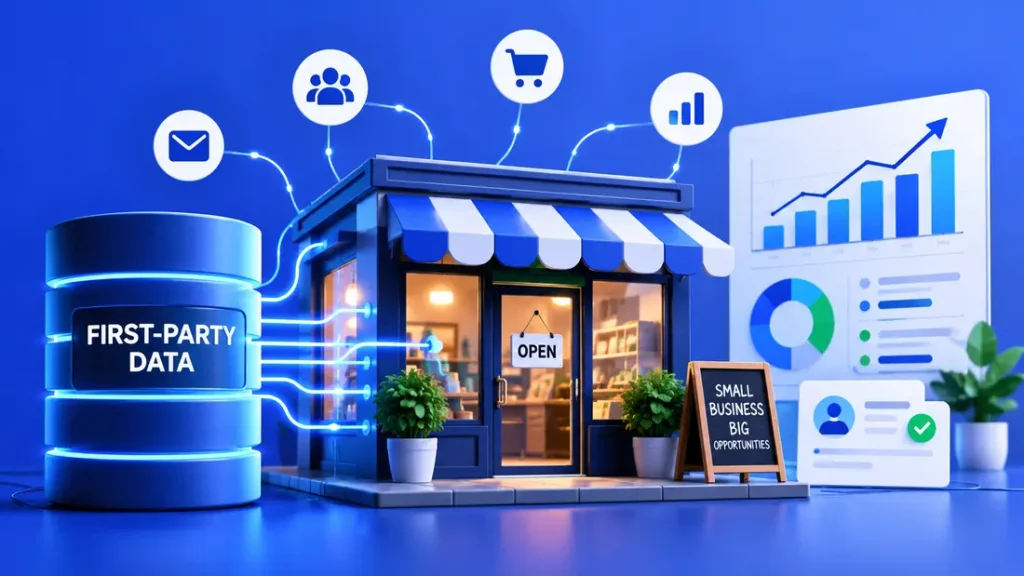
First-party data is fast becoming the only customer information a small business can actually count on. A few years back, you could drop a pixel on your site and rent a list of lookalike shoppers. That setup is dying. Browsers now block the trackers. Privacy laws keep tightening. And the big platforms hoard their best data for themselves.
The upside is you are almost certainly gathering it already without thinking about it. It is in your orders and the customer records already in your CRM. So we will run through 7 reasons first-party data matters more than ever. Then the inexpensive ways to collect data, and how to actually use it without hiring a data team.
What First-Party Data Actually Is (And How It Is Different)
Before we get to the reasons, let’s clear up what actually counts as first-party data. The term gets used loosely, so this is the no-nonsense version.
First-party data is information your customers hand you directly through their own direct interactions with you. It is their purchases and their email signups. It is the pages they visit and what they type into your forms. These are some of the simplest first-party data examples.
You gathered these customer interactions yourself through your own channels, and they knew it was happening. That is the whole difference from data a broker sells you about strangers.
How First-Party Data Compares To Second-Party And Third-Party Data
The easiest way to see the difference is to line all 3 up next to each other. One of them is genuinely yours. The other two you are basically renting.
| Type | Where It Comes From | Accuracy | Who Owns It | Example |
| First-Party Data | Collected directly from your own customers | Highest | You do | A purchase on your site |
| Second-Party Data | Another company’s first-party data, shared | High | The original collector | A partner’s email list |
| Third-Party Data | Aggregated and bought from data brokers | Lowest | The broker | A rented audience segment |
7 Reasons First-Party Data Collection Is Becoming More Important for Small Businesses
The 7 reasons below aren’t marketing padding. Each one genuinely changes how a small business runs day to day.
1. Third-Party Cookies Are Disappearing For Good
For about 20 years, the entire online ad world ran on third-party cookies that trailed people from site to site. That run is ending. Safari and Firefox block them out of the box. Privacy rules keep shrinking what is allowed. And plenty of people just tap decline now. Every year, the rented audience data you counted on gets thinner.
That is a big reason 93% of marketers now say collecting first-party data matters more to their business than ever. Once the borrowed data runs out, what you own is all that is left.
2. You Own It, Not Some Platform
First-party data is something that your company collects directly, so nobody can take it away from you. Lean your whole reach on Meta or Google and one algorithm tweak or account ban can wipe you out overnight. A list of your customers’ emails and numbers doesn’t work like that.
You have a direct relationship with the people who already chose to buy from you, and it keeps working no matter what the platforms show today.
3. Accuracy You Can’t Get From Bought Data
Bought data is really just shaky assumptions wearing a suit. A broker calls someone a new parent from a few loose signals, and plenty of it is flat-out wrong. First-party data drops the assumptions entirely. If someone bought a specific item from you last Tuesday, that is not a maybe. It is a fact, and you can act on it.
4. Personalization That Fits A Small Budget
Personalization used to mean pricey software and a whole team to run it. First-party data changes that math for a small shop. Since this behavioral data comes straight from what people actually do, you can send something relevant without paying to chase strangers. A quick follow-up based on a real purchase costs almost nothing, and it beats a generic blast.
And the payoff is real. Personalization built on first-party data pushed campaign ROI up by as much as 30% in 2025. You don’t even need the fancy AI layer. Basic personalization off your own data and based on actual customer behavior still runs circles around a rented lookalike audience.
5. Customers Show You What They Want Next
Your own first-party data also works as an early-warning system for changing demand. The questions people ask support and the requests they make hint at what they want next. So do the things they try to buy but can’t. Third-party data can’t see any of that. It paints people in broad strokes, not what your customers want this week.
Take how people want to pay. It is one of the subtlest shifts to notice, since it rarely shows in a survey. Someone emails asking if you take a certain method. A cart gets abandoned when the option they wanted isn’t there. By the time it is obvious, the early movers have gone elsewhere.
A clear example of exactly that is already happening. A real and growing group of shoppers now keep a portion of their money in crypto. Plenty would rather spend it straight from their wallet than cash out and wait on a bank transfer. For years, that was awkward enough that most stores ignored it. That is genuinely changing.
These shoppers now lean on a new breed of app that lets them pay by transferring crypto to a bank account straight from their wallet. It converts to regular money on the way, so the business just receives an ordinary payment that settles in seconds. The shop doesn’t set up anything new or touch crypto at all.
This belongs in a chapter about your data for one reason. You would never spot this crowd from a bought audience file. But your own numbers show it plainly, in the checkout drop-offs and payment questions hitting your inbox. Notice it early, and you can serve those buyers before a competitor does. The businesses ahead here just read their own transactional data.
6. Lower Customer Acquisition Costs
Winning a brand-new customer through ads keeps getting pricier. Getting a past buyer to come back is way cheaper, and first-party data makes it doable. You already know their name and what they liked. A well-timed note to them costs a sliver of a cold ad. It is also the simplest way to turn existing traffic into repeat sales.
The numbers agree. Businesses that actually put their first-party data to work in marketing efforts saw revenue climb 1.5 to 2.9 times higher than those with weaker data. Your own list is the cheapest audience insights you will ever get.
7. Ready For AI And Tighter Privacy Rules
Two big things are colliding, and first-party data is right in the middle of both. Every AI tool people are rushing to use is only as smart as the data points you feed it. Feed it generic web scraps, and you get generic output. Feed it your own customer data, and it actually becomes useful.
On the other side, privacy laws keep leaning toward data you collected with clear permission. Bought data brings legal risk that first-party data mostly sidesteps. So the same asset keeps you on the right side of the law and ready for whatever tool shows up next. That said, you still need to obtain explicit consent when the type of data or its use requires it.
Where Small Businesses Can Collect First-Party Data (Without A Big Budget)
Knowing why it matters means nothing if you don’t know how first-party data is collected. The nice part is that most of these sources are free and already running on your site.
1. Your Website And Its Analytics
Your website is the hardest-working data collector you have, and most of the valuable insights into user behavior it gathers just go to waste. Every page someone opens and every product they hover over says what they want. A clean analytics setup turns those visits into patterns you can read. It even reveals what people are typing into search before they ever reach you.
2. Email Signups And Preference Centers
For most small businesses, an email address is the single most valuable scrap of first-party data collected. But the signup itself is just the doorway. Add a short customer preference center where people pick what they actually want to hear about, and they hand you their interests directly. No assumptions, and every email you send after that hits better.
3. Purchases And Loyalty Programs
Nothing tells you more about a customer than what they have actually paid for. Customers’ purchase history shows real preferences and real timing, not what someone claims. A simple loyalty program takes it further by tying every repeat purchase back to one named person. Bit by bit, you get a sharp picture of who buys what, and how often they return.
4. Direct Questions And Short Surveys
Sometimes the quickest way to get customer feedback on something is to just ask. A single-question post-purchase survey or a fast poll gives you data people volunteer on purpose. It is often called zero-party data, and it is brilliant because there is zero guessing involved. People are telling you what they think outright, in their own words.
How To Make Better Use Of First-Party Data: 5 Proven Strategies
Collecting the data is the easy bit. The real payoff shows up when your whole business can see it and act on it, and that is exactly where most small teams get stuck.
1. Give Your Whole Team One Place To See It
First-party data loves to scatter. Your sales notes are in one tool. Support tickets are in another. The email numbers are in a third place entirely. When one customer’s story is split across 5 customer data platforms, nobody sees the whole thing. The data is all there. But it may as well not be if the people who need it can’t reach it.
What fixes this is boringly simple. You want one page the whole team can pull up to see the customer clearly, without switching between 6 systems. The problem is that building something like that from scratch usually means begging a developer for time you don’t have. A ready-made template gets you there far faster.
This is what SharePoint is made for. It gives you a solid place to build an internal portal, but creating a polished, useful dashboard from its standard options can still take time and technical know-how.
Something like ShortPoint has SharePoint site templates for exactly this, so someone non-technical can drag a clean dashboard together. You can pull the customer data and tools your team needs into one clean page, then publish it as a central place everyone can use. Nothing to code. No waiting weeks on IT.
And that is the real point for your data. It stops being trapped behind logins only one person remembers. Instead, it is out in the open, on a screen everyone actually opens. Once marketing and support share the same view of a customer, decisions get quicker and more consistent. That single shared page removes a shocking amount of daily friction.
- Agree on the 5 customer metrics everyone on the team checks weekly
- Give both sales and support read access to the exact same customer records
- Assign one owner to keep the shared customer view current and accurate weekly
- Walk through the shared dashboard together in one short weekly team meeting
2. Keep It Organized And Governed As It Grows
A heap of data with no rules behind it goes bad fast. One person names a field one thing, someone else names it another. Nobody is sure which spreadsheet is current. A customer asks what you hold on them, and you have to look around. As it grows, these cracks turn into real problems. You need an agreed way of working, not more storage.
Two tools plenty of teams already recognize handle this nicely. A knowledge base like Confluence becomes the home for your data framework, the place you explain what you collect and what each field means. A tracker like Jira turns the upkeep into actual tasks, so the cleanups and reviews never just get missed.
The problem is that setting these up properly is a real skill in itself, down to the structure and who is allowed to touch what. Get it wrong at the start, and you have built the exact confusion you were trying to dodge. That is where handing it to Jira implementation services pays off.
As a certified partner, they can set up and run Atlassian tools like Confluence and Jira for you. They handle the configuration and the permissions, then stick around to manage the whole thing so you don’t need a full-time admin on payroll.
What you are left with is a documented and governed home for your data that holds up as you grow. No more drawer full of spreadsheets nobody trusts. That is the gap between data you can stand behind and data you are forever doubting. For a small team, that trust is everything.
- Write one clear definition for every customer field your team actually collects
- Decide exactly who may view or edit each type of customer record here
- Schedule a recurring cleanup task to remove duplicates and fix obvious errors
- Keep a running written record of exactly what data you hold and why
3. Connect It To The Tools You Already Use
Data inside separate tools can’t really do anything. Your email platform has no clue what someone bought if your store never tells it. The magic only happens when these systems actually talk and pass along what each one knows.
Integrating first-party data is also what keeps your message lined up across every channel a customer bumps into. Someone who just bought a product shouldn’t then get an ad for it on social media platforms the next day. Connected tools stop those awkward mix-ups on their own.
- List out every single tool that holds a piece of your customer data
- Try built-in native integrations first before paying for any custom development work
- Sync your purchase data into your email platform to trigger timely follow-ups
- Send every new signup straight into your CRM without any manual exports
4. Group Customers Into Segments You Can Target
One big list of customers is tough to do anything with. Segments divide it into smaller groups that share something real, like first-timers or people who left long ago. Once those groups exist, the right message for each pretty much writes itself. You stop firing the same thing at everyone and start matching your message to each customer journey stage based on engagement data.
- Separate your existing customers by how recently and how often they place orders
- Build one separate group of the one-time buyers you want to re-engage soon
- Tag your highest-spend customers so you can treat that group differently later
- Keep your segments few enough that each one gets its own message
5. Measure What Is Working And Feed It Back In
Using first-party data once and moving on isn’t enough. The businesses that get ahead treat it like a cycle. You do something. You watch what happens. Then you pour that lesson straight into the next move.
Skip the measuring, and you are just making assumptions with more steps. And no, you don’t need expensive software for this. A simple reporting setup is plenty to spot which strategies actually paid off and which ones flopped.
- Pick one clear success metric for each campaign before you ever launch it
- Compare how each segment responded so you learn what actually resonates with them
- Cut the tactics that fail to move your metric after a fair test
- Write down what you learned so your next campaign starts a step smarter
3 First-Party Data Mistakes Small Businesses Make + How To Fix Them
Even the businesses that gather loads of data keep making the same mistakes. These are the ones worth dodging before they cost you real money.
1. Letting Your Data Go Stale
Customer data goes off faster than people think. Emails change. Numbers get handed to someone new. What someone wanted two years ago says nothing today. A list you built once and never touched fills with dead ends. Every campaign off it gets weaker. Old data isn’t just useless. It wastes time and budget chasing people who aren’t there.
How to Fix: Treat your list like something that needs regular care. Every quarter, clear out the bounced emails and the obvious duplicates. Ask people to confirm their details at natural moments like a checkout or a preference update, so the list keeps refreshing itself.
2. Copying What Big Brands Do Instead Of Starting Small
It is tempting to copy whatever some big brand did. But that brand has a data team and a budget you simply don’t. It is also solving problems you won’t run into for years. Copy their elaborate setup, and you will mostly end up with expensive tools gathering dust. You will spend your days dealing with software instead of learning from your actual customers.
How to Fix: Start with one thing you genuinely want to know, like which products bring people back for more. Reach for the simplest tool that answers it, even a plain spreadsheet. Only add more complexity when a real wall forces you to, not because a big brand did it first.
3. Leaving The Data Unprotected
The second you start collecting customer data, keeping it safe becomes your job. Loads of small businesses skip that part. Customer details end up in an open spreadsheet or a shared team login. One breach or lost laptop can spill everything and destroy the trust you built.
With 63% of adults experiencing cyber abuse at least once, the risk is far from theoretical. And the fines for mishandling personal data don’t go down because you are small.
How to Fix: Sort out access first. Give everyone their own strong login instead of one shared password. Switch on two-factor authentication anywhere it is offered. And only keep the data you genuinely use, then delete the rest. Less data on hand simply means less data at risk.
Conclusion
The mindset shift is the real takeaway. Stop filing first-party data strategy under “marketing add-on” and treat it as part of how the business runs. The trackers and rented lists that carried small businesses aren’t coming back. The shops still talking to their customers in 5 years are building that direct line right now, one order at a time.
That is the bit we genuinely care about over at Rank Visely. We build SEO and conversion-focused sites that turn anonymous visitors into valuable first-party data you own. That means the search terms that pull them in and the forms that capture them. If you would rather grow your customer list than just look pretty, get in touch.