Getting leads has always been an essential part of growing a B2B business. However, traditional methods such as cold calling, large email campaigns, and manual prospecting are no longer as effective as they once were. Today’s B2B buyers are more informed, more selective, and far less responsive to generic sales approaches.
B2B sales cycles are also longer and more complex than ever. With multiple decision-makers, high-value deals, and rising expectations, sales teams often struggle to focus on the right prospects. As a result, many businesses face low-quality leads, wasted resources, and disappointing conversion rates.
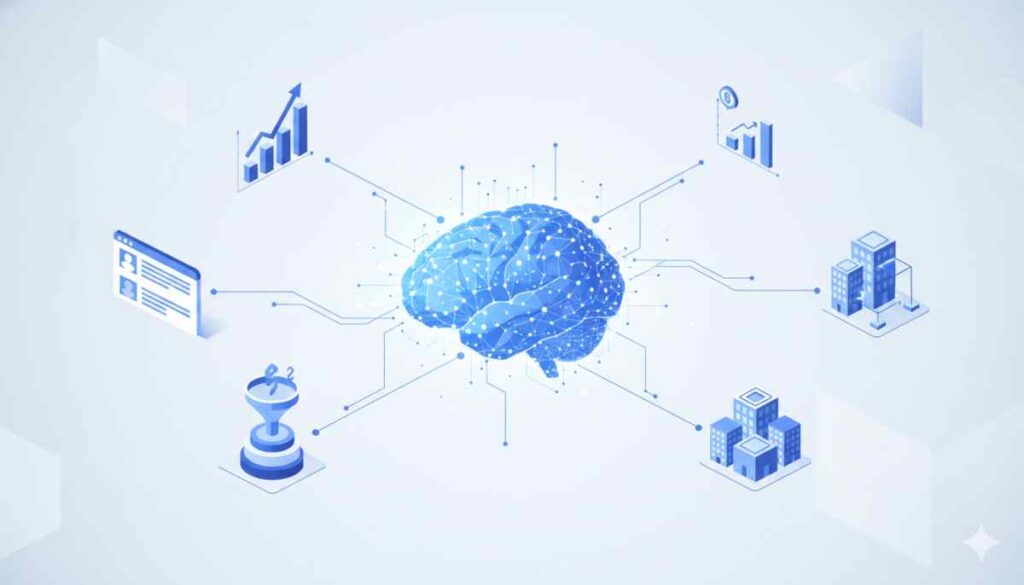
This is where artificial intelligence (AI) is transforming the process. AI-powered lead generation enables B2B companies to identify, qualify, and engage prospects more efficiently by using data, automation, and predictive analytics to achieve better sales results.
What Is AI-Powered Lead Generation?
AI-powered lead generation refers to the use of artificial intelligence technologies—such as machine learning, predictive analytics, and data automation—to identify and qualify potential B2B customers who are most likely to convert.
Unlike traditional lead generation methods that rely on manual research and fixed criteria, AI-driven systems analyze large volumes of data in real time. These systems continuously learn from patterns, behaviors, and past outcomes to improve lead accuracy and relevance.
AI-powered lead generation focuses on:
- Identifying the right companies and decision-makers
- Predicting buying intent
- Prioritizing leads based on conversion likelihood
- Automating outreach and follow-ups
This approach shifts the focus from lead quantity to lead quality, allowing sales teams to spend more time closing deals instead of chasing unqualified prospects. For B2B companies looking to build or enhance these AI-driven lead generation systems, partnering with experienced artificial intelligence services providers can accelerate implementation – especially when integrating machine learning models with existing CRM infrastructure, ensuring predictive lead scoring aligns with actual sales processes, and building custom automation workflows that fit your specific industry and buyer journey.
Why B2B Companies Should Use AI-Powered Lead Generation
B2B sales differ significantly from B2C sales. Purchasing decisions are rarely impulsive and typically involve careful evaluation, internal discussions, and long decision-making processes. Because of this complexity, lead quality is far more important than lead volume.
AI-powered lead generation is critical for B2B companies because it helps them:
- Spend less time on low-intent leads
- Align marketing and sales teams more effectively
- Increase conversion rates and deal sizes
- Optimize the entire sales funnel
By leveraging AI, B2B companies can move from reactive sales tactics to proactive, data-driven strategies that target the right prospects at the right time.
How AI-Powered Lead Generation Works Step by Step
1. Data Collection and Integration
AI-powered lead generation begins with data. AI systems collect and integrate data from multiple sources, including:
- Website behavior and user interactions
- CRM systems and historical sales data
- Email engagement and campaign performance
- Professional and social networks
- Demographic and firmographic information
The more accurate and comprehensive the data, the better the AI model performs.
2. Identifying the Ideal Customer Profile (ICP)
AI analyzes historical customer data to identify patterns among the most successful clients. This helps define an Ideal Customer Profile (ICP) based on factors such as:
- Industry and company size
- Geographic location
- Revenue and growth stage
- Decision-maker roles
Once the ICP is defined, AI can automatically search for similar companies and prospects that meet these criteria.
3. Predictive Lead Scoring
Predictive lead scoring is one of the most powerful applications of AI in B2B sales. Instead of using static scoring rules, AI models evaluate leads dynamically based on:
- Behavioral signals
- Engagement history
- Intent data
- Similarity to past successful customers
Each lead receives a score representing its likelihood of conversion. Sales teams can then prioritize high-scoring leads and deprioritize low-quality prospects.
4. Buying Intent Detection
AI can identify subtle buying signals that human teams often miss. These signals may include:
- Repeated visits to key website pages
- Downloads of decision-focused content
- Searches involving competitor-related keywords
- Changes in company growth patterns or hiring activity
By detecting intent early, AI helps sales teams engage prospects at the most effective moment.
5. Automated Outreach and Lead Nurturing
AI-powered systems automate and personalize lead nurturing across multiple channels. AI-powered systems automate and personalize lead nurturing across multiple channels, complementing the efforts of a b2b cold caller by providing data-driven insights and better-qualified prospects. This includes:
- Personalized email sequences
- Optimized follow-up timing
- Content recommendations based on prospect behavior
- Automated reminders for sales teams
Automation ensures consistent, timely, and relevant communication while maintaining personalization. Many organizations implement this level of automation through a White label AI agent platform, allowing them to manage outreach workflows under their own branding while maintaining full control over lead data and engagement logic.
The Role of AI in Sales Optimization
AI-powered lead generation goes beyond acquiring leads—it plays a key role in optimizing the entire B2B sales process.
AI supports sales teams by:
- Providing data-driven insights into sales performance
- Improving revenue forecasting accuracy
- Identifying bottlenecks in the sales funnel
- Recommending next-best actions for sales representatives
By combining lead generation with sales optimization, AI creates a more efficient and predictable revenue engine.
AI-Powered Lead Generation in the Italian B2B Market
Italian B2B companies are increasingly adopting AI as part of their digital transformation strategies. With growing competition across Europe, businesses must improve efficiency and decision-making to remain competitive.
AI-powered lead generation helps Italian SMEs and large enterprises:
- Compete with larger international companies
- Expand into new European markets
- Modernize sales processes without increasing headcount
As data-driven sales become the standard, AI adoption is shifting from a competitive advantage to a business necessity.
How A.I. Quality Leads Supports B2B Growth
A.I. Quality Leads specializes in AI-powered lead generation and sales optimization for B2B companies. By combining advanced AI models with deep market expertise, the company helps businesses generate high-quality, sales-ready leads instead of wasting time on unqualified prospects.
Their approach focuses on:
- Data-driven lead identification
- Predictive lead scoring
- Sales funnel optimization
- Scalable AI solutions tailored for Italian and European markets
Learn more about their AI-driven approach at aiqualityleads.com.
Common Mistakes to Avoid in AI Lead Generation
While AI offers powerful capabilities, success depends on proper implementation. Common mistakes include:
- Using incomplete or low-quality data
- Relying on automation without a clear sales strategy
- Poor alignment between marketing and sales teams
- Expecting immediate results without ongoing optimization
AI delivers the best results when combined with human expertise and continuous improvement.
Conclusion: The Future of B2B Lead Generation
AI-powered lead generation is reshaping how B2B companies identify, qualify, and convert prospects. By leveraging data, machine learning, and automation, businesses can focus on high-intent leads and achieve sustainable growth.
The future of B2B sales lies in the combination of AI-driven insights and human decision-making. Companies that adopt AI-powered lead generation today will be better positioned to compete, scale, and succeed in an increasingly data-driven market.
Read Also: Why Most German Business Websites Don’t Rank on Google?