Enterprise buyers no longer just buy software features when comparing options in the $375 billion SaaS market. They buy assurance.
When a security team blocks a deal because your documentation is scattered across shared drives, your sales cycle grinds to a sudden halt. Modern revenue engineering requires you to turn security from a defensive obligation into a visible sales accelerator.
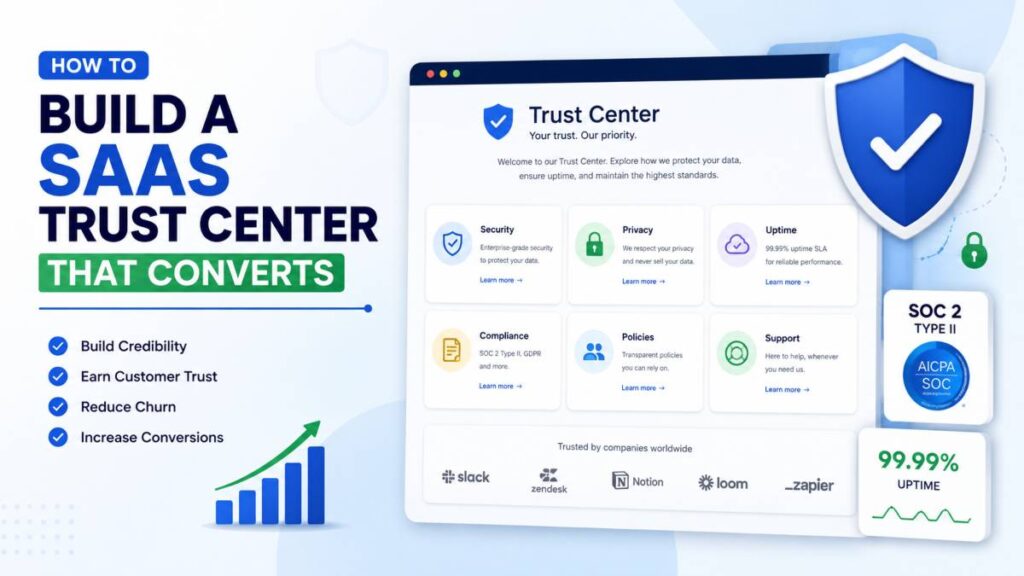
A high-converting Trust Center acts as a self-service asset that intercepts lengthy security questionnaires and closes deals faster. It transforms abstract security promises into quantifiable, structured data that compliance officers can audit in minutes. By consolidating your risk documentation into a public, professional portal, you establish immediate credibility before the first sales discovery call even begins.
Image Source: Google Gemini
Architectural Blueprint of a High-Performing Trust Hub
A successful Trust Center must be organized logically to serve both the curious prospect and the technical auditor. Software buyers need a clear hierarchy that separates high-level system availability from deep-dive technical documentation. Your portal should display live system uptime alongside your active compliance certificates to demonstrate continuous operational integrity.
Enterprise security teams typically look for concrete proof of internal controls, specifically regarding data handling, security infrastructure, and third-party risk management. For companies handling corporate data, achieving and displaying SOC 2 compliance serves as the baseline requirement for entering mid-market and enterprise procurement tracks. This reporting framework verifies that your operational controls successfully protect client data over extended observation periods.
The design should prioritize quick navigation, allowing technical reviewers to find specific infrastructure details without forcing them to request a meeting. High-converting trust portals balance public transparency with secure, gated access for sensitive internal documentation.
Optimizing the Subprocessor and Evidence Architecture
Transparency is the foundation of digital sales velocity. To build a trust portal that effectively short-circuits the standard procurement bottleneck, you must structure your external vendor risk and operational data cleanly. Security teams want to know exactly who processes their data and how those sub-processors are monitored.
A dedicated subprocessor directory shows absolute transparency and prevents unexpected compliance surprises during deep procurement reviews. Your technical portal should categorize these vendors by function and clearly list their data center locations and specific operational responsibilities.
To maximize conversions and capture high-intent accounts, use a tiered access model for your compliance evidence:
- Public frameworks like ISO status or GDPR posture can remain completely open to establish immediate top-of-funnel credibility
- Highly sensitive infrastructure documentation should be placed behind an automated non-disclosure agreement workflow
- Granular penetration test results ought to require manual administrative approval to ensure proper engagement tracking
Automating this request pipeline allows your sales team to monitor real-time prospect intent as buyers download specific compliance artifacts. When an enterprise prospect downloads an audit report independently, it signals that the account is actively accelerating toward a final purchasing decision.
Technical Conversion Optimization and Search Architecture
Building a great trust asset only works if your prospects and search engines can discover it easily. Implementing structured FAQ schema helps capture technical long-tail queries directly within organic search results pages, and accounts for AI’s impact on search visibility. When a security auditor searches for your platform alongside specific data processing questions, your trust hub should answer them immediately.
Integrating live system status dashboards directly into the portal reinforces your platform’s reliability with hard historical data. Rather than relying on generic promises of stability, showing real-time operational uptime builds measurable confidence during the active evaluation process.
Many software providers make the mistake of hiding their security documentation behind complex, multi-stage contact forms. True conversion rate optimization means removing unnecessary friction so qualified technical buyers can verify your posture and pass your deal to the next procurement stage.
Orchestrating Automated NDA Workflows
High-intent buyers want immediate access to your data, but your legal team requires protection before releasing sensitive infrastructure details. Forcing a prospect to wait 48 hours for a manual sign-off kills momentum when they are ready to evaluate your security posture. A modern trust portal solves this friction by embedding automated non-disclosure agreements directly into the document download path.
When a prospect clicks to view your full architectural diagrams, an integrated click-wrap or e-signature workflow should trigger instantly. This system validates their corporate email domain, executes the legal agreement, and provisions time-bound access to the requested files without human intervention. Your sales team receives a real-time notification showing exactly which enterprise accounts are actively auditing your systems, allowing them to follow up with precise context.
Centralizing Questionnaire Elimination Engines
Security questionnaires are a notorious drain on engineering and sales resources. Instead of treating your trust portal as a passive document repository, you can configure it as a proactive defense against repetitive spreadsheet use. A comprehensive center should feature a searchable knowledge base that indexes your historical answers to standard security assessments.
Enterprise reviewers can use natural-language search to locate specific technical answers on encryption keys, network isolation, or incident-response timelines in seconds. By publishing these structured responses openly, you drastically reduce the volume of custom questionnaires your team must complete. The remaining bespoke questions can be imported directly into the platform, leveraging your existing verified answers to auto-populate compliance data and cut completion times down from weeks to minutes.
Scaling Trust Across Continuous Deployment Lifecycles
Security is a continuous operational state rather than a static point-in-time certification achievement, protecting remote teams as much as end users. A high-converting portal must reflect your real-time security operations to maintain credibility with sophisticated enterprise architects. Integrating your internal security tools directly with your public dashboard provides verifiable proof that your controls remain active during every product deployment.
The idea is to show buyers that you actively monitor your infrastructure for vulnerabilities, track vendor dependencies, and enforce access controls. Displaying live telemetry from your configuration management and vulnerability scanners transforms your trust center into a living operational ledger. This level of continuous transparency builds deep institutional confidence that static PDF reports can never replicate.
Scaling Enterprise Revenues Through Verified Accountability
A dedicated trust hub changes how your organization handles complex security conversations with enterprise accounts. Instead of manually managing repetitive security questionnaires, your sales team can guide prospects to an automated repository that addresses their technical concerns. This structured approach directly lowers your cost of acquisition while significantly shortening enterprise sales cycles.
As regulatory landscapes expand globally, maintaining an updated, centralized security posture remains critical for competitive positioning. Investing in automated trust infrastructure enables your company to demonstrate operational excellence, scale enterprise revenue, and build verifiable market authority.
For more actionable strategies on managing security infrastructure, technical scaling, and modern data architecture, explore our comprehensive collection of technical insights on our blog.