CRM software has come a long way. It’s no longer just a digital address book where you store names, emails, and phone numbers. In 2026, a modern CRM acts more like a smart business assistant tracking customer behavior, predicting sales outcomes, and automating daily tasks behind the scenes.
That’s why understanding the Top Features Every Modern CRM Must Have is critical before choosing a platform. Businesses today need more than contact storage. They need AI-powered insights, workflow automation, real-time analytics, and seamless integrations that connect sales, marketing, and support teams in one place.
The shift from basic databases to intelligent, cloud-based systems has completely changed how companies manage relationships. Modern CRM platforms now help teams close deals faster, personalize customer experiences, and make data-driven decisions with confidence.
In this guide, you’ll find a practical, no-fluff checklist designed for business owners, managers, and decision-makers who want to invest in the right CRM solution for 2026 and beyond.
Why Modern CRM Features Matter More Than Ever
Businesses today operate in a fast, data-driven world. Customers expect quick responses, personalized offers, and smooth communication across channels. If your CRM system can’t keep up, your competitors will.
Understanding the Top Features Every Modern CRM Must Have is no longer optional. It’s a strategic decision that directly impacts revenue, customer satisfaction, and long-term growth.
From Contact Storage to Intelligent Platforms
In the early days, CRM systems were simple. They stored contact details and basic interaction history. That was enough when sales teams relied on manual follow-ups and spreadsheets.
Today, that approach is outdated.
Modern CRM software has evolved into an intelligent platform. Instead of just storing data, it analyzes it. It tracks customer behavior, monitors engagement patterns, and turns raw information into actionable insights. This shift enables data-driven decision-making, helping managers forecast revenue, measure performance, and adjust strategies before problems grow. You can also explore and compare CRM software options on saasadviser to find solutions that match your business needs.
A CRM is no longer a passive tool it actively guides business decisions.
Competitive Advantage Through Automation and AI
Automation and AI have changed the game.
With automated workflows, leads are assigned instantly. Follow-ups are triggered automatically. Reminders are sent without manual effort. This shortens sales cycles and reduces missed opportunities.
AI takes it even further. It identifies high-converting prospects, recommends the best time to contact them, and suggests personalized messaging. The result? Faster deal closures and more meaningful customer experiences.
In 2026, companies that leverage these advanced CRM features don’t just manage relationships they optimize them.
AI-Driven Insights and Predictive Analytics
If there’s one feature that defines modern CRM software in 2026, it’s artificial intelligence. Today’s businesses don’t just want data they want direction. That’s where AI-powered CRM platforms stand out.
Instead of reacting to past results, intelligent CRM software uses predictive analytics to anticipate what’s likely to happen next. It studies customer behavior, engagement patterns, and historical sales data to uncover trends that humans might miss. The result is smarter decisions made faster.
Predictive Lead Scoring
One of the most powerful capabilities of AI-driven CRM systems is predictive lead scoring.
In traditional systems, sales reps manually judged which leads looked promising. Now, AI analyzes behavior automatically. It tracks actions such as email opens, website visits, demo requests, and content downloads. Based on these signals, the system assigns a score to each lead.
High-scoring prospects are more likely to convert. This allows sales teams to prioritize high-conversion opportunities instead of wasting time on cold leads.
Think of it as having a smart filter that highlights the most valuable prospects at the top of your pipeline. This improves focus, boosts productivity, and increases close rates.
Smart Recommendations and Forecasting
Modern CRM platforms go beyond scoring. They also provide real-time recommendations.
For example, the system might suggest the best time to follow up with a lead based on past engagement patterns. It can recommend the next action whether that’s sending a proposal, scheduling a call, or sharing a case study.
Predictive analytics also strengthens revenue forecasting. By analyzing pipeline stages, deal velocity, and win rates, the CRM generates accurate sales forecasts. Managers can spot potential gaps early and adjust strategy before targets are missed.
On top of that, AI delivers performance insights. It tracks agent productivity, response times, and conversion rates, helping teams optimize performance with data-backed clarity.
In short, AI-driven insights turn your CRM from a tracking tool into a strategic growth engine.
Contact and Lead Management
At the heart of any customer relationship management system is strong contact and lead management. But in 2026, this feature goes far beyond storing names and phone numbers. Modern platforms focus on centralized customer data, smart organization, and seamless CRM pipeline management.
When your customer information is scattered across spreadsheets, inboxes, and different tools, mistakes happen. Leads get lost. Follow-ups are missed. Opportunities slip away. A modern CRM solves this by bringing everything into one structured system.
Centralized Customer Database
A centralized customer database acts as a single source of truth for your entire team.
Every interaction emails, calls, meetings, support tickets, purchases is stored in one unified profile. Sales, marketing, and support teams can access the same information in real time. This unified data access reduces confusion and ensures everyone works with accurate, up-to-date details.
Another major benefit is duplicate elimination. Intelligent CRM systems automatically detect and merge duplicate records. This keeps your database clean and prevents multiple reps from contacting the same lead.
Clean data leads to clearer decisions and stronger pipeline visibility.
Smart Lead Capture and Segmentation
Modern CRM platforms don’t wait for manual data entry. They automatically capture leads from:
- Website forms
- Social media platforms
- Email campaigns
- Landing pages
Once captured, leads are segmented based on behavior, demographics, and engagement level. For example, someone who downloads a pricing guide may be treated differently than someone who only subscribes to a newsletter.
Many systems also use engagement-based scoring to rank prospects inside your CRM pipeline management system. This helps sales teams focus on leads that are most likely to convert.
In short, effective contact and lead management ensures no opportunity is missed and every customer interaction is informed by complete, organized data.
Workflow Automation and Task Management
Time is one of the most valuable assets in any business. Yet many teams still spend hours on repetitive tasks sending follow-up emails, assigning leads, updating records, or reminding colleagues about next steps. This is where modern CRM automation tools make a measurable difference.
Workflow automation turns manual processes into structured, trigger-based systems. Instead of relying on memory or sticky notes, your CRM handles routine actions automatically. Platforms like Gumloop AI, an easy-to-use no-code tool that allows non-technical users to create automated workflows and AI-powered agents, make it even simpler to implement such systems. This reduces human error, speeds up operations, and ensures consistency across teams. You can also streamline outreach with DM automation tools that help teams handle routine social interactions without extra manual work.
Automated Lead Nurturing
Lead nurturing no longer needs to be manual.
With workflow automation software, you can create trigger-based workflows that activate when a lead takes a specific action. For example:
- If a user downloads a whitepaper → send a follow-up email after 2 days.
- If a prospect books a demo → notify the assigned sales rep instantly.
- If a lead remains inactive → trigger a re-engagement campaign.
These automated sequences guide prospects through the sales funnel without constant oversight. Follow-up automation ensures no lead is forgotten, which directly improves conversion rates.
Think of it like setting up dominoes. Once the first action happens, the rest follow automatically.
Custom Sales Pipelines
Modern CRM platforms also allow businesses to build custom sales pipelines that reflect their actual process.
Each stage from initial contact to closed deal can include automated task assignments. When a deal moves forward, the system assigns responsibilities to the right team member. This keeps momentum strong and prevents bottlenecks.
Approval flows are another critical feature. For example, when a deal reaches a certain value, the system can automatically request manager approval before moving forward. This keeps compliance and accountability intact.
In short, workflow automation transforms your CRM from a tracking system into a productivity engine. It frees your team to focus on strategy and relationship building instead of routine admin work.
Advanced Analytics and Reporting
Data is only powerful when you can understand it. That’s why advanced analytics and reporting are among the top features every modern CRM must have. Today’s businesses need more than static spreadsheets they need clear insights delivered in real time.
Modern CRM reporting tools transform raw data into visual stories. They help leaders track performance, measure growth, and make confident decisions backed by numbers instead of guesswork.
Custom Dashboards and KPI Tracking
Custom dashboards allow teams to see what matters most at a glance.
Instead of digging through reports, managers can build visual dashboards that display key performance indicators (KPIs) such as:
- Sales revenue
- Conversion rates
- Deal velocity
- Lead response time
- Customer acquisition cost
These visual reports often include charts, graphs, and funnel diagrams that make trends easy to understand. Sales funnel analysis becomes simple when you can see exactly where prospects drop off and where deals accelerate.
The result? Faster decisions and better strategy adjustments.
Real-Time Reporting
In fast-moving markets, delayed data is dangerous.
Real-time dashboards update automatically as new information enters the system. This allows businesses to identify trends early whether it’s a sudden drop in conversions or a spike in new leads.
Real-time reporting also helps optimize campaigns before problems escalate. For example, if a marketing campaign underperforms, teams can adjust messaging, budget, or targeting immediately instead of waiting until the quarter ends.
With accurate, up-to-date insights, modern CRM platforms empower businesses to act quickly and stay competitive.
Omnichannel Communication and Mobile CRM Access
Customers no longer communicate through just one channel. They send emails, start live chats, comment on social media, and sometimes call all within the same buying journey. A modern CRM must bring these conversations together in one place.
Strong omnichannel support ensures your team never misses context. Instead of jumping between tools, agents can view every interaction inside a single system. This creates a smoother customer experience and prevents repeated questions or miscommunication.
Email, Chat, Phone, and Social Integration
Modern CRM platforms integrate directly with email, live chat, phone systems, and social media platforms.
This means every touchpoint whether it’s a support ticket, sales inquiry, or social media message is automatically logged under the customer’s profile. Teams can see the full conversation history before responding.
Unified customer conversations improve response quality and reduce friction. For example, a sales rep can see that a prospect previously contacted support. Instead of starting from scratch, they continue the conversation naturally.
The result is consistent communication across all channels.
Mobile-First CRM Experience
Work no longer happens only at desks. Sales reps travel, field agents visit clients, and managers work remotely. That’s why mobile CRM software is no longer optional.
A mobile-first CRM experience allows teams to:
- Access customer data anytime, anywhere
- Update deals on the go
- Receive instant notifications
- Log calls and notes in real time
Offline access is another key feature. Even without internet connectivity, users can view critical data and sync updates once reconnected.
Some modern systems even support voice-enabled queries. Reps can ask for pipeline updates or customer details hands-free.
In short, mobile access and omnichannel support ensure productivity never stops no matter where your team works.
Seamless Integrations and Customization
No business operates with a single tool. Sales teams use email platforms. Marketing relies on automation software. Finance depends on ERP systems. If your CRM cannot connect with these systems, data becomes fragmented and unreliable.
That’s why seamless integration and deep customization are among the top features every modern CRM must have.
Integration with ERP and Marketing Tools
Modern CRM integration tools allow businesses to connect their CRM with ERP systems, accounting software, marketing automation platforms, help desks, and eCommerce tools.
Through APIs and iPaaS (Integration Platform as a Service) connectivity, data flows automatically between systems. For example:
- A closed deal in CRM updates billing in the ERP system
- A new marketing lead syncs directly into the sales pipeline
- Customer purchase history becomes visible to support teams
This creates a single source of truth across the organization. Instead of manually transferring data between platforms, information updates in real time. Teams make decisions based on accurate, unified insights.
Without integration, businesses risk working with incomplete or outdated data.
Custom Fields, Pipelines, and Dashboards
Every business operates differently. A real estate agency, a SaaS company, and a manufacturing firm all have unique sales cycles and reporting needs. That’s where customizable CRM software becomes essential.
Modern CRM platforms allow you to:
- Create custom fields to capture industry-specific data
- Design pipelines that reflect your actual sales process
- Build dashboards tailored to your KPIs
- Configure user roles and permissions
This flexibility ensures the CRM adapts to your business not the other way around.
Scalability is equally important. Small businesses need simplicity and affordability, while enterprises require advanced automation, complex workflows, and multi-department visibility. A customizable CRM grows alongside your company.
In short, seamless integration and flexibility transform a CRM from a basic tool into a fully connected business ecosystem.
Security, Compliance, and Personalization
As CRM systems become more powerful, they also store more sensitive data. Customer contact details, purchase history, payment information, and communication records all live inside one platform. That’s why security and compliance are no longer optional features they are essential.
At the same time, customers expect personalized experiences. Modern CRM platforms must balance strong data protection with intelligent personalization.
Built-In Data Security and GDPR Compliance
A modern CRM should include built-in security measures that protect customer information at every level.
This includes:
- Data encryption (both in transit and at rest)
- Secure cloud infrastructure
- Multi-factor authentication
- Regular system audits
Role-based access control is equally important. Not every team member needs access to all data. A sales rep may view lead details, while finance teams access billing information. Limiting access reduces risk and improves internal security.
Consent tracking is another critical feature, especially for businesses operating under GDPR and other data privacy regulations. The CRM should record when and how customers give permission to receive communications. Integrating communication tools like an SMS API can further support compliance by ensuring all customer interactions, including text messaging consent and delivery logs, are properly recorded and managed within the CRM. This protects the company from compliance issues and builds trust with customers.
Hyper-Personalization Capabilities
Security protects relationships. Personalization strengthens them.
Modern CRM systems use AI-driven customer journeys to tailor communication based on behavior, preferences, and engagement history. Instead of sending generic emails, businesses can deliver targeted messages that feel relevant and timely.
For example, a CRM can trigger personalized product recommendations based on browsing behavior or send renewal reminders based on usage patterns.
This level of personalization increases engagement, improves retention, and drives higher conversion rates all while maintaining strong data protection standards.
Checklist: Must-Have CRM Features for 2026 Buyers
If you’re evaluating CRM platforms, use this quick checklist to compare options. The best systems in 2026 should include the following core capabilities:
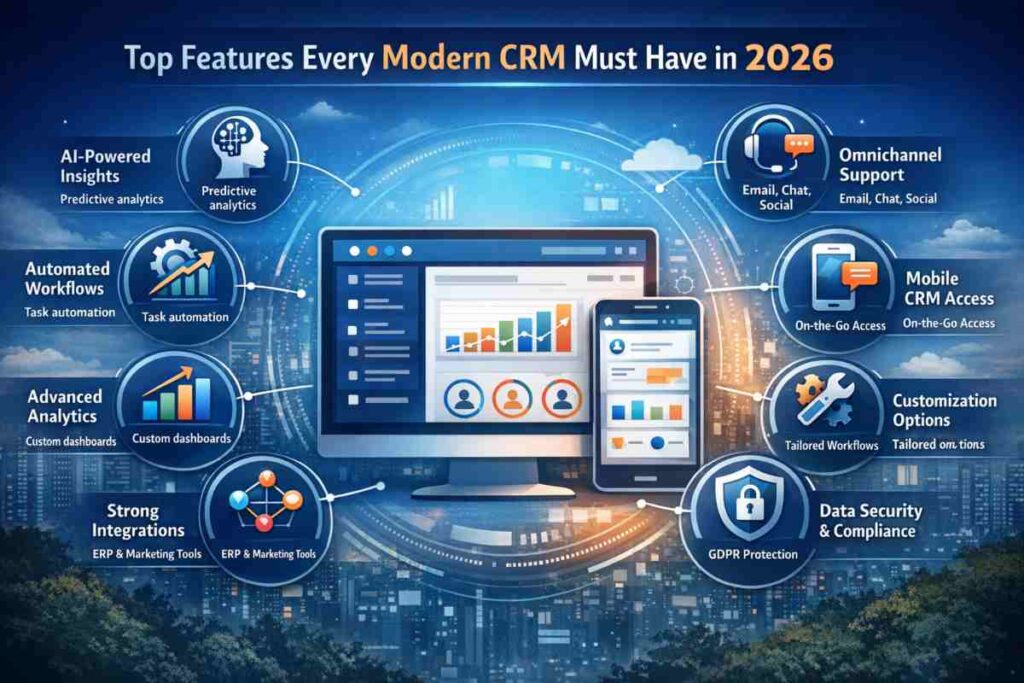
- AI-powered insights – Built-in predictive analytics, intelligent lead scoring, and smart recommendations that help teams prioritize high-value opportunities.
- Automated workflows – Trigger-based automation for lead nurturing, task assignments, follow-ups, and approval processes.
- Advanced analytics – Custom dashboards, KPI tracking, sales funnel analysis, and accurate forecasting tools.
- Omnichannel support – Unified communication across email, chat, phone, and social media channels.
- Mobile access – Full-featured mobile CRM with real-time updates and offline functionality for field teams.
- Strong integrations – Seamless connectivity with ERP systems, marketing platforms, accounting tools, and third-party apps.
- Customization – Flexible fields, pipelines, dashboards, and user permissions tailored to your business model.
- Data security – Encryption, role-based access control, and compliance tools such as consent tracking.
If a CRM platform lacks several items from this list, it may struggle to support long-term growth. Use this checklist as your foundation when comparing vendors and making a confident decision.
How to Choose the Right CRM for Your Business
Choosing a CRM isn’t just about features it’s about fit. The right system should align with your business size, goals, and growth plans.
Small Business vs. Enterprise Needs
Small businesses often need simplicity and speed. A lightweight CRM with essential automation, contact management, and reporting may be enough. The focus should be ease of setup, affordability, and quick team adoption.
Enterprises, on the other hand, require deeper functionality. They often need advanced automation, complex workflows, multi-department visibility, custom reporting, and strong integrations with ERP and marketing platforms. Security and compliance controls also become more critical at scale.
Understanding your current stage prevents overpaying for features you don’t need or underinvesting in tools that limit growth.
Scalability
Your CRM should grow with your business. Look for a platform that allows you to add users, automate more processes, integrate new tools, and customize workflows over time.
Switching CRM systems later can be costly and disruptive. Choosing a scalable solution from the start saves time and resources.
Ease of Use
Even the most powerful CRM fails if your team doesn’t use it. A clean interface, intuitive navigation, and clear onboarding resources improve adoption rates.
ROI Evaluation
Finally, evaluate return on investment. Consider time saved through automation, improved conversion rates, better forecasting accuracy, and enhanced customer retention. The right CRM should not just manage data it should drive measurable business growth.
Final Verdict
Choosing the top features every modern CRM must have is more than a checklist it’s a strategic decision that influences your business performance, customer satisfaction, and long-term growth. In 2026, CRM systems have evolved far beyond contact directories. They are intelligent platforms powered by AI, predictive analytics, automation, and seamless integrations that support teams across sales, marketing, and support.
A CRM worth investing in should not only centralize customer information but also turn that data into actionable insights, automate repetitive tasks, and streamline workflows. It should empower your team to communicate consistently across channels, provide real-time visibility into performance, and adapt to your unique business process. Strong security and compliance features ensure customer data stays protected, while customization allows the system to grow with your needs.
When evaluating CRM tools, focus on scalability, ease of use, and ROI not just feature lists. A solution that aligns with your specific business goals will deliver more value than one overloaded with unnecessary bells and whistles.
In short, the right modern CRM brings clarity to your data, efficiency to your operations, and intelligence to your decisions giving your business a competitive edge in an increasingly customer-centric world.
Read Also: Improve Healthcare Workflow Using Clinic Management Software & EMR