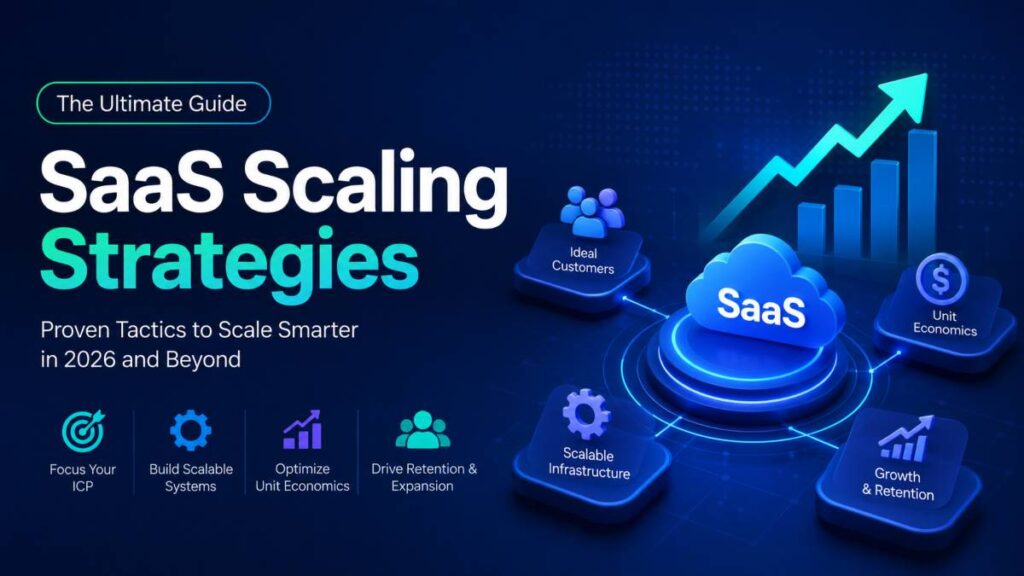
Growth used to look simple. Add more features, launch more campaigns, hire more people. It felt like momentum. In 2026, that approach quietly drains cash, stretches teams, and slows everything down.
Scaling a SaaS business now is a different game. It is not about doing more. It is about doing the right things with precision.
The companies pulling ahead are not shipping endless updates. They are building systems that run clean, tight, and repeatable. They focus on strong unit economics, clear customer value, and infrastructure that holds under pressure. Every decision is measured. Every move has a reason.
This is where modern SaaS scaling strategies come into play. Growth comes from efficiency, not noise. From clarity, not chaos.
In this guide, we break down what actually works. From AI that speeds up onboarding, to pricing models that drive expansion, to infrastructure that scales without cracks. And most important, how customer retention turns growth into something that lasts.
Why Most SaaS Scaling Strategies Fail in 2026
There is a pattern you see again and again. A SaaS company starts to grow, then tries to push harder by adding more. More features, more channels, more campaigns. It looks like progress on the surface. Underneath, things begin to crack.
In 2026, the failure is not a lack of effort. It is a lack of focus.
The Problem With “More” Thinking
Feature bloat is often the first warning sign. Teams keep shipping updates, hoping each new release will unlock growth. Instead, the product becomes harder to use and slower to deliver value.
At the same time, marketing spreads across too many channels. SEO, paid ads, partnerships, outbound. Everything runs at once, but nothing runs well. The result is noise without traction.
Then comes the real pressure point. Customer acquisition cost starts climbing. Each new customer becomes more expensive to win, and the return begins to shrink. Growth feels active, but efficiency drops.
The Hidden Cost of Poor Unit Economics
Weak unit economics sit at the center of most scaling problems. When the LTV to CAC ratio is off, every new deal adds strain instead of strength.
Revenue grows, but margins tighten. Teams expand, but profits do not follow. This is growth that looks good in reports and fails in reality.
The danger is simple. Without strong fundamentals, scaling becomes expensive motion. And over time, that motion burns cash faster than it builds value.
Strategic Focus: Narrow ICP, Bigger Growth
If scaling feels slow, the issue is rarely effort. It is direction. Most SaaS teams cast the net too wide, chasing anyone who might convert. What they get is long sales cycles, weak fit, and customers who do not stay.
In 2026, growth sharpens when focus tightens. The best SaaS scaling strategies start with a clear decision. Who is this product really for, and who is it not for.
Defining a High Value ICP
A high value ideal customer profile is not built on broad traits. It is shaped by precision. Industry, company size, use case, urgency, and buying behavior all matter.
Tight segmentation creates clarity. Messaging lands faster because it speaks to a real problem. Sales cycles shorten because the fit is obvious. Product adoption improves because the solution matches the need.
When the ICP is right, conversion stops feeling like persuasion. It feels like alignment.
The “Frame, Floor, Focus” Model
Strong growth needs structure. The Frame, Floor, Focus model gives that structure in simple terms.
Frame sets the direction. It defines what success looks like and where the company is heading.
Floor raises the minimum standard. Low value deals, weak leads, and scattered efforts get cut. Only what meets the bar moves forward.
Focus removes distraction. Teams stop splitting attention across too many bets and commit to what works.
This model forces discipline. It replaces busy work with deliberate action.
Why Subtraction Beats Expansion
Most teams try to grow by adding. More features, more campaigns, more segments. The result is complexity that slows everything down.
Subtraction does the opposite. It removes what does not contribute to real growth.
Customer acquisition cost drops because efforts are targeted. Sales teams spend time on leads that convert, helping build a healthier sales pipeline. Marketing stops wasting budget on low intent traffic.
Pipeline velocity increases because decisions happen faster and friction disappears.
In the end, scaling is not about how much you can add. It is about how much you can remove while still growing stronger.
SaaS Infrastructure That Actually Scales
Infrastructure rarely gets the spotlight. It sits behind the product, quiet and technical, until growth hits a wall. Then everything depends on it.
In 2026, scaling a SaaS business is not just about users and revenue. It is about building a system that can handle pressure without slowing down. The right infrastructure keeps teams fast, costs controlled, and customers satisfied.
Monolith First, Microservices Later
There is a strong temptation to build complex systems early. Microservices sound modern and flexible. In reality, they often introduce friction too soon.
A well structured monolith gives speed. It is easier to build, test, and ship. Teams move faster because everything lives in one place with clear boundaries.
Microservices have their place, but timing matters. They make sense when scale demands separation, not before. Early complexity slows progress and creates overhead that small teams cannot afford.
The real trade off is simple. Speed now or complexity later. Most growing SaaS companies win by choosing speed first.
Designing Replaceable Systems
Strong infrastructure is not about building something permanent. It is about building something that can change without breaking.
Replaceable systems follow a modular approach. Each part of the product works as a unit that can be swapped or updated without affecting the whole.
This creates flexibility. As the business grows, new tools, new features, or new workflows can be introduced without rewriting everything.
It also reduces risk. When one part fails or needs improvement, the rest of the system continues to run.
Scaling becomes less about rebuilding and more about adjusting.
Performance as a Growth Lever
Performance is not just a technical concern. It shapes how users experience the product from the first click.
Load speed is critical. When pages respond in under two seconds, users stay engaged. When they do not, drop off rises fast.
Database optimization plays a key role here. Clean queries, efficient indexing, and smart data handling keep the system responsive as usage grows.
Multi tenant architecture adds another layer of efficiency. Instead of managing separate environments for each customer, resources are shared in a controlled way. This reduces cost and simplifies scaling.
In the end, performance drives trust. A fast, stable product keeps users active and supports growth without friction.
AI and Automation in SaaS Growth
AI has moved from a nice addition to a core part of how SaaS companies grow. In 2026, it is not about adding AI for the sake of it. It is about using it where it speeds things up and removes friction.
The goal is simple. Help users reach value faster while freeing teams from repetitive work.
AI for Faster Time to Value
The first moments inside a product matter more than ever. If users do not see value quickly, they leave.
AI improves onboarding by guiding users through the right steps based on their behavior. Instead of static flows, the product adapts in real time. It shows what matters and removes what does not.
Smart analytics push this further. AI tracks patterns across users and surfaces insights that would take hours to find manually. Teams can see where users get stuck and fix it fast.
The result is a shorter path from signup to value. That speed directly improves retention. The same push toward speed has reached how products get built, with no-code app builder platforms now letting founders assemble a working SaaS in days rather than waiting on engineering sprints.
Automation That Frees Teams
Growth creates pressure on operations. More users mean more payments, more support requests, more data to manage.
Automation steps in to handle the routine. Billing systems run without manual checks. CRM updates happen in the background. Support workflows route questions to the right place instantly.
This does not just save time. It lets teams focus on work that actually moves the business forward. Strategy, product improvement, and customer relationships.
Efficiency becomes part of the system, not something teams chase.
Where AI Should Not Replace Humans
There is a limit to what AI should handle. Not every decision can be reduced to data.
Customer judgment still matters. Understanding context, reading tone, and making calls in uncertain situations require human input.
Relationships also depend on nuance. Trust is built through real interaction, not automated responses.
The strongest SaaS companies use AI as support, not as a replacement. It handles scale and speed, while people handle judgment and connection.
That balance is what turns automation into real growth.
Customer Success That Drives Expansion Revenue
Growth does not come from acquisition alone. It compounds through retention, expansion, and the depth of value customers get after they sign up. In 2026, customer success sits at the center of SaaS scaling strategies because it turns existing users into long term revenue.
The shift is clear. Customer success is no longer a support function. It is a growth engine.
Segmentation Beyond ARR
Most teams segment customers by revenue alone. It is a clean metric, but it misses the full picture.
A stronger approach looks at complexity. How many stakeholders are involved, how the product is used, and how critical it is to daily operations. Two customers with the same revenue can require very different levels of support.
Complexity based tiers help teams allocate resources with precision. High touch support goes to accounts that need it. Lower complexity users move through lighter, more automated flows.
Stakeholder mapping adds another layer. Understanding who makes decisions, who uses the product, and who influences outcomes reduces friction. It ensures communication reaches the right people at the right time.
This level of segmentation improves both efficiency and experience.
Designing Activation Funnels That Convert
The first experience inside a product sets the tone for everything that follows. If users struggle early, they rarely recover.
Strong activation funnels focus on one clear job to be done. Instead of overwhelming users with options, they guide them toward a single outcome that proves value.
Speed matters here. When users reach that moment of value in under ninety seconds, engagement rises sharply. The product feels useful right away, not something that requires effort to understand.
Progress tracking reinforces this. Users can see how far they have come and what comes next. That sense of movement keeps them active.
Activation is not about showing features. It is about delivering a result as quickly as possible.
Proactive Retention Systems
Retention does not happen by chance. It comes from systems that detect risk and act before users disengage.
Health scores are a key part of this. They combine signals like usage patterns, feature adoption, and engagement frequency into a clear view of account status. When a score drops, teams know where to look.
Journey mapping supports this by outlining the full customer path. From onboarding to expansion, each stage is defined with expected actions and outcomes.
When these systems work together, customer success becomes proactive. Teams do not wait for problems to appear. They step in early, guide users forward, and protect revenue.
That is how customer success moves from support to growth.
Marketing and Pricing Strategies for Scalable SaaS
Growth without direction burns budget. Growth with structure compounds. In 2026, SaaS scaling strategies depend on how well marketing and pricing work together. One drives demand. The other turns that demand into revenue that expands over time.
The strongest companies treat both as connected systems, not separate functions.
Multi Channel Growth That Converts
Traffic alone means nothing if it does not convert. The focus now is on alignment across channels.
SEO brings in steady, high intent users who are already searching for solutions. Paid campaigns add speed, helping test offers and reach new segments quickly. Content builds trust, giving users a reason to stay and engage.
When these channels work together, each one supports the other. Content improves SEO. SEO reduces reliance on paid spend. Paid campaigns provide fast feedback that shapes both.
The key is consistency. Messaging, positioning, and value must match across every touchpoint. When they do, conversion rates improve and acquisition costs stay under control.
Usage Based and Tiered Pricing Models
Pricing is no longer just a number. It is a growth lever.
Usage based models tie cost directly to how much value a customer receives. As usage increases, revenue grows naturally. This creates a clear path to expansion without constant selling.
Tiered pricing adds structure. Different levels match different needs, allowing customers to move up as they grow. Entry points stay accessible, while higher tiers capture more value from advanced use.
Together, these models create momentum. Instead of chasing new customers, revenue expands within the existing base.
Continuous Pricing Optimization
Markets shift fast. Pricing that works today may not hold tomorrow.
Continuous testing keeps pricing aligned with demand. A B testing different price points, packaging, and offers reveals what customers are willing to pay.
This is not a one time effort. It is an ongoing process that responds to changes in competition, customer behavior, and product value.
Responsive pricing protects margins while keeping the product competitive. It ensures growth does not come at the cost of sustainability.
In the end, marketing brings the right users in. Pricing makes sure their value continues to grow.
Key SaaS Metrics You Can’t Ignore
Numbers tell the truth that growth stories often hide. You can feel momentum, see new signups, even celebrate revenue spikes. But without the right metrics, it is easy to miss what is really happening underneath.
In 2026, SaaS scaling strategies rely on a small set of signals that show whether growth is strong or fragile.
Core Metrics Table
Here are the metrics that matter most when scaling a SaaS business:
- Customer Acquisition Cost
The cost of winning a new customer. This should trend down over time as efficiency improves. - LTV to CAC Ratio
The value a customer brings compared to what it costs to acquire them. A healthy benchmark is above three to one. - Churn Rate
The percentage of customers who leave each month. Keeping this below five percent protects long term revenue. - Time to Value
How quickly users see real benefit after signing up. The faster this happens, the stronger retention becomes. - MRR Growth
Monthly recurring revenue growth shows whether the business is moving forward at a steady pace. Strong SaaS companies often aim for consistent double digit quarterly growth.
How to Interpret These Metrics
Metrics on their own do not mean much. What matters is how they move together.
A good pattern is simple. Acquisition cost goes down, customer value goes up, and churn stays low. That combination creates growth that compounds over time.
Warning signs are just as clear. Rising acquisition cost with flat customer value points to inefficiency. High churn signals that users are not getting enough value. Slow time to value shows friction inside the product.
The key is not to track everything. It is to track what reflects reality and act on it quickly.
Building a Scalable SaaS System Step by Step
Scaling does not happen through one big move. It comes from a series of small, deliberate steps that strengthen the system behind the business. When each part works well, growth feels smooth instead of forced.
Here is how to build a SaaS system that can handle scale without breaking.
Step 1: Tighten ICP and Value Prop
Start with clarity. Define exactly who the product is for and what problem it solves best.
A tight ideal customer profile removes guesswork. Marketing speaks to the right audience. Sales conversations become shorter and more direct. The product delivers value without confusion.
When the value proposition is clear, everything else becomes easier to scale.
Step 2: Fix Infrastructure Bottlenecks
Next, look at the system itself. Where does it slow down under pressure
It could be load times, database performance, or parts of the product that struggle as usage grows. These bottlenecks limit growth even if demand is strong.
Fixing them early keeps the product stable and responsive. It ensures new users have the same experience as early ones.
Step 3: Automate Repetitive Work
As the business grows, routine tasks multiply. Payments, onboarding steps, support requests, and data updates can overwhelm teams.
Automation removes that pressure. It handles repetitive work in the background so teams can focus on decisions and improvements.
This shift increases efficiency without increasing headcount.
Step 4: Optimize Pricing and Retention
Finally, focus on how revenue grows over time.
Pricing should reflect the value customers receive. As usage increases, revenue should rise with it. At the same time, retention systems need to keep users engaged and satisfied.
When pricing and retention work together, growth becomes steady and predictable.
Each of these steps builds on the last. Together, they create a system that supports scale instead of resisting it.
Conclusion: Scaling Is Precision, Not Speed
There is a quiet shift happening in SaaS. Growth is no longer about moving faster than everyone else. It is about moving with control.
The companies that win in 2026 are not the ones doing the most. They are the ones doing the right things with clarity. Clean systems. Strong economics. Clear focus. Every part works together without friction.
Smart systems beat rushed growth every time. When infrastructure holds, onboarding feels smooth, pricing fits the value, and retention stays strong, scale stops feeling risky. It becomes predictable.
Efficiency is what makes that possible. Not cutting corners, but removing what does not matter. Clarity is what keeps it on track. Knowing who you serve and why it matters.
If growth feels messy, that is the signal. Step back, review the system, and fix what slows it down. Tighten the foundation before pushing forward.
Because real scale is not built on speed. It is built on precision.
Read more: https://rankvisely.com/why-your-small-business-needs-to-be-visible-in-ai-search/