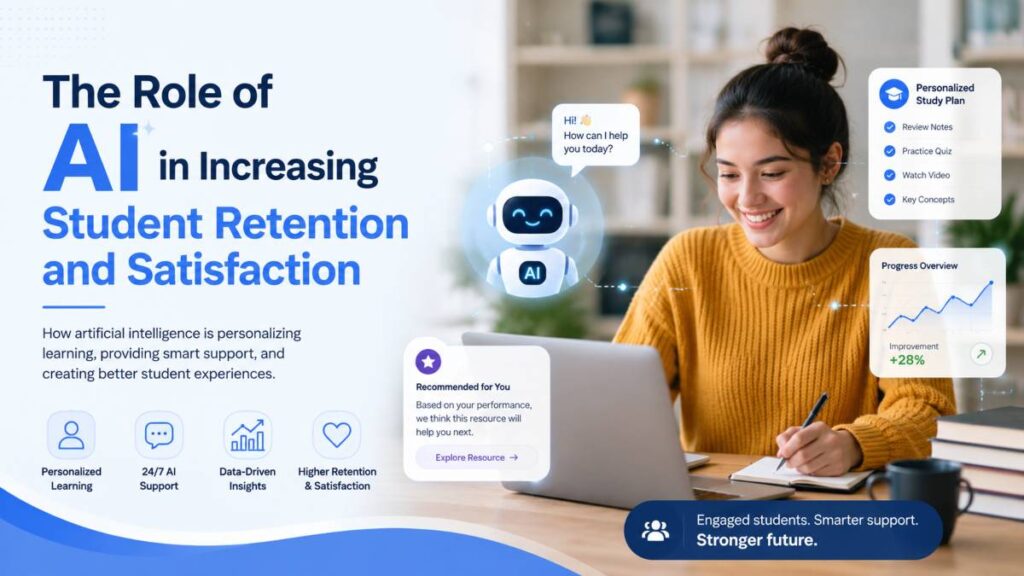
Artificial intelligence is no longer a futuristic add-on in higher education, it has become a practical tool for addressing one of the field’s most persistent challenges: keeping students enrolled and engaged through to graduation.
AI systems can now identify students at risk of disengagement weeks before traditional methods would catch the same signals, giving institutions a meaningful window to intervene.
According to key research on AI-driven student outcomes, artificial intelligence tools are demonstrating measurable impact on learner engagement and academic persistence.
How to Start Implementing Personalized Learning with AI at Your Institution
Getting started doesn’t have to be overwhelming. This step-by-step guide walks administrators and faculty through a practical path toward adopting AI tools that meaningfully improve student outcomes.
- Audit your current student data infrastructure: Identify what data you already collect: LMS engagement, grade trends, attendance, and support interactions. Clean, centralized data is the foundation every AI system depends on.
- Define clear retention goals: Establish measurable benchmarks before selecting any tool. Institutions see stronger results when AI strategies align with specific, pre-defined student success metrics.
- Select an AI platform built for higher education: Evaluate tools designed to deliver personalized learning with AI, prioritizing those that flag at-risk students early and recommend targeted interventions. Many institutions also use an AI form builder to streamline student surveys, intake forms, feedback collection, and enrollment workflows while reducing manual administrative work.
- Train advisors and faculty on AI-generated insights: Technology alone won’t move the needle. Human-AI collaboration (not replacement) drives the most meaningful engagement improvements.
- Launch a pilot cohort: Test your approach with one department or student population before scaling institution-wide.
- Measure, adjust, and expand: Review outcomes after each term and refine your model accordingly.
With this foundation in place, it’s worth examining exactly why retention and satisfaction are so deeply connected, and what that means for your strategy going forward.
Understanding Student Retention and Satisfaction
Student retention is not simply about keeping enrollment numbers healthy, it reflects how well an institution supports learners through real academic and personal challenges. Before any AI tool can make a meaningful difference, understanding why students leave is essential.
Predictive analytics student retention strategies give institutions a data-driven lens for identifying at-risk students before they disengage entirely.
Follow these steps to build that foundational understanding:
- Audit your dropout data by examining historical records for patterns such as financial hardship, academic struggle, and lack of belonging are among the most cited factors.
- Survey current students regularly to capture satisfaction signals that raw performance data misses.
- Map key friction points across the student journey, from enrollment to graduation, to pinpoint where disengagement typically begins.
- Align retention goals with measurable satisfaction benchmarks so interventions can be tracked meaningfully.
With this groundwork in place, institutions are positioned to apply AI-powered personalized learning in ways that directly address the gaps uncovered.
AI-Powered Personalized Learning
AI personalization in education transforms how institutions deliver instruction: shifting from a one-size-fits-all model to adaptive experiences that respond to each student’s pace, strengths, and gaps.
- Audit your current curriculum data. Identify which course materials, assessments, and engagement metrics are already tracked digitally, these become the raw inputs for any personalization engine. Before institutions choose an LMS, weigh the platform’s reporting depth, integration scope, and adaptive content against their retention goals. Long contracts lock in decisions that are difficult to reverse once student workflows depend on the system.
- Select an adaptive learning platform aligned with your LMS. Look for tools that adjust content difficulty in real time based on quiz performance and time-on-task signals.
- Map learning objectives to student profiles. Aligning AI recommendations to clearly defined competency goals produces measurably stronger outcomes.
Predictive Analytics for Early Intervention
Beyond personalized learning, AI tools like student engagement software extend into one of the most impactful applications in higher education: predicting which students are at risk before they reach a crisis point.
Predictive analytics models analyze signals like attendance patterns, assignment submission timing, and LMS login frequency to flag struggling learners weeks in advance. Here’s how an institution can implement this approach effectively.
- Identify key risk indicators – gather historical data on students who previously withdrew, then map the behavioral patterns that preceded their departure.
- Select a predictive model – apply machine learning algorithms to weight each risk factor according to its documented influence on retention.
- Integrate data sources – connect your LMS, financial aid system, and attendance records into a unified dashboard.
Done consistently, this process transforms reactive advising into proactive support. Precisely the kind of timely outreach that shapes whether a student stays enrolled. That responsiveness, however, depends heavily on the support infrastructure behind the alert system.
AI-Driven Student Support Services
Setting up effective AI-driven support means more than flipping a switch, it requires deliberate configuration so every student interaction is timely and meaningful. Here is how institutions typically implement these services to strengthen retention.
- Audit existing support gaps by reviewing help-desk tickets, advising logs, and counseling wait times to identify where students fall through the cracks.
- Deploy one of the modern AI chatbots universities on your student portal to field common FAQs regarding financial aid deadlines, registration steps, or campus resources, so students get answers outside office hours.
- Measure and refine by tracking response rates, support-ticket resolution time, and semester-over-semester retention to evaluate what’s working.
With support infrastructure in place, the logical next question is how AI keeps students actively engaged throughout their academic journey, not just during moments of crisis.
Enhancing Student Engagement Through AI
Putting AI engagement tools into practice requires a clear, repeatable process. Follow these steps to activate AI-driven engagement across your institution’s student success infrastructure.
- Audit your current touchpoints: Map every student interaction channel (LMS, advising portals, help desks) to identify where engagement gaps exist before layering in AI.
- Select an AI platform aligned with your student population’s needs, prioritizing tools that integrate with existing systems rather than requiring a full technology overhaul.
- Review and refine engagement metrics monthly, adjusting trigger thresholds and message cadence based on response rates and retention outcomes.
Research published by IEEE confirms that structured, AI-powered engagement frameworks meaningfully improve persistence rates in higher education. Executed consistently, this process transforms passive data into active support. It is setting the stage for the broader institutional benefits that AI delivers across the entire campus ecosystem.
Benefits of AI for Educational Institutions
Implementing AI across your institution delivers measurable advantages beyond student-facing tools. Follow these steps to unlock and document the core institutional benefits as your AI deployment matures.
- Audit your current retention data to establish a baseline: track dropout rates, GPA trends, and advising touchpoints before AI intervention so you have clear benchmarks to measure against.
- Activate predictive analytics across enrollment data; institutions using AI-driven early-alert systems consistently identify at-risk students weeks earlier than traditional methods allow.
- Report outcomes to stakeholders using compiled dashboards that connect AI adoption directly to improved retention rates and institutional revenue.
Documenting these gains builds the institutional case for sustained AI investment. Still, every benefit comes paired with a responsibility, and that’s where thoughtful implementation gets more complex.
Challenges and Ethical Considerations
Navigating AI adoption responsibly requires institutions to anticipate common pitfalls before they become systemic problems. Follow these steps to address the core ethical and operational challenges head-on.
- Audit your data practices for student privacy compliance. AI systems rely on sensitive personal data, making FERPA adherence non-negotiable. Review data collection, storage, and access protocols before any deployment.
- Identify and mitigate algorithmic bias by regularly testing predictive models across demographic groups. Biased training data can cause models to disadvantage students from underrepresented backgrounds, reinforcing existing inequities rather than closing gaps.
- Establish a governance committee to review AI tools periodically, updating policies as capabilities and risks evolve.
Addressing these challenges creates a foundation of trust that makes every AI investment more effective, and sets the stage for exploring what emerging innovations may bring next.
Future Trends in AI and Student Success
Staying ahead of emerging AI developments helps your institution prepare students and staff for what’s coming next. Here’s how to position your institution for the next wave of AI-driven student success.
- Monitor predictive analytics advancements. Track how newer models move beyond flagging at-risk students to actively recommending personalized intervention pathways in real time.
- Explore generative AI integration. Evaluate tools that create adaptive learning content on demand, tailoring coursework pacing and style to each student’s demonstrated needs.
- Review infrastructure for scalability. Audit data pipelines and staffing models now so your institution can absorb new tools without disrupting ongoing retention efforts.
As these AI trends and tools converge, institutions that have already addressed challenges and built ethical foundations will be best positioned to lead.
Conclusion
Putting everything you’ve learned into action doesn’t have to feel overwhelming. Follow these steps to move from awareness to measurable impact on student retention and satisfaction.
- Audit your current data infrastructure to identify gaps in early-warning systems and intervention workflows before deploying any AI tools.
- Align stakeholders like faculty, advisors, and IT staff around shared goals, ensuring human oversight remains central to every AI-assisted decision.
- Review and iterate regularly, using retention and satisfaction metrics to refine your approach each semester.
The role of AI in increasing student retention and satisfaction is still evolving, but the direction is clear. Institutions that act thoughtfully today; balancing innovation with equity and human connection, will be best positioned to help every student cross the finish line.