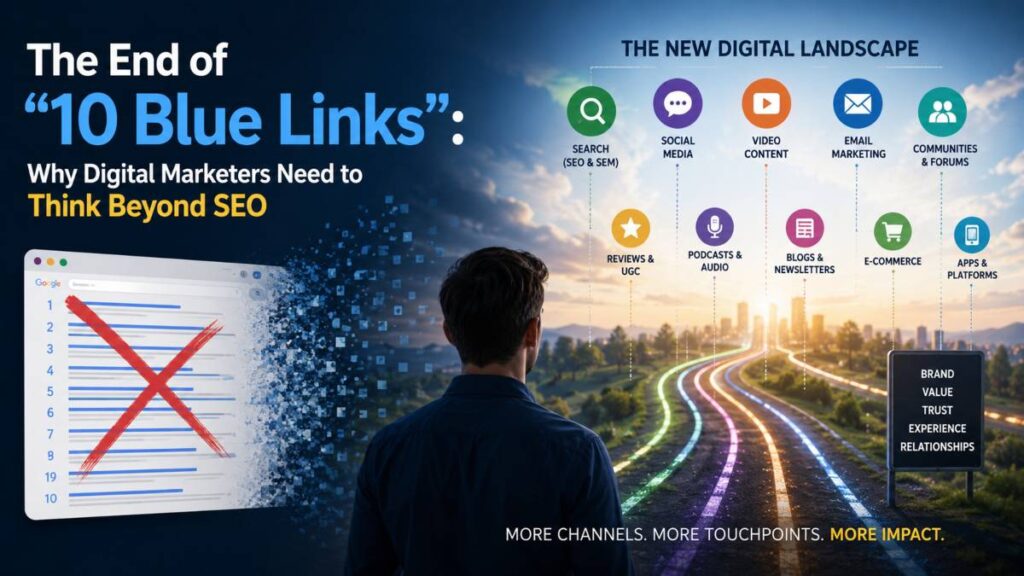
For more than 20 years, SEO has been one of the foundations of digital marketing. The formula was simple: create useful content, optimize your website, earn backlinks, and rank as high as possible on Google. The higher you ranked, the more visitors you could attract.
That formula still works today. SEO isn’t going anywhere.
But the way people discover information is changing.
Instead of opening Google and comparing multiple websites, more people are asking ChatGPT, Google AI Overviews, Gemini, Claude, and Perplexity for answers. Whether they’re looking for the best CRM software, a marketing agency, or a hotel for their next vacation, they increasingly expect AI to do the research for them.
This isn’t just changing how consumers search. It’s also changing how businesses buy.
A recent study found that 94% of B2B buying groups already use ChatGPT, Gemini, or other large language models (LLMs) during the early stages of their research. That means many buying decisions are starting before a prospect even visits a company’s website.
That small change has a much bigger impact than most marketers realize.
Search Used to Give You Choices. AI Gives You Recommendations.
Imagine you’re looking for project management software.
A few years ago, you probably searched on Google, opened five different websites, read reviews, watched YouTube videos, and compared pricing before making a decision.
Today, many people simply ask an AI assistant.
Instead of showing hundreds of search results, AI might reply:
“Here are the three project management tools I’d recommend…”
The research has already been done for you.
That’s a completely different experience.
People are no longer choosing from hundreds of websites. They’re choosing from a handful of recommendations.
For marketers, that means the competition has changed. It’s no longer just about ranking on Google. It’s also about becoming one of the brands that AI chooses to recommend.
Why SEO Alone Is No Longer the Whole Picture
SEO is still important because search engines need to understand your website.
Over the past few years, new terms have also started appearing, such as Generative Engine Optimization (GEO) and Answer Engine Optimization (AEO). While the names may sound unfamiliar, the ideas are quite simple.
- SEO helps search engines understand and rank your webpages.
- GEO focuses on making content easier for generative AI platforms to understand and reference.
- AEO helps content become direct answers in AI-powered search experiences.
Each discipline solves a different problem.
Interestingly, AI isn’t replacing SEO. In many cases, it’s creating new opportunities. One analysis found that webpages cited in Google AI Overviews received 35% more organic clicks and 91% more paid clicks than pages that weren’t cited.
The findings suggest that being recognized by AI can actually increase visibility instead of reducing it.
While researching how AI is changing digital marketing, I stumbled upon a research paper called Authority & Visibility Optimization (AVO). Instead of treating SEO, GEO, and AEO as separate strategies, the paper connects them under a broader framework designed for the AI era.
It made me think that maybe the conversation shouldn’t be about choosing between SEO, GEO, or AEO. Maybe the real question is how all of them work together.
What Is AVO?
At its simplest, AVO is about helping a brand achieve two things:
- Be easy to discover.
- Be trusted enough to be recommended.
That might sound similar, but they’re actually different.
Imagine you’re looking for a dentist in a new city.
One clinic has hundreds of positive reviews, has been featured in health publications, and is recommended by many people.
Another clinic has almost no online presence.
Which one would you trust?
Most people would choose the first one.
AI works in a similar way.
Before recommending a brand, AI looks for signals that suggest the brand is credible and trustworthy. In the AVO framework, those trust signals are called Authority. They can come from many places, including high-quality content, media coverage, backlinks, expert recognition, reviews, and consistent information across the web.
Authority Is Only Half of the Story
Now imagine something different.
You own the best coffee shop in town.
Your customers love your coffee.
Everyone who visits comes back.
The problem?
Almost nobody knows your shop exists.
Even though your coffee is excellent, people can’t recommend what they don’t know.
That’s what Visibility is about.
Visibility measures how easily your brand can be found across the digital ecosystem, including AI platforms. A brand may have strong authority, but if AI rarely encounters reliable information about it, that brand is less likely to appear in recommendations.
This shift is already happening. More and more people are getting the answers they need without ever visiting another website.
In fact, nearly 60% of Google searches now end without a click, according to research by SparkToro. AI assistants simply take that behavior one step further by providing complete answers instead of a list of links.
AVO brings these two ideas together.
Authority helps AI trust your brand.
Visibility helps AI find your brand.
To be consistently recommended, you need both.
Can You Measure Authority and Visibility?
One of the things I liked most about the research is that it doesn’t stop at introducing new ideas. It also asks a practical question:
If Authority and Visibility matter, shouldn’t marketers be able to measure them?
To answer that, the framework introduces two metrics.
The first is the Authority Score.
Think of it like a credit score, but for your brand instead of your finances. Rather than measuring your financial history, it evaluates digital trust signals that indicate how authoritative your brand appears online.
The second is the Visibility Score.
Imagine asking ChatGPT, Gemini, or Perplexity questions related to your industry. Does your brand appear in the answers? How often? How does it compare to your competitors?
That’s what Visibility Score is designed to measure. Together, these two metrics provide a broader view of your digital presence than rankings or organic traffic alone.
Interestingly, these ideas have already been put into practice through tools such as AVO by Avonetiq, where marketers can measure both their Authority Score and Visibility Score to better understand how their brands perform across AI-powered search and recommendation platforms.
A New Way to Think About Digital Marketing
The biggest takeaway from the AVO research isn’t that SEO is becoming less important.
It’s that digital marketing has become bigger than SEO alone.
Ranking on Google is still valuable. But as more people rely on AI to research products, compare services, and make decisions, marketers also need to think about something new:
Will AI recommend my brand when someone asks?
That’s a different question from “Can people find my website?”, and it requires a broader way of thinking about digital marketing.
Whether AVO becomes the industry’s standard term is something only time will tell. But the shift it describes is already happening. Understanding how authority and visibility influence AI recommendations is likely to become an increasingly valuable skill for marketers in the years ahead.
If you’re interested in exploring the ideas behind AVO in more depth, the original research paper is well worth reading. And if you’re curious about how your own brand performs today, tools like getavo.ai make it possible to measure both your Authority Score and Visibility Score, turning these concepts into practical, not theoretical, metrics.
Author: Anangga Gunawan
Description: Anangga Gunawan leads marketing for a technology company focused on AI visibility. He writes about AI search, digital authority, and how brands can adapt to the changing landscape of digital discovery.