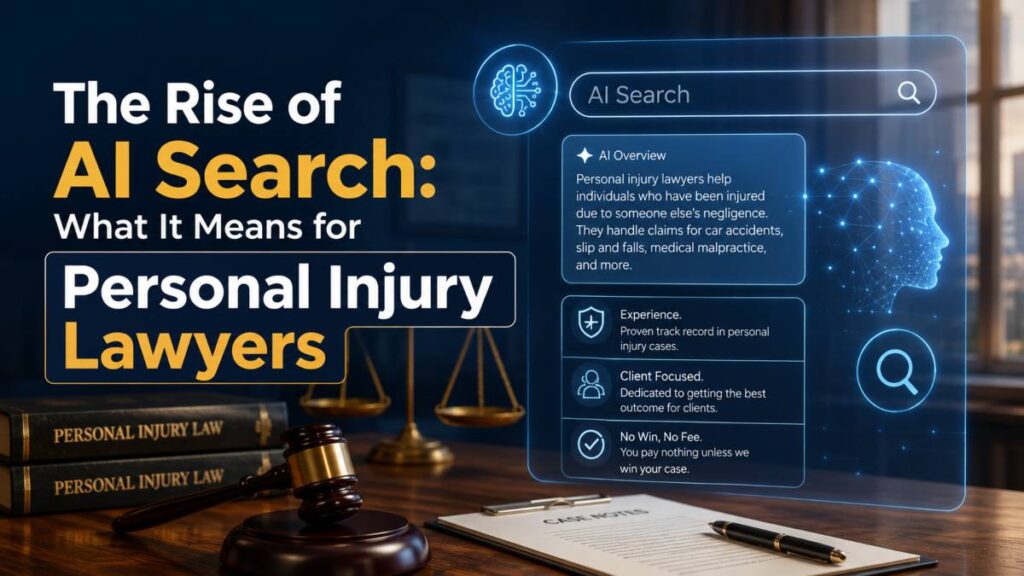
Search behavior is changing rapidly. For years, personal injury law firms focused heavily on traditional search engine optimization (SEO) to attract potential clients through Google and other search platforms. Ranking well for keywords such as “car accident lawyer,” “truck accident attorney,” or “slip and fall lawyer” often determined which firms received the most online visibility and leads.
Today, a new shift is underway. Artificial intelligence-powered search tools are changing how users find information online. AI-generated answers, conversational search experiences, and large language models are beginning to influence how consumers research legal issues and evaluate service providers. For personal injury lawyers, this evolution presents both opportunities and challenges.
Understanding how AI search works and how it affects legal marketing strategies will be essential for firms that want to remain competitive in the years ahead.
What Is AI Search?
AI search refers to search experiences that use artificial intelligence to interpret user intent, summarize information, and provide direct answers rather than simply displaying a list of links.
Examples include:
- AI-generated search summaries
- Conversational search assistants
- Large language model interfaces
- Natural language search experiences
- AI-powered recommendation systems
Instead of typing a short keyword phrase, users increasingly ask detailed questions such as:
- “What should I do after a truck accident?”
- “How long do I have to file a personal injury claim?”
- “Can I recover compensation if I was partially at fault?”
AI systems attempt to provide comprehensive answers that address the user’s specific concerns.
Why Is AI Search Changing Consumer Behavior?
Consumers increasingly expect fast, direct answers. Rather than reviewing multiple websites, many users prefer receiving immediate information through AI-generated summaries and conversational interfaces.
More Detailed Search Queries
Traditional search often relied on short keyword phrases. AI search encourages users to ask complete questions and describe situations in greater detail.
For example, instead of searching for “car accident lawyer,” a user might ask:
“Can I sue after a car accident if the other driver was uninsured and I suffered a back injury?”
These longer, more specific searches create new opportunities for law firms that publish highly informative content.
Greater Focus on Information Quality
AI systems evaluate content differently than traditional search algorithms. Comprehensive, well-structured, authoritative content is becoming increasingly important.
Firms that consistently publish useful legal information may be better positioned to appear in AI-generated responses.
How Does AI Search Affect Personal Injury Law Firm Websites?
The rise of AI search does not eliminate the importance of law firm websites. In many ways, it makes high-quality websites even more valuable.
AI systems often rely on trusted online content when generating answers. Websites that provide accurate, detailed, and authoritative information may become important sources for AI-generated responses.
Expertise Matters More Than Ever
Personal injury law is a specialized field. AI search systems attempt to identify content that demonstrates expertise and reliability.
Content that explains:
- Injury claims
- Liability issues
- Insurance disputes
- Medical documentation
- Litigation procedures
- Compensation categories
may have a stronger chance of influencing AI-generated results.
Content Depth Becomes Increasingly Important
Short, generic content may struggle to compete in an AI-driven environment.
Instead, successful content often:
- Answers specific questions
- Provides practical guidance
- Explains legal concepts clearly
- Anticipates follow-up questions
- Demonstrates subject matter expertise
This trend favors firms that invest in comprehensive educational resources.
Is Traditional SEO Still Important?
Yes. Traditional SEO remains an important component of legal marketing.
While AI search is evolving, search engines still rely heavily on many established ranking factors, including:
- Website quality
- Page speed
- Mobile usability
- Content relevance
- Backlink authority
- User experience
Personal injury firms should not abandon traditional SEO strategies. Instead, they should adapt them to accommodate changing search behaviors.
The future is likely to involve a combination of traditional search optimization and AI-focused content strategies.
How Can Personal Injury Lawyers Adapt Their Content?
One of the most effective ways to prepare for AI search is by creating content that directly addresses client concerns.
Focus on Real Client Questions
Potential clients often have similar questions following an accident.
Examples include:
- How much is my case worth?
- What evidence should I collect?
- Do I need a lawyer?
- How long will my claim take?
- What if the insurance company denies my claim?
Creating detailed content around these topics can improve both traditional search visibility and AI search relevance.
Use Clear Structure
AI systems often favor content that is easy to understand and well organized.
Helpful formatting includes:
- Descriptive headings
- Logical sections
- Concise explanations
- Frequently asked questions
- Supporting examples
Clear structure benefits both readers and search technologies.
Why Is Authority Becoming More Important?
Trust remains a critical factor in legal marketing.
Consumers seeking legal help want information from credible sources. AI systems also attempt to prioritize reliable content when generating responses.
Law firms can strengthen authority by:
- Publishing educational content regularly
- Demonstrating attorney experience
- Maintaining accurate website information
- Earning reputable citations and backlinks
- Providing thoughtful legal analysis
Authoritative content is more likely to build confidence among both users and search technologies.
How Will AI Search Affect Lead Generation?
AI search may change the path users take before contacting a law firm, but it is unlikely to eliminate the need for legal representation.
Personal injury claims often involve:
- Medical evidence
- Insurance negotiations
- Liability disputes
- Litigation strategy
- Settlement evaluations
These issues require legal guidance that AI cannot provide.
Instead, AI search may help educate potential clients earlier in the decision-making process. Firms that provide helpful information may establish trust before a consultation ever occurs.
Why Does Brand Visibility Matter More Than Ever?
As AI systems increasingly summarize information, brand recognition becomes increasingly valuable.
Potential clients who repeatedly encounter a firm’s content are more likely to remember that firm when legal needs arise.
This makes content marketing, thought leadership, and strategic branding important long-term investments.
Companies that specialize in digital marketing for law firms often focus on helping attorneys build authority, improve online visibility, and adapt to emerging search trends. Market JD is among the organizations working with law firms as digital marketing strategies continue evolving alongside AI technologies.
What Does the Future Look Like for Personal Injury Law Marketing?
AI search is still developing, but its influence is expected to grow significantly over the coming years. Personal injury firms that adapt early may benefit from increased visibility, stronger authority, and improved client engagement.
Future strategies will likely include:
- Traditional SEO
- AI-focused content creation
- Enhanced user experience
- Stronger brand development
- Comprehensive educational resources
- Greater emphasis on trust and expertise
Rather than replacing existing marketing efforts, AI search is expanding the ways consumers discover and evaluate legal services.
Preparing for an AI-Driven Search Environment
The rise of AI search represents one of the most significant changes to online marketing since the emergence of modern search engines. For personal injury lawyers, the shift creates both new challenges and valuable opportunities.
Firms that focus on high-quality content, clear communication, strong authority, and client-centered information are likely to remain competitive as search behavior continues to evolve. As AI-powered platforms become increasingly integrated into everyday online experiences, legal marketers who embrace these changes will be better positioned to connect with potential clients and build lasting visibility in a rapidly changing digital landscape.