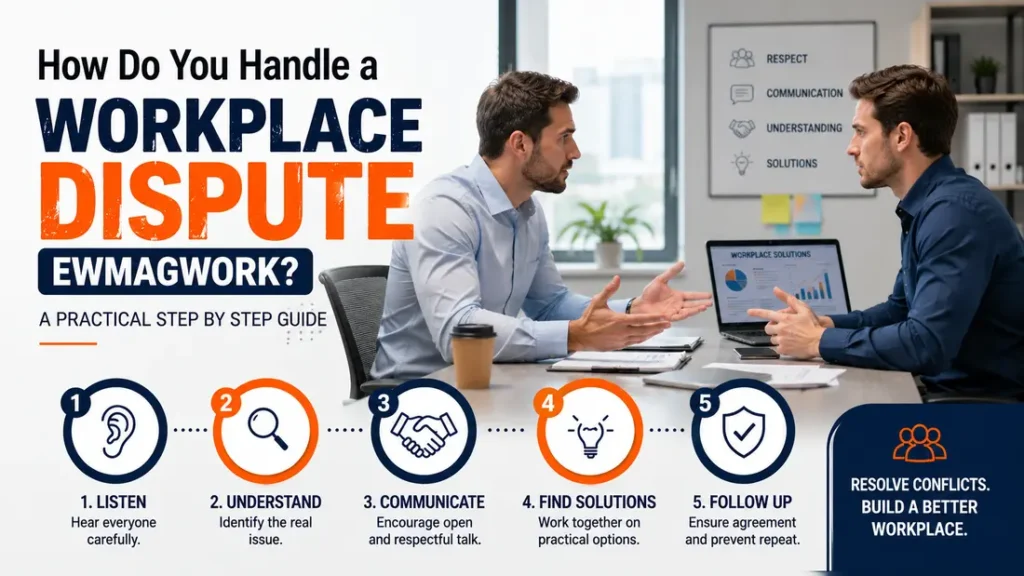
You handle a workplace dispute by addressing it early, listening to every side without taking sides too fast, separating the facts from the feelings involved, and working toward a solution both people can actually live with. If informal conversation does not resolve it, the next step is a documented, structured process involving HR or a neutral mediator.
This article is for employees who are stuck in a disagreement with a coworker, and for managers or team leads who need to step in and resolve conflict without making it worse. You do not need a law degree or a psychology background to do this well. You need a clear process and the willingness to follow it even when the conversation feels uncomfortable.
Key Takeaways
- Most workplace disputes get worse not because the issue was serious, but because nobody addressed it early.
- Around 85 percent of employees deal with some form of conflict at work, yet most managers have never had formal training in how to resolve it.
- A short, structured conversation resolves the majority of disputes. Formal grievance processes should be the last resort, not the first move.
- Documenting what was discussed and agreed on protects both people and the organization if the issue resurfaces.
- Software and workflow tools can support communication, but no tool resolves a dispute on its own. The people involved still have to talk.
What Counts as a Workplace Dispute
A workplace dispute is any disagreement between coworkers, between an employee and a manager, or between teams, that affects how people work together. It can be small, like two people disagreeing about who owns a task, or serious, like accusations of harassment or unfair treatment.
Disputes generally fall into a few categories. There are task based disputes, where people disagree about how work should be done or who is responsible for it. There are relationship based disputes, where personality clashes or communication styles create friction. And there are value based disputes, where people disagree about what is fair, ethical, or appropriate in the workplace.
Knowing which type you are dealing with matters because the fix is different for each one. A task dispute usually needs clearer roles and expectations. A relationship dispute needs better communication habits. A value dispute often needs a policy decision or HR involvement, because it usually cannot be solved by the two people alone.
Why Workplace Disputes Happen
Understanding the root cause makes resolution faster, because you stop treating the symptom and start treating the actual problem.
Lack of Trust and Unclear Roles
Research consistently points to a small set of repeat offenders behind most workplace conflict. Lack of trust between colleagues, personality clashes, and unclear roles are the three most commonly cited triggers, and together they account for the majority of disputes reported by employees. When people are not sure who owns a decision or a task, they step on each other’s work without meaning to, and resentment builds quietly until it surfaces as an argument.
Poor Communication Habits
A large share of employees say they simply avoid conflict rather than address it. Data from workplace research firms shows that roughly half of employees who experience conflict admit they took no action and just let it go. That avoidance does not make the issue disappear. It usually makes it worse, because the underlying frustration keeps building while nothing actually changes.
The Cost of Letting It Slide
Unresolved workplace conflict is expensive, and not just emotionally. Estimates put the annual productivity cost of workplace conflict in the United States well into the hundreds of billions of dollars, driven by lost focus, absenteeism, and turnover. Managers report spending a significant chunk of their week, sometimes 20 to 40 percent of their time, dealing with disputes that could have been resolved in a single early conversation. That is time pulled directly away from coaching, planning, and actual leadership.
How to Handle a Workplace Dispute Ewmagwork Step by Step
This process works whether you are one of the people involved in the dispute or the manager stepping in to help resolve it.
Step 1: Address It Early, Before It Grows
The single biggest predictor of how badly a dispute escalates is how long it sits unaddressed. A disagreement that gets raised within a day or two is usually a short, manageable conversation. The same disagreement left to simmer for weeks turns into a pattern of resentment that is much harder to untangle.
If you are the employee, this means saying something as soon as a pattern starts, not waiting until you are furious. If you are the manager, this means not waiting for a formal complaint before you check in with the people involved.
Step 2: Listen to Every Side Without Taking One Too Fast
When you sit down to talk through a dispute, your first job is to understand, not to judge. Let each person explain their view of what happened without interrupting or defending the other side. People are far more willing to compromise once they feel genuinely heard, and rushing to a verdict before that happens almost always backfires.
Ask open questions like “walk me through what happened from your side” rather than leading questions that assume you already know who is right.
Step 3: Separate the Facts From the Feelings
Most disputes are a tangle of two different things: what actually happened, and how each person felt about it. Both matter, but they need to be handled differently. The facts, such as who missed a deadline or who was left off an email, can usually be verified. The feelings, such as feeling disrespected or excluded, need to be acknowledged even if you cannot fully verify the intent behind them.
Naming this split out loud in the conversation, for example saying “let’s look at what actually happened first, then talk about how it made each of you feel,” keeps the discussion from going in circles.
Step 4: Explore Options Together Instead of Handing Down a Verdict
Once both sides feel heard and the facts are clear, ask the people involved what a fair resolution would look like to them, rather than just announcing one. People are much more likely to follow through on a solution they helped shape than one that was imposed on them.
This does not mean every option is on the table. As the manager or the neutral party, you still need to rule out anything that violates policy or is unfair to a third party. But within those limits, give people real input into the outcome.
Step 5: Agree on Next Steps and Put Them in Writing
Vague resolutions fall apart within a week. A good resolution includes specific, concrete commitments: who will do what differently, by when, and how you will check that it is working. Send a short written summary afterward, even if it is just a two line email, so there is a shared record of what was agreed.
This step protects everyone. If the issue comes up again, you have a clear reference point instead of two competing memories of what was decided.
Step 6: Escalate to HR or Formal Mediation When Needed
Not every dispute can or should be resolved informally. If the issue involves harassment, discrimination, safety, or repeated behavior that has not improved despite direct conversation, it needs to go to HR or a trained mediator.
Formal mediation has a strong track record when it is used appropriately. The majority of workplace mediation cases end with the conflict fully or largely resolved, and mediation is generally faster and less damaging to working relationships than a formal grievance process or legal action. The organizations that handle disputes best are not the ones with zero conflict. They are the ones with a clear, known path for when a dispute needs to move beyond a one on one conversation.
Step 7: Follow Up
The conversation is not the finish line. Check back in with both people a week or two later to confirm the agreement is holding. If it is not, address it again quickly rather than letting it slide back into the same pattern that caused the original dispute.
Handling a Dispute as an Employee Versus as a Manager
The steps above apply to both roles, but the responsibilities inside each step shift depending on where you are standing.
If You Are the Employee
Your job is to raise the issue directly and specifically, focused on behavior and impact rather than character. Instead of saying a coworker is careless, describe what happened: the report was submitted without your review even though that was the agreed process, and it affected the deadline. Come to the conversation ready to describe what you need going forward, not just what went wrong in the past.
If a direct conversation does not resolve things, or if the issue involves a power imbalance such as a dispute with your own manager, loop in HR early rather than letting it drag on.
If You Are the Manager
Your job is to stay neutral until you have heard every side, resist the urge to solve it in five minutes just to move on, and make sure any resolution is documented. Managers who are seen as fair, even when the outcome is not what one person wanted, retain far more trust from their teams than managers who avoid the conversation altogether or who visibly pick favorites.
It also helps to normalize conflict as something that gets addressed openly rather than something that is shameful or career damaging to bring up. Teams where people are afraid to raise small disagreements tend to build up much bigger ones over time.
Common Mistakes That Make Disputes Worse
A few patterns show up again and again in disputes that spiral instead of resolve.
Waiting too long to say anything is the most common one, since silence rarely calms a situation down. Taking sides before hearing both people out is another, since it makes the person who was not favored feel like the process was never fair to begin with. Handling everything through email or chat instead of a real conversation strips out tone and context, which makes misunderstandings more likely, not less. And skipping documentation means that if the same issue resurfaces, there is nothing to point back to except memory, which tends to be selective on both sides.
Where Workflow Tools Fit In
Task boards, shared calendars, and project management platforms can reduce a specific category of dispute, the ones caused by unclear roles and missed handoffs, simply by making who owns what more visible. If your team’s conflicts often trace back to confusion over responsibilities rather than genuine personality clashes, tightening up your workflow tooling and role definitions is a reasonable first move before anything more formal.
You may come across the term ewmagwork while researching this. It is worth knowing that ewmagwork is not an established, independently verified workplace platform. It shows up across a cluster of similar articles online, each describing it slightly differently, some as a task board tool and others as a general management framework, without a consistent product page, pricing, or independent reviews behind it. If you are looking for a real tool to reduce role confusion on your team, any established project management platform with clear task ownership and due dates will do the job. The specific brand matters far less than actually using it consistently.
Frequently Asked Questions
How long should you wait before addressing a workplace dispute?
Address it within a few days at most. Waiting longer gives resentment time to build and makes the eventual conversation harder for everyone involved. If the issue is serious, such as harassment or safety, it should be raised immediately rather than waited on.
What if the other person will not engage in the conversation?
Document your attempts to resolve it directly, then bring the issue to your manager or HR. You are not required to keep trying indefinitely if the other person refuses to participate in good faith.
Should HR be involved in every dispute?
No. Most disputes are resolved faster and with less strain on working relationships through a direct conversation. HR should be involved when the issue involves policy violations, harassment, discrimination, repeated unresolved behavior, or a significant power imbalance between the people involved.
Is ewmagwork a real tool you should use for workplace disputes?
Not in any verified sense. It appears across a set of similar, unofficial articles online without a consistent product identity, and there is no independent evidence it is an established software platform. Rely on well known project management or HR platforms instead if you want a tool to support clearer roles and communication.
What is the difference between conflict resolution and mediation?
Conflict resolution usually refers to the direct conversation between the people involved, sometimes with a manager guiding it. Mediation involves a neutral third party, often trained specifically in mediation, who helps both sides reach an agreement without deciding who is right. Mediation is typically used when direct conversation has not worked or when the situation requires a more formal, documented process.
Conclusion
Handling a workplace dispute well comes down to a simple sequence: address it early, listen before judging, separate facts from feelings, build the resolution together, write it down, and follow up. Most disagreements never need to go further than a direct conversation. The ones that do need a clear, fair path to HR or mediation, not silence and not favoritism.
Start with the next small disagreement on your team. Handle it early and directly, and you will likely prevent it from ever needing a formal process at all.
Read Also: What Is www DigitalNewsAlerts.com? What We Found When We Actually Looked Into It