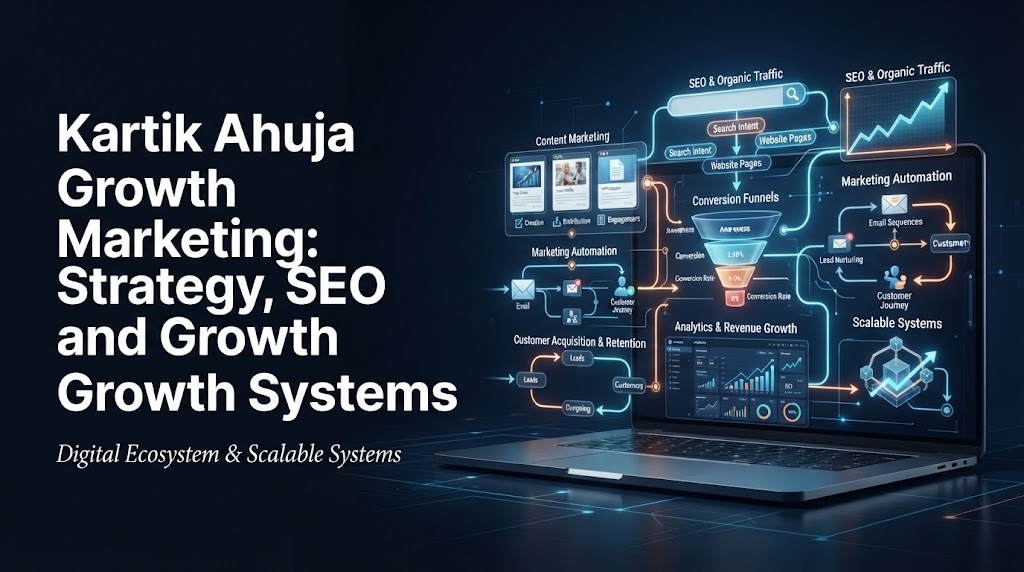
Kartik Ahuja growth marketing focuses on building repeatable systems that help internet businesses attract, convert, and retain customers over time. His approach brings SEO, content, automation, funnels, and owned digital assets into one connected growth model rather than treating each marketing channel as a separate task.
A key part of this approach is creating assets that a business can control and continue using as it grows. SEO content can attract people with strong search intent, while funnels and conversion paths can turn that attention into leads and customers. Email systems, automation, and customer retention processes can then support the next stages of the journey.
This approach puts attention on how each part of marketing works with the others. Instead of focusing only on traffic or short campaign results, the goal is to build a system that can repeatedly support customer acquisition and revenue growth.
In this guide, we will look at Kartik Ahuja’s background, his growth marketing principles, his SEO approach, the role of automation and funnels, and practical ways businesses can apply these ideas.
Who Is Kartik Ahuja?
Kartik Ahuja is a growth marketing expert, business operator, and investor known for his work around SEO, content, digital media, automation, and online business growth. His public profile presents him as someone focused on building and scaling internet businesses through systems that can support customer acquisition over time.
Kartik Ahuja’s Background in Growth Marketing
Ahuja describes himself as an operator and investor with more than 12 years of experience across marketing operations, media properties, and internet ventures. His work connects marketing strategy with the wider needs of an online business, including traffic generation, conversion, customer retention, and revenue growth.
His approach to growth marketing focuses on creating repeatable processes instead of depending entirely on short campaigns. SEO content, digital assets, funnels, and automation can work together to create a more consistent path from search traffic to customers.
What Is GrowthScribe?
GrowthScribe is closely connected to Kartik Ahuja’s professional profile. He is identified as its Founder and CEO, placing the company within his broader work in digital marketing and business growth.
The agency model also fits his wider marketing philosophy. Businesses can use strategy, content, SEO, conversion systems, and automation to build acquisition processes that support ongoing growth.
His Operator Led Approach
Ahuja’s public work places practical business experience at the center of his marketing strategy. Ideas can be tested across real businesses, refined through performance data, and turned into documented systems.
This operator mindset connects marketing decisions with actual business outcomes. Rather than looking at traffic or campaign activity alone, the focus extends to leads, conversions, retention, and revenue. That makes Kartik Ahuja’s growth marketing approach closely tied to how an online business operates as a whole.
What Does Kartik Ahuja Growth Marketing Mean?
Kartik Ahuja growth marketing strategy centers on building connected marketing systems that can bring customers to a business and support them throughout their journey. The approach gives attention to assets a business owns, such as websites, SEO content, email lists, funnels, and customer data.
SEO led content is a major part of this model. Instead of creating content only to attract visitors, the focus is on reaching people who have a clear need or buying interest. Useful content can then guide those visitors toward relevant pages, offers, and conversion points.
The wider model can be understood through this simple path:
Traffic → Trust → Leads → Conversion → Retention → Scale
Traffic brings relevant people to the business through search and other channels. Trust grows when visitors find useful content, clear information, and credible offers. Leads are created when interested visitors take an action, such as joining an email list or requesting more information.
Conversion turns qualified leads into customers through clear offers and focused customer journeys. Retention keeps customers engaged through useful communication, strong products, and follow up systems. Scale comes when these processes can support more customers without requiring the same increase in manual effort.
Automation can support many repeatable tasks across this journey. Together, SEO, content, funnels, automation, conversion, and retention form growth marketing systems designed for sustainable customer acquisition and long term organic growth.
Core Principles of Kartik Ahuja’s Growth Marketing Strategy
Kartik Ahuja’s growth marketing strategy is built around creating marketing assets and systems that can support a business beyond a single campaign. The focus is on ownership, repeatable customer acquisition, connected channels, and automation. Together, these ideas create a structure where marketing activity can continue supporting the business as it grows.
Build Owned Marketing Assets
A key idea is to build assets that the business controls. These can include websites, content libraries, email lists, funnels, customer data, and documented workflows. Unlike a temporary campaign, these assets can remain useful after the initial work is complete.
A strong website can attract search traffic, while a growing content library can target different customer needs. Email lists provide a direct communication channel, while customer data can help businesses understand behavior and improve their offers. Documented workflows also make recurring tasks easier to manage.
Focus on Long Term Acquisition
Short campaigns can produce quick results, but their value may end when the campaign stops. A repeatable acquisition system works differently. SEO traffic, useful content, email sequences, and media properties can continue attracting and engaging people after the original work has been completed.
This gives businesses a way to build marketing assets that can keep contributing to customer acquisition. The focus moves from gaining attention for a brief period to creating resources that remain useful over time.
Connect Marketing Channels Into One System
SEO, content, email, funnels, conversion optimization, and retention can work together as parts of one customer journey. SEO can bring a visitor to useful content. That content can guide the visitor toward an email signup, product page, or offer. Email can then support follow up and retention.
This connected approach makes each channel more useful because one stage can support the next. Marketing becomes a complete customer journey rather than a collection of separate activities.
Use Automation for Repeatable Work
Automation can handle recurring tasks such as lead qualification, email follow ups, customer onboarding, reporting, lead scoring, and CRM workflows. Once a process has been tested and documented, automation can reduce the amount of manual work required to keep it running.
People still handle areas that require judgment, creativity, positioning, and strategic decisions. Automation supports those efforts by taking care of routine processes. This combination can help a business run more consistent marketing workflows while its team focuses on higher value work.
How Kartik Ahuja Uses SEO for Growth
SEO is a central part of Kartik Ahuja’s growth marketing strategy. The approach focuses on attracting visitors through search terms connected to real customer needs, especially searches made by people who are already comparing solutions or looking for a product.
Bottom of Funnel SEO
Bottom of funnel SEO focuses on people who are closer to making a purchase. Instead of creating content only around broad informational topics, the strategy targets searches that show a clear interest in a product, service, or solution.
Examples include product comparisons, competitor comparisons, alternative pages, product use cases, feature searches, and integration searches. A software company, for example, could create pages explaining how its product compares with another platform or how it works for a specific business need.
This type of content can connect search traffic with commercial pages while giving readers useful information at the point when they are evaluating their options.
Target High Intent Keywords
Search volume is not the only measure of a keyword’s business value. A keyword with fewer monthly searches can bring stronger opportunities when the people searching for it have a clear reason to buy.
Useful keyword patterns include:
[product] vs [competitor]
best [tool] for [use case]
[competitor] alternative
[software] for [audience]
These searches often reveal what the visitor wants to compare, solve, or purchase. For this reason, a focused SEO strategy can target specific phrases rather than relying only on broad keywords with large search volumes.
Connect SEO Content With Revenue Pages
SEO content becomes more useful when visitors have a clear next step. Relevant articles can link to pricing pages, feature pages, product pages, demo pages, trial pages, and consultation pages.
For example, an article about choosing software for a specific use case can guide readers toward a related feature page or product page. A comparison article can lead readers to pricing or a free trial.
This creates a direct path from organic search to business action. The goal is not simply to attract visitors, but to help the right visitors move from search to trust, evaluation, and conversion.
The Growth Engine Behind His Marketing Approach
Kartik Ahuja’s growth marketing approach can be viewed as a connected growth engine where each stage supports the next. The framework moves beyond attracting visitors and looks at what happens after someone discovers a business. Acquisition, activation, retention, revenue, and referral can work together to create a more complete customer journey.
Acquisition
Acquisition is about bringing the right people to a business. SEO and useful content can attract visitors through relevant search terms, while search intent helps identify what those visitors are looking for. Community distribution can extend the reach of useful content, giving businesses additional ways to attract organic traffic.
The goal is to bring people who have a genuine interest in the product, service, or problem being addressed.
Activation
Once someone arrives, the next step is helping them understand the value of the product or service. Clear onboarding can guide new users through the first steps, while a simple user journey can reduce confusion.
Early product value matters because users need a reason to continue. Removing unnecessary steps after signup can also make the first experience easier and more useful.
Retention
Retention focuses on keeping customers engaged after their first interaction or purchase. Email automation can support timely communication, while product engagement helps users continue getting value from what they have chosen.
Regular customer communication can answer questions, introduce useful features, and keep the relationship active. The central idea is to give customers reasons to stay.
Revenue
Revenue connects marketing activity with business results. Conversion optimization can improve how visitors and leads move toward an offer. Clear pricing, relevant offers, upsells, and well structured funnels can create more opportunities from existing demand.
Tracking funnel performance also helps businesses see where visitors become leads, where leads become customers, and where people leave the journey.
Referral
Satisfied customers can become another source of growth through sharing, word of mouth, referral programs, and customer advocacy. A positive experience can encourage people to recommend a product to colleagues, friends, or other businesses.
When referral activity connects with acquisition, the growth engine can become more efficient because existing customers help introduce new people to the business.
Kartik Ahuja Growth Marketing vs Traditional Digital Marketing
Traditional digital marketing often centers on individual campaigns, traffic targets, and engagement metrics. The Kartik Ahuja marketing approach takes a broader view by connecting SEO, content, conversion, automation, and customer journeys into a growth marketing strategy.
| Area | Traditional Approach | Kartik Ahuja Style |
|---|---|---|
| Main focus | Campaign performance | Business growth systems |
| SEO | General traffic | Search intent and revenue |
| Content | Regular publishing | Revenue focused content |
| Website | Online presence | Conversion asset |
| Data | Reporting | Testing and optimization |
| Automation | Task support | Repeatable workflows |
| Growth | Campaign based | System based |
| Goal | Traffic and engagement | Leads, customers and revenue |
The biggest difference is how marketing activity is connected to business outcomes. Traditional campaigns may measure traffic, clicks, impressions, or engagement as key results. A system based approach looks at how those activities contribute to leads, customers, revenue, and retention.
SEO is another clear difference. Rather than focusing only on attracting visitors, the Kartik Ahuja approach gives attention to search intent and the commercial value behind specific searches. Content can then connect with product pages, offers, and conversion paths.
Websites also have a wider role. Instead of serving mainly as an online presence, a website can function as a conversion asset that attracts visitors, builds trust, captures leads, and supports sales.
Automation further strengthens this model by turning tested processes into repeatable workflows. Together, these elements create scalable marketing systems where different parts of marketing support the same growth goals.
The result is a marketing model that treats campaigns as part of a larger system rather than as isolated activities.
How to Apply Kartik Ahuja’s Growth Marketing Strategy
Kartik Ahuja’s growth marketing strategy can be turned into a practical process by connecting search demand, content, conversion paths, customer data, and automation. The aim is to build a system where each marketing asset has a clear purpose and supports the next stage of the customer journey.
Map Your Product to Search Intent
Start by mapping your product to the problems customers are trying to solve. Create a list of key features, use cases, integrations, pricing questions, customer problems, and desired outcomes.
Next, connect each area with relevant search terms. For example, a software company could target searches related to a specific feature, a product integration, or a solution for a particular business problem. This gives the SEO strategy a clear connection to real customer needs.
Create Bottom of Funnel Content
Build content for people who are already evaluating products or looking for a solution. Useful formats include:
- Comparison pages
- Alternative pages
- Use case articles
- Product guides
- Integration pages
- Buying guides
These pages can target searches with stronger commercial intent. They also give potential customers information they need while comparing options and deciding what to do next.
Build Conversion Paths
Every content asset should give readers a logical next action. The right action depends on the topic, customer stage, and type of business.
Possible next steps include:
- Free trial
- Demo
- Consultation
- Newsletter signup
- Product page
- Lead magnet
For example, a buying guide could link to a product page, while an educational article could invite readers to join a newsletter. The goal is to make the path from search to action clear without forcing the reader into an unrelated offer.
Collect First Party Customer Data
First party data can help businesses understand how people interact with their marketing and products. Useful information can include email addresses, signups, product behavior, customer segments, and purchase activity.
This information can support better email and CRM campaigns. A business can send different messages to new leads, active users, trial users, and existing customers instead of sending the same message to everyone.
Automate Proven Workflows
Automation works best when a process has already been tested and shown to work. Common examples include welcome emails, trial reminders, lead scoring, follow ups, reporting, and customer onboarding.
Once these workflows are documented, automation can handle recurring steps with less manual effort. Teams can then spend more time improving offers, content, customer journeys, and other areas that require human judgment.
Applied consistently, this approach turns individual marketing activities into a connected growth system. SEO brings relevant visitors, content builds trust, conversion paths create action, customer data supports communication, and automation keeps proven processes running.
Who Can Benefit From This Growth Marketing Approach?
Kartik Ahuja’s growth marketing approach can work across different types of online businesses. Its focus on SEO, content, customer journeys, automation, and owned marketing assets makes it useful for teams that want repeatable ways to attract and convert customers.
SaaS Companies
SaaS companies can use feature based SEO to reach people searching for specific solutions. Comparison searches, alternative pages, and use case content can attract potential buyers who are already evaluating software.
Product led acquisition can then connect this traffic with trials, demos, and product experiences. Retention systems can support customers after signup and encourage continued product use.
Startups and Small Teams
Startups and small teams often have limited time and resources. Building repeatable marketing systems can reduce dependence on constant manual work.
SEO content, automated emails, documented workflows, and conversion paths can keep useful processes running without requiring a team member to manage every step manually.
B2B Companies
B2B companies can benefit from high intent search strategies that target specific business problems and buying needs. Content can support lead generation by answering questions that potential customers ask before making a purchase.
CRM workflows can then help manage leads, follow ups, and customer communication after someone enters the sales process.
Agencies and Marketers
Agencies and marketers can use this framework to look beyond isolated campaign metrics. Instead of measuring only clicks or traffic, they can connect marketing activity with leads, customers, conversions, and revenue.
This creates a clearer view of how individual channels contribute to wider business results.
Personal Brands and Creators
Personal brands and creators can use SEO to build steady organic traffic and create content libraries that remain useful over time. Owned audiences, such as email lists, provide a direct way to communicate with followers.
Regular content can also build authority within a specific topic. Combined with useful resources and consistent communication, these assets can turn audience attention into a more durable growth channel.
Common Misconceptions About Growth Marketing
Growth marketing is often reduced to traffic, content, or automation. In practice, the approach is broader because it connects acquisition with conversion, retention, and revenue.
More Traffic Always Means More Sales
More visitors do not automatically produce more customers. Traffic quality and search intent matter because someone looking for a general topic may have very different needs from someone comparing products.
Conversion paths also affect results. Visitors need clear next steps, relevant offers, and useful information that helps them move toward a purchase. Retention matters too because acquiring a customer is only one part of the growth process.
SEO Means Publishing as Much Content as Possible
Publishing large amounts of content does not guarantee strong SEO results. Content should have a clear purpose and match what people are actually searching for.
Relevant, commercially useful pages can be more valuable than publishing articles simply to increase the size of a website. Comparison pages, product guides, use case content, and solution focused pages can target searches that have a stronger connection to business needs.
Automation Replaces Human Strategy
Automation can handle repeatable execution, but it does not replace strategic thinking. Automated workflows can send emails, organize leads, trigger reminders, collect reports, and support onboarding.
Decisions about positioning, audience, content direction, offers, customer experience, and business goals still require human judgment. The role of automation is to support tested processes rather than decide the entire marketing strategy.
Growth Marketing Only Works for Large Companies
Growth marketing does not require a large team or a large budget. Startups and small businesses can begin with focused SEO, useful content, simple conversion paths, and a few well chosen automated workflows.
A small team can start with one customer segment, a focused group of search terms, and a clear funnel. As these systems produce useful results, the business can expand them gradually. This makes growth marketing practical for companies at different stages, not just established businesses with large marketing teams.
Key Lessons From Kartik Ahuja’s Growth Marketing Approach
Kartik Ahuja’s growth marketing approach centers on building marketing systems that connect customer acquisition with wider business goals. The strongest lessons from this model can be summarized in a few practical ideas.
- Build assets you control. Websites, SEO content, email lists, customer data, and documented workflows can continue supporting a business over time.
- Connect SEO with business intent. Search traffic becomes more useful when content targets people looking for solutions, products, comparisons, or specific use cases.
- Focus on customer journeys rather than isolated channels. SEO, content, email, funnels, conversion, and retention should work together instead of operating as separate marketing activities.
- Build repeatable acquisition systems. A reliable process can help a business attract customers consistently without depending entirely on one campaign.
- Use automation for routine processes. Tasks such as emails, follow ups, reporting, lead scoring, and onboarding can be handled through tested workflows.
- Track conversions and revenue, not traffic alone. Traffic can show whether people are arriving, but conversions and revenue show how marketing contributes to business results.
- Build systems that can continue working as the business grows. The wider goal is to create marketing processes and assets that remain useful as customer demand and business activity increase.
Together, these lessons present growth marketing as a connected system rather than a collection of individual tactics. The focus stays on useful assets, relevant customers, clear journeys, repeatable processes, and measurable business outcomes.
Final Takeaway
Kartik Ahuja’s growth marketing approach centers on building systems that can support customer acquisition beyond individual campaigns. SEO, useful content, conversion paths, automation, and retention work together to create a connected customer journey.
The key idea is simple: build marketing assets that a business can control, connect them with real customer intent, and create repeatable processes around them. Instead of measuring success through traffic alone, the approach gives attention to leads, customers, conversions, and revenue.
For SaaS companies, startups, B2B businesses, agencies, and personal brands, these principles can provide a practical structure for building sustainable marketing systems. The process can start small with focused SEO, useful content, clear conversion paths, and a few automated workflows.
As those systems become more refined, they can support a larger customer base while reducing reliance on constant manual marketing work. That is the central lesson behind Kartik Ahuja growth marketing: build useful assets, connect every stage of the customer journey, and create systems that can keep working as the business grows.
FAQs About Kartik Ahuja Growth Marketing
Who is Kartik Ahuja in growth marketing?
Kartik Ahuja is presented as a growth marketing expert, operator, and investor with a focus on internet businesses. His work connects SEO, content, automation, marketing systems, and customer acquisition. He is also identified as the Founder and CEO of GrowthScribe.
What is Kartik Ahuja’s growth marketing strategy?
His growth marketing strategy focuses on building owned assets and repeatable acquisition systems. SEO led content, conversion paths, automation, customer retention, and digital assets work together to support customer acquisition and business growth.
What is GrowthScribe?
GrowthScribe is connected to Kartik Ahuja’s professional work, with Ahuja identified as its Founder and CEO. It sits within his broader work around marketing, SEO, content, business growth, and repeatable systems.
How does Kartik Ahuja approach SEO?
His publicly described SEO approach gives attention to bottom of funnel content and high intent searches. Examples include comparison pages, alternative pages, use case content, and other pages connected to commercial needs. The focus is on SEO that can support customer acquisition and revenue rather than traffic alone.
What is bottom of funnel SEO?
Bottom of funnel SEO targets people who are closer to making a buying decision. These searches may include product comparisons, alternatives, pricing questions, or specific solution searches. Because the visitor already has a defined need, this type of content can connect more directly with conversion paths.
How does automation fit into growth marketing?
Automation can handle recurring marketing and customer processes such as welcome emails, follow ups, lead scoring, reporting, trial reminders, and onboarding. This allows tested workflows to run with less manual effort while people continue to manage strategy and business decisions.
Can startups use this growth marketing approach?
Yes. Startups can begin with focused search intent research, useful content, simple funnels, and a small number of automated workflows. They do not need to build a large system from the start. A focused process can be expanded as the business gains more customers and data.
Is Kartik Ahuja’s approach focused only on SEO?
No. SEO is a major part of the publicly described approach, but the wider framework also includes content, funnels, automation, conversion, retention, and customer acquisition. SEO can bring relevant visitors into the system, while the other parts help move those visitors toward business outcomes.
Read More: TechTrendery.com USA