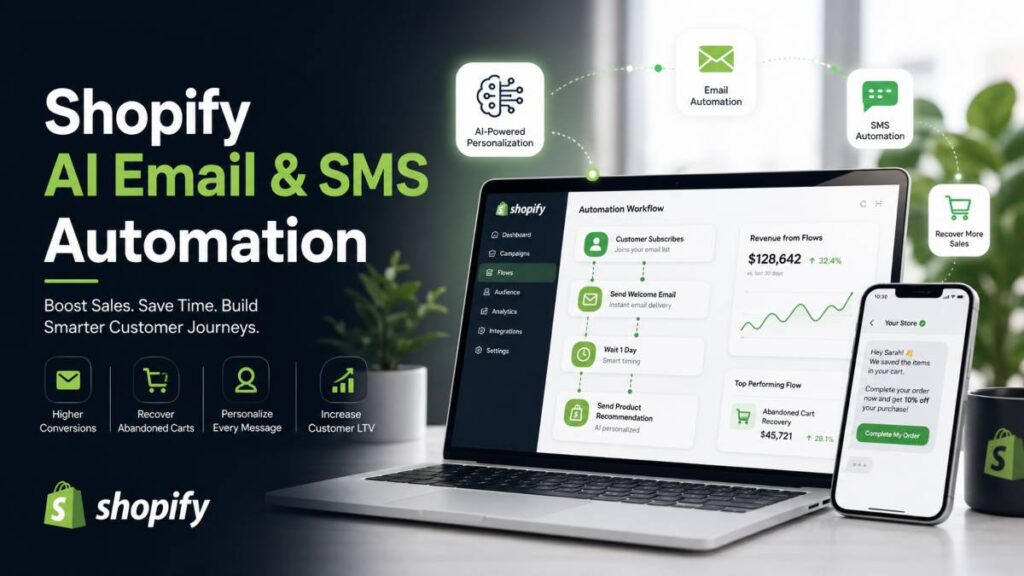
AI automation for Shopify SMS and email marketing is changing how ecommerce brands connect with customers. Instead of sending the same campaign to every subscriber, stores can now deliver personalized messages based on shopping behavior, browsing activity, purchase history, and customer intent.
Imagine a skincare brand running on Shopify. A customer adds a moisturizer to their cart but leaves before checking out. Within an hour, an automated email reminds them about the product. The next day, an SMS offers free shipping. A week later, the customer receives personalized recommendations based on similar purchases from other buyers.
That entire sequence can run automatically.
This is why AI powered ecommerce marketing has become such a major growth channel for Shopify stores. Automated email and SMS flows help brands recover abandoned carts, increase repeat purchases, and improve customer retention without requiring constant manual work.
AI also improves timing and personalization. Messages can be sent when subscribers are most likely to open them, while product recommendations adapt to customer behavior in real time.
For many ecommerce businesses, these automations now generate a large share of total revenue quietly in the background. Instead of relying only on paid ads, brands build stronger long term customer relationships through smarter communication and automated lifecycle marketing.
What AI Automation Means for Shopify Stores
Shopify marketing automation helps ecommerce brands send smarter email and SMS campaigns without handling every message manually. Instead of relying on fixed schedules and generic broadcasts, AI ecommerce marketing systems respond to customer behavior in real time.
The difference between traditional marketing and AI assisted automation is speed, personalization, and consistency.
Before automation, a marketing team might send one campaign to an entire email list and hope it performs well. With AI automation, customers receive messages based on what they viewed, purchased, ignored, or added to cart.
That creates a much more personalized shopping experience. You can also improve product launch strategy by using Shopify pre order apps to capture demand early and automate notifications before items officially go live.
How AI Automation Works
AI automation runs through triggers, customer segmentation, and predictive timing.
A trigger starts the workflow. For example:
- A customer abandons a cart
- A subscriber joins an email list
- Someone views a product repeatedly
- A customer stops purchasing for several months
Once the trigger activates, AI systems decide which message should be sent and when it should arrive.
Segmentation helps organize customers into groups based on behavior, purchase history, spending habits, or engagement levels. Instead of sending identical campaigns to everyone, stores can target specific audiences with more relevant offers.
Predictive timing improves delivery schedules even further. AI analyzes when individual subscribers are most likely to open emails or respond to SMS messages, then sends campaigns during those windows automatically.
What AI Can Actually Improve
AI tools work best when handling repetitive marketing tasks and data heavy decisions.
Some of the most useful improvements include:
- Product recommendations based on browsing and purchase behavior
- Smart Send Time optimization
- Automated subject line testing
- Dynamic A/B testing
- Personalized product blocks inside emails
For example, a customer who recently purchased running shoes may automatically receive recommendations for socks, performance apparel, or hydration products instead of random storewide promotions.
This kind of personalization often increases click rates and repeat purchases significantly.
What Still Needs Human Input
AI can improve efficiency, but it still cannot replace strong creative direction or brand understanding completely.
Human input still matters for:
- Brand voice
- Storytelling
- Campaign concepts
- Product positioning
- Emotional messaging
- Long term strategy
AI generated copy can also sound generic without editing.
The strongest Shopify stores usually combine automation with human creativity. AI handles timing, segmentation, and optimization while marketers focus on building campaigns that actually feel memorable and connected to the brand.
Why AI Email and SMS Automation Matters
For many Shopify brands, email and SMS marketing are no longer just support channels. They have become major revenue drivers. Strong ecommerce email automation systems help stores communicate with customers consistently while reducing the amount of manual work required from marketing teams.
Instead of sending occasional campaigns and hoping customers return, brands can build automated customer journeys that run continuously in the background.
This is why Shopify SMS automation has become such an important part of modern ecommerce growth strategies.
Many stores now generate between 20 and 40 percent of total revenue through automated email and SMS flows alone.
Increase Customer Retention
Customer retention improves when communication feels timely and relevant.
AI automation helps stores stay connected with shoppers after the first purchase through:
- Welcome sequences
- Product education emails
- Reorder reminders
- Review requests
- Loyalty offers
- Personalized recommendations
For example, a supplement brand can automatically remind customers to reorder products before they run out. A fashion store can send personalized product suggestions based on previous purchases.
These automated touchpoints keep customers engaged without requiring constant manual campaign creation.
Repeat purchase rates also improve when brands maintain regular communication instead of disappearing after checkout.
Recover Lost Revenue
One of the biggest advantages of automation is abandoned cart recovery.
Many shoppers leave products in their cart without completing checkout. Without follow up campaigns, those sales often disappear permanently.
Automated abandoned cart flows help recover part of that lost revenue through reminder emails and SMS messages sent shortly after the customer leaves the site.
A typical sequence may include:
- An email reminder after one hour
- A second message with reviews or FAQs
- A final incentive such as free shipping or a discount
Some stores recover 10 to 30 percent of abandoned sales using these flows alone.
For larger ecommerce businesses, that can translate into tens or even hundreds of thousands in recovered revenue annually.
Improve Customer Lifetime Value
AI automation also improves customer lifetime value by increasing repeat purchases and cross selling opportunities.
Instead of promoting random products, AI systems recommend items based on:
- Browsing behavior
- Purchase history
- Similar customer activity
- Replenishment timing
A customer who buys skincare products may later receive automated recommendations for complementary items such as serums or cleansers.
This creates more personalized shopping experiences while increasing average customer value over time.
Save Time With Automated Flows
Manual campaign management becomes difficult as ecommerce stores scale.
Automation reduces repetitive tasks by handling:
- Email scheduling
- SMS triggers
- Customer segmentation
- Product recommendations
- Send time optimization
- A/B testing
This allows smaller marketing teams to manage sophisticated customer communication without sending every message manually.
Instead of building campaigns from scratch every day, brands can focus more on strategy, creative direction, and customer experience while automation handles routine execution in the background.
Best AI Powered Tools for Shopify Email and SMS Marketing
Choosing the right AI email marketing Shopify platform depends on how your store sells, how large your customer list has become, and how heavily you rely on SMS campaigns.
Some brands need advanced predictive segmentation and detailed automation workflows. Others simply want affordable email and SMS automation that works without a steep learning curve.
The good news is that Shopify merchants now have several strong options that support automated campaigns, customer segmentation, personalized recommendations, and AI assisted optimization.
Below are the most widely used Shopify SMS marketing tools for ecommerce brands in 2026.
| Tool | Best For | AI Features | SMS Included | Starting Price |
|---|---|---|---|---|
| Klaviyo | Scaling Shopify brands | Predictive CLV, Smart Send Time, AI recommendations | Yes | $20/month |
| Omnisend | Small and mid sized stores | Send time optimization, automation templates | Yes | $16/month |
| Postscript | SMS focused brands | AI SMS testing, conversational flows | SMS only | Pay per message |
| Shopify Email | Beginners | Basic automations and templates | No | Free up to 10,000 emails |
Klaviyo
Klaviyo remains one of the strongest platforms for advanced Shopify automation.
It works especially well for brands generating steady ecommerce revenue and managing large customer databases. Fashion, beauty, skincare, supplement, and lifestyle stores commonly use Klaviyo because of its deep Shopify integration and sophisticated automation features.
Best for
- Scaling Shopify stores
- Brands with strong repeat purchase cycles
- Ecommerce businesses focused on retention
AI Features
- Predictive customer lifetime value scoring
- Churn risk analysis
- Smart Send Time optimization
- AI product recommendations
- Advanced segmentation
Pricing Snapshot
- Free for small lists
- Paid plans start around $20 monthly
- Costs increase with subscriber growth
Pros
- Powerful automation builder
- Strong customer data integration
- Advanced segmentation flexibility
- Excellent abandoned cart workflows
Limitations
- Pricing increases quickly at scale
- Requires setup time for advanced flows
- AI copy suggestions still need editing
For example, a supplement store using Klaviyo can automatically trigger replenishment reminders based on estimated product usage timing. That creates more repeat purchases without manual campaign work.
Omnisend
Omnisend is popular with smaller Shopify brands looking for email and SMS automation at a lower price point.
The platform combines email, SMS, and push notifications into one system, which simplifies campaign management for growing ecommerce teams.
Best for
- Small and mid sized Shopify stores
- Brands with limited marketing budgets
- Stores starting automation for the first time
AI Features
- Send time optimization
- Product recommendations
- Prebuilt automation templates
Pricing Snapshot
- Free plan available
- Paid plans start around $16 monthly
Pros
- Affordable pricing
- SMS included in plans
- Beginner friendly interface
- Fast setup process
Limitations
- Less advanced segmentation
- Fewer predictive AI capabilities
- Limited workflow flexibility compared to Klaviyo
A small apparel brand can launch welcome flows, abandoned cart emails, and SMS reminders quickly without needing a dedicated email marketing specialist.
Postscript
Postscript focuses heavily on SMS marketing for Shopify brands.
It works particularly well for stores where text messaging drives a large share of customer engagement and sales. Beauty, fashion, and consumable product brands often use SMS heavily because customers respond quickly to limited offers, restocks, and product drops.
Best for
- SMS first ecommerce brands
- Shopify stores with strong mobile engagement
- US and Canada focused businesses
AI Features
- AI SMS message testing
- Conversational SMS automation
- Tone optimization
Pricing Snapshot
- Free entry plan
- Usage based SMS pricing
- Advanced plans start around $100 monthly
Pros
- Strong SMS automation depth
- High engagement rates
- Fast promotional delivery
- Conversational customer flows
Limitations
- Limited email capabilities
- SMS costs rise with volume
- Less useful for email focused brands
For example, a beauty brand launching a limited product drop can use Postscript to send automated SMS alerts the moment inventory becomes available.
Shopify Email
Shopify Email is the simplest entry level option because it is built directly into Shopify.
It works best for smaller stores that need basic email marketing without adding external software immediately.
Best for
- Beginner ecommerce brands
- Stores under $25k monthly revenue
- Basic email automation
AI Features
- Simple automation triggers
- Basic templates
- Product integration
Pricing Snapshot
- First 10,000 emails monthly are free
- Additional sends billed at low cost
Pros
- Native Shopify integration
- Easy setup
- Low barrier for beginners
- Minimal maintenance
Limitations
- No advanced AI segmentation
- No built in SMS system
- Limited automation depth
A newer Shopify store can use Shopify Email to launch welcome emails and promotional campaigns before graduating to more advanced automation platforms later.
The Highest Converting Shopify Automation Flows
Not all automations generate the same results. Some Shopify email flows produce far more revenue than standard promotional campaigns because they target customers at moments of high intent.
The strongest performing flows usually focus on customer behavior:
- Joining an email list
- Leaving products in a cart
- Browsing without purchasing
- Completing an order
- Becoming inactive over time
When AI personalization and timing are added into these workflows, conversion rates often improve even further.
Below are the highest converting Shopify automation flows most ecommerce brands should set up first.
Welcome Series Automation
The welcome series is usually the first automated flow a customer receives after subscribing.
These emails often generate extremely high open rates because subscribers are already interested in the brand.
Typical Trigger
- New email or SMS subscriber
- Popup signup
- Checkout opt in
Recommended Flow
- Immediate email delivering discount or offer
- Follow up email introducing the brand story
- Product focused email with best sellers and reviews
- SMS reminder or limited time incentive
AI Personalization Examples
- Product recommendations based on browsing behavior
- Smart Send Time optimization
- Segmentation by signup source
For example, a beauty brand may recommend skincare products differently depending on whether the subscriber originally viewed acne treatments, moisturizers, or anti aging products.
This flow helps build trust quickly while driving early conversions.
Abandoned Cart Recovery
Shopify abandoned cart automation remains one of the highest revenue generating ecommerce flows available.
Many customers leave products behind before completing checkout. Automated recovery campaigns help bring part of that lost revenue back.
Typical Trigger
- Cart abandoned for one hour
Recommended Flow
- Email reminder after one hour
- Follow up email after twenty four hours with reviews or FAQs
- Final reminder after seventy two hours with free shipping or discount
- SMS follow up for high intent shoppers
Revenue Impact
- Some stores recover 10 to 30 percent of abandoned sales
- Email recovery alone can generate strong return on investment
AI Personalization Examples
- Dynamic product recommendations
- Predictive discount suppression for likely buyers
- Personalized urgency messaging
A fashion store, for example, may avoid sending discounts to loyal customers who usually return and purchase without incentives.
Browse Abandonment Campaigns
Browse abandonment campaigns target visitors who viewed products but never added anything to cart.
These flows are often overlooked, yet they can generate strong conversion rates because customer interest already exists.
Typical Trigger
- Product page viewed without cart activity
- Usually sent within four hours
Recommended Flow
- Reminder email featuring viewed product
- Social proof or review quote
- Similar product recommendations
AI Personalization Examples
- Related product suggestions
- Category based recommendations
- Personalized browsing sequences
For example, a home decor brand may recommend matching furniture pieces based on the style category a customer viewed earlier.
These campaigns keep products visible while shoppers are still considering a purchase.
Post Purchase Automation
Many stores stop marketing after checkout. That leaves significant repeat revenue untapped.
Post purchase flows help brands increase customer retention and repeat buying behavior.
Typical Trigger
- Completed purchase
Recommended Flow
- Order confirmation email immediately
- Product education email after delivery
- Review request several days later
- Cross sell or replenishment recommendation
- Loyalty or VIP offer
Revenue Impact
- Repeat purchase rates often improve noticeably
- Strong cross sell opportunities increase average order value
AI Personalization Examples
- Product recommendations based on similar customer behavior
- Replenishment timing predictions
- Personalized usage tips
For example, a supplement brand may automatically recommend reordering protein powder thirty days after purchase based on expected usage patterns.
Win Back Campaigns
Win back flows target customers who have stopped purchasing for a specific period.
These automations help recover dormant customers before they disappear permanently.
Typical Trigger
- No purchases for ninety to one hundred eighty days
Recommended Flow
- Personalized check in email
- Product recommendations based on previous purchases
- Limited incentive or loyalty offer
- SMS reminder for high value customers
Revenue Impact
- Some brands recover 8 to 12 percent of inactive customers
AI Personalization Examples
- Churn prediction
- Customer lifetime value segmentation
- Personalized incentives based on buying history
For example, a pet supply store may send premium offers to high value repeat buyers while sending lighter re engagement campaigns to low activity customers.
The strongest automation systems combine timing, personalization, and behavioral targeting to keep customers connected to the brand long after the first visit.
How AI Improves Personalization and Segmentation
One of the biggest reasons AI ecommerce marketing performs so well is personalization. Customers respond better when messages feel relevant to their interests, shopping habits, and buying behavior. Generic campaigns sent to an entire email list rarely perform as strongly as targeted communication built around customer data.
This is where predictive customer segmentation changes the game for Shopify brands.
AI systems can analyze browsing activity, purchase history, engagement patterns, and product preferences automatically. Instead of marketers manually organizing customer groups, automation platforms create dynamic audiences that update continuously in real time.
The result is more personalized email marketing with less manual work.
Smart Send Time Optimization
Timing plays a major role in email and SMS performance.
AI powered Smart Send Time tools analyze when individual subscribers are most likely to open messages or click through campaigns. Instead of sending every email at the same hour, the system delivers campaigns at different times for different customers.
For example:
- A fashion shopper who usually browses late at night receives emails around evening hours
- A supplement customer who shops during work breaks may receive campaigns near lunchtime
- A home goods shopper who engages mostly on weekends receives promotional emails on Saturday mornings
These adjustments may seem small, but they often improve open rates and click rates noticeably over time.
Predictive CLV and Churn Scoring
Predictive customer lifetime value scoring helps brands estimate which customers are likely to spend more in the future.
AI systems also identify churn risk by detecting customers who may stop purchasing soon.
This allows ecommerce stores to create smarter retention campaigns.
For example:
- A beauty brand may send VIP offers to high value repeat buyers
- A supplement company may target inactive customers before they disappear completely
- A fashion retailer may reduce discounts for loyal shoppers who already purchase regularly
Instead of treating every subscriber equally, brands focus their strongest offers where they matter most.
AI Product Recommendations
AI product recommendations improve conversion rates by matching products to customer interests automatically.
Rather than showing generic best sellers, AI systems recommend items based on:
- Previous purchases
- Browsing behavior
- Similar customer activity
- Seasonal buying patterns
A home goods brand, for example, may recommend matching furniture or decor items after a customer purchases a sofa. A skincare brand may automatically suggest cleansers, serums, or moisturizers connected to earlier purchases.
This creates a more relevant shopping experience while increasing average order value naturally.
Dynamic Customer Segments
Traditional segmentation often relies on static customer lists that quickly become outdated.
AI powered segmentation updates automatically as customer behavior changes.
Customers can move between segments such as:
- New subscribers
- VIP customers
- High spenders
- At risk buyers
- Frequent browsers
- Inactive customers
For Shopify brands, this creates much more flexible marketing workflows.
Instead of manually rebuilding lists every week, automation systems continuously adjust audiences based on real customer activity. That keeps campaigns more relevant while improving retention, engagement, and repeat revenue over time.
Real ROI From Shopify AI Automation
The biggest reason ecommerce brands invest in automation is simple: revenue. Once the right systems are running, automated email and SMS campaigns can generate sales every day without requiring constant manual effort from the marketing team.
For many stores, ecommerce marketing ROI from automation becomes noticeable within the first few months. Instead of relying only on paid ads and one time campaigns, Shopify brands create automated customer journeys that continue producing revenue in the background.
Research from ecommerce automation platforms shows that automated email and SMS flows can generate between 20 and 40 percent of total store revenue for well optimized brands.
That makes automation one of the highest return marketing channels available to Shopify merchants.
Revenue Generated From Automated Flows
Some flows produce stronger returns because they target customers during moments of high buying intent.
Abandoned cart recovery campaigns are often the largest revenue driver. When a shopper leaves products behind before checkout, automated reminders help bring part of those sales back.
A typical abandoned cart sequence may include:
- Email reminder after one hour
- Follow up message with reviews or FAQs
- Final incentive such as free shipping
- SMS reminder for high intent shoppers
Many stores recover between 10 and 30 percent of abandoned sales using these workflows.
Welcome series automations also perform extremely well because new subscribers are already interested in the brand. Open rates often outperform standard promotional campaigns significantly.
Post purchase flows create another major revenue stream through:
- Cross sell recommendations
- Product education
- Reorder reminders
- Loyalty campaigns
These sequences improve repeat purchase rates while increasing average customer value over time.
Case Study Examples
Several ecommerce case studies highlight how strong Shopify automation results can become when flows are optimized properly.
One fashion brand reportedly grew from roughly $500,000 in annual revenue to nearly $950,000 after improving automated email and SMS workflows. Automated campaigns eventually generated around 30 percent of total revenue.
Beauty and skincare brands often perform especially well with SMS marketing because customers respond quickly to:
- Product launches
- Restock alerts
- Limited promotions
- Loyalty offers
Home goods brands benefit heavily from browse abandonment and post purchase automations because customers usually spend longer researching products before purchasing.
The strongest results typically come from combining:
- AI segmentation
- Personalized product recommendations
- Smart Send Time optimization
- Email automation
- SMS follow ups
ROI Breakdown for a Shopify Store
Automation software costs are usually small compared to the revenue generated.
For a Shopify store producing around $1 million annually, automation platforms may cost several thousand dollars per year depending on subscriber count and SMS volume.
However, automated flows can recover and generate substantial additional revenue through retention and conversion improvements.
| Automation Type | Revenue Impact | Typical ROI |
|---|---|---|
| Abandoned Cart Recovery | Recovers 10 to 30 percent of lost sales | Very high |
| Welcome Series | Strong early purchase conversions | High |
| Post Purchase Automation | Increases repeat customer revenue | High |
| Win Back Campaigns | Reactivates inactive buyers | Moderate to high |
| SMS Promotions | Fast response during launches and flash sales | High |
For many Shopify brands, the real advantage is consistency. Automated campaigns continue working every day, helping stores generate repeat revenue without building every campaign manually from scratch.
Best Practices for Shopify AI Email and SMS Automation
Automation works best when it feels helpful instead of overwhelming. Many Shopify stores install powerful AI tools but still struggle with weak engagement because their campaigns lack strategy, personalization, or proper maintenance.
Strong Shopify email marketing best practices focus on relevance, timing, list quality, and customer trust. The goal is not sending more messages. The goal is sending better messages at the right moments.
The same applies to AI SMS marketing tips. SMS can produce excellent conversion rates, but customers lose interest quickly if every text feels promotional or repetitive.
Use Smart Segmentation
Segmentation improves nearly every automation metric.
Instead of sending identical campaigns to every subscriber, divide audiences based on:
- Purchase history
- Product interests
- Browsing behavior
- Average order value
- Engagement activity
- Customer lifetime value
For example:
- VIP customers may receive early product access
- New subscribers may receive educational content
- Inactive buyers may receive win back campaigns
- Frequent shoppers may receive loyalty rewards
AI tools can update these segments automatically as customer behavior changes.
This keeps campaigns more personalized while improving open rates, click rates, and repeat purchases.
Keep SMS High Value
SMS marketing works best when messages feel urgent or useful.
Good SMS use cases include:
- Restock alerts
- Flash sales
- Shipping updates
- Limited inventory drops
- VIP launches
Poor SMS habits usually lead to unsubscribes quickly.
Avoid:
- Sending daily promotional texts
- Repeating email content through SMS
- Overusing discount messages
- Sending texts at inconvenient hours
Customers treat SMS as a more personal communication channel than email. That makes timing and message quality much more important.
Clean Your Email Lists
List quality matters more than list size.
Large inactive email lists can damage deliverability and reduce campaign performance over time. AI systems also perform better when subscriber data stays accurate and engaged.
Good list maintenance includes:
- Removing inactive subscribers regularly
- Using double opt in forms
- Monitoring bounce rates
- Reviewing spam complaints
- Suppressing unengaged contacts
Double opt in helps verify subscriber intent while improving overall email quality.
Review Automation Performance Regularly
Automation is not something you set once and ignore forever.
Customer behavior changes constantly, which means flows should be reviewed regularly.
Monitor:
- Open rates
- Click rates
- Conversion performance
- SMS opt out rates
- Revenue per flow
- Deliverability trends
A welcome series that worked six months ago may perform differently today.
Regular testing helps improve:
- Subject lines
- Timing
- Product recommendations
- Incentives
- SMS wording
Small adjustments often create meaningful revenue improvements over time.
Follow Compliance Rules
Compliance protects both customer trust and long term deliverability.
Every Shopify store running automation should properly configure:
- SPF
- DKIM
- DMARC
These authentication settings help email providers verify legitimate sending domains while reducing spam issues.
Brands should also follow:
- GDPR requirements for international subscribers
- TCPA rules for SMS consent
- CAN SPAM regulations for email communication
Always make unsubscribe options clear and easy to access.
Short term growth tactics that ignore compliance often create larger deliverability and reputation problems later.
Choosing the Right Shopify AI Marketing Stack
The best Shopify marketing stack depends on how your business sells, how large your audience has become, and which channels generate the most revenue. A small brand just starting with automation needs very different tools compared to a fast growing ecommerce store managing thousands of customers across multiple regions.
The goal is not building the biggest software setup possible. The goal is choosing ecommerce automation tools that support growth without creating unnecessary complexity or cost.
Below are practical stack recommendations based on different business situations.
Best Setup for Beginners
New Shopify stores usually need simple automation with low monthly costs and easy setup.
Recommended Stack
- Shopify Email
- Omnisend free plan
- Basic popup and signup forms
- Welcome email automation
- Abandoned cart recovery
Why This Works
Beginners often benefit more from simplicity than advanced segmentation. Omnisend combines email and SMS inside one platform, making it easier to manage customer communication without multiple tools.
This setup works well for stores with smaller lists and limited marketing resources.
Best Setup for Scaling Stores
As revenue and subscriber counts increase, brands usually need deeper segmentation, predictive analytics, and more advanced automation workflows.
Recommended Stack
- Klaviyo
- AI powered product recommendations
- Smart Send Time optimization
- Advanced customer segmentation
- Dedicated SMS campaigns
Why This Works
Scaling ecommerce stores need more behavioral data and automation flexibility. Klaviyo performs particularly well for brands focused on retention, repeat purchases, and customer lifetime value growth.
This setup is common among beauty, supplement, fashion, and lifestyle brands generating strong repeat revenue.
Best Setup for SMS First Brands
Some ecommerce categories perform especially well through SMS marketing.
Fashion launches, limited inventory drops, beauty promotions, and supplement reminders often generate fast response rates through text messaging.
Recommended Stack
- Postscript for SMS
- Klaviyo or Omnisend for email
- Automated SMS flows
- Conversational messaging
- VIP subscriber campaigns
Why This Works
Postscript focuses heavily on SMS optimization and conversational customer engagement. Combining it with a dedicated email platform creates stronger lifecycle marketing coverage.
This stack works best for brands with high mobile engagement and strong SMS opt in rates.
Best Setup for International Stores
International ecommerce brands need reliable deliverability, advanced segmentation, and scalable automation infrastructure.
Recommended Stack
- Klaviyo
- Regional segmentation workflows
- Localized email campaigns
- Country specific SMS timing
- Multi currency personalization
Why This Works
International stores often manage multiple customer behaviors, shopping habits, and time zones. Strong segmentation and predictive timing become much more valuable at scale.
This setup helps global brands maintain more personalized customer communication across different markets while keeping automation workflows centralized.
Common Mistakes to Avoid
AI automation can increase revenue and improve customer retention, but poor execution often creates the opposite result. Many Shopify brands install automation tools expecting instant growth, then damage engagement because their workflows feel repetitive, aggressive, or disconnected from the customer experience.
Most Shopify automation mistakes happen when businesses focus too heavily on automation itself instead of customer behavior and message quality.
Avoiding a few common AI marketing errors can improve results significantly.
Over Automating Every Message
Automation should support communication, not replace all human interaction.
Some brands create too many flows too quickly:
- Daily promotional emails
- Excessive browse reminders
- Multiple overlapping automations
- Constant discount messaging
This creates fatigue fast.
Customers stop paying attention when every action triggers another campaign. Instead of building stronger relationships, the brand begins feeling noisy and transactional.
A smaller number of well timed automations usually performs better than dozens of overlapping flows.
Sending Too Many SMS Campaigns
SMS marketing can generate excellent conversion rates, but it becomes annoying very quickly when overused.
Warning signs include:
- Rising unsubscribe rates
- Lower click rates
- Spam complaints
- Reduced engagement
SMS works best for:
- Product launches
- Flash sales
- Restock alerts
- Shipping updates
- VIP promotions
Customers generally tolerate fewer text messages than emails. Sending too many campaigns damages trust and weakens long term engagement.
Ignoring Deliverability Problems
Even strong campaigns fail if messages never reach the inbox.
Many ecommerce brands focus heavily on automation design while ignoring deliverability health completely.
Common issues include:
- Poor list hygiene
- Spam complaints
- Missing SPF, DKIM, or DMARC setup
- High bounce rates
- Purchased email lists
These problems reduce inbox placement and hurt campaign performance over time.
Regular list cleaning and domain authentication help maintain stronger deliverability and sender reputation.
Using Generic AI Copy Without Editing
AI generated copy can save time, but raw output often sounds repetitive or emotionally flat.
Customers notice when messages feel generic.
Weak AI copy usually includes:
- Robotic phrasing
- Overused marketing language
- Generic urgency
- Repetitive product descriptions
Strong ecommerce brands still apply human editing and brand personality before campaigns go live.
AI works best as a support tool for drafting, testing, and optimization while human marketers shape the final voice and customer experience.
Final Thoughts
AI automation is changing how Shopify brands build customer relationships. Instead of relying only on manual campaigns and constant promotional blasts, ecommerce stores can now create smarter email and SMS systems that respond to customer behavior automatically.
The biggest advantage is consistency.
Automated flows continue working every day through:
- Abandoned cart recovery
- Welcome sequences
- Product recommendations
- Win back campaigns
- Post purchase follow ups
These systems help stores recover lost revenue, improve retention, and increase repeat purchases without expanding marketing workload dramatically.
But strong results usually come from simple execution first.
Many successful ecommerce brands start with only a few core automations:
- Welcome emails
- Abandoned cart recovery
- Post purchase flows
- Basic customer segmentation
From there, testing and optimization create long term growth.
Small improvements in timing, messaging, personalization, and segmentation often produce major revenue gains over time.
A practical next step is simple:
- Audit your current Shopify flows
- Test one abandoned cart automation this week
- Review your segmentation strategy
- Compare AI marketing tools before scaling your stack
The brands seeing the strongest automation results are not necessarily using the most software. They are using the right automation at the right moments for the right customers.
Read more: https://rankvisely.com/what-is-ai-powered-search-a-beginners-guide-to-how-it-works/