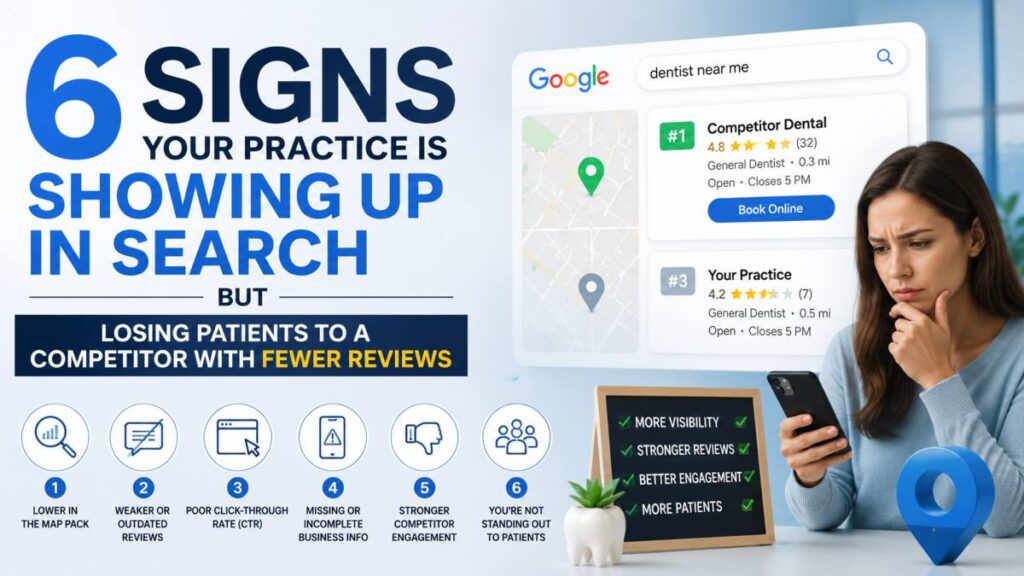
Your name appears in search results. Patients type exactly what you treat and your listing shows up. Yet the competitor two blocks away, with half your review count, keeps filling their schedule. The problem is not your rankings. It is what patients see after they find you.
TL;DR: Ranking in local search is only the beginning of the patient decision. If a competitor with fewer reviews keeps winning the appointment, your practice has a trust gap, not a visibility problem. These six signs identify exactly where that gap lives.
Your Review Volume Has Gone Stale
Review recency is a trust signal that patients and Google both read closely. A practice with 300 reviews, the most recent posted 14 months ago, looks far less active than a competitor who collected 20 reviews over the past two months. Patients check dates. A patient engagement platform that automatically prompts satisfied patients after each appointment makes steady review collection routine rather than sporadic. Stale volume gives the impression that your practice is either struggling to attract patients or too disengaged to care about feedback.
Your Competitor Responds to Reviews and You Stay Silent
According to the RepuGen 2025 Patient Review Survey, 59% of patients are more likely to choose a provider who responds to both positive and negative reviews. When patients see a competitor reply to every review, including the difficult ones, they read that practice as attentive and trustworthy. Your silence says the opposite. A response does not need to be long. A genuine reply in one or two sentences does more for your conversion rate than any amount of advertising.
Your Star Rating Sits Below 4.5
Three stars used to mean acceptable. Today it functions as a disqualifier. Most patients apply a quiet filter around 4.5 stars when comparing providers, so a competitor who maintains that threshold with fewer total reviews still wins the appointment. The math is clear: 30 reviews at 4.8 outperforms 120 reviews at 4.1 in the minds of prospective patients. Building a stronger rating requires making sure satisfied patients have a fast, easy path to share their experience before the feeling fades.
Your Google Business Profile Has Gaps
An incomplete Google Business Profile creates friction at the exact moment a patient decides. Missing hours, an outdated phone number, no photos, and a blank services section all raise quiet doubts about whether your practice is still open and worth the effort. Your competitor may have fewer reviews, but if their profile answers every practical question at a glance, they lower the barrier to booking. Patients pick the path of least resistance. A complete, detailed profile removes the reasons to look elsewhere.
Your Practice Does Not Appear in AI Recommendations
Search behavior has shifted beyond Google results pages. A 2025 survey found that 26% of patients reported AI tools had directly influenced their choice of healthcare provider. ChatGPT, Perplexity, and Google AI Overviews pull from review content, healthcare directories, and your overall online presence when generating recommendations. Practices with consistent recent reviews and detailed, accurate profiles appear in those results. A competitor with fewer reviews may still surface in AI answers if their reviews include specific clinical language and their listings stay current across platforms. Tracking which prompts surface your listing and which competitors get cited alongside it has become a practical step for practices that want to protect appointment volume, and a focused Arobis AI Visibility Checker offers a quick read on where the gap actually sits.
Your Listing Gets Views but Not Calls
Google Business Profile Insights shows how many people see your listing versus how many actually call or request directions. A high view count paired with low action rates almost always signals a reputation issue. Patients compare two listings side by side and make a judgment in seconds. If your photos look dated, your reviews skew older, and your response history is sparse, patients scroll past and call your competitor instead. Visibility drew them in. What they saw made them leave.
What Fills Schedules After Rankings
Search rankings confirm patients can find you. Everything they encounter after that point decides whether they trust you enough to book. The practices that grow consistently in competitive markets are not always the ones that outrank everyone. They are the ones that treat their online reputation as an active part of patient care, not a task to set up once and forget.
FAQs
Can a competitor with fewer reviews actually outrank my practice in Google?
Yes. Google’s local ranking algorithm weighs review recency, response rate, and profile completeness alongside total review count. A competitor who actively manages their profile can outperform a practice with more reviews but lower engagement.
How many reviews does a practice need to be competitive?
There is no fixed number. Practices that generate a steady stream of new reviews, even just a few each month, consistently outperform those with large but stagnant counts. Recency carries as much weight as volume in local search.
What is the fastest way to close the gap with a competitor?
Audit your Google Business Profile for missing information first, then set up a review request process that triggers automatically after each appointment. Responding to all existing reviews is a step most practices skip, and it pays off quickly in both trust signals and conversion rate.