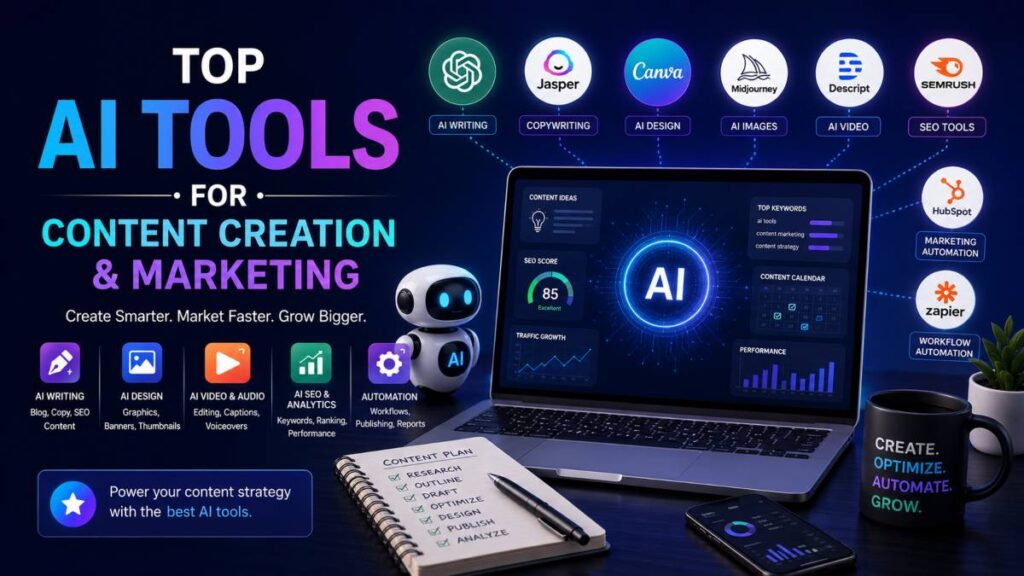
The top AI tools for content creation and marketing are changing how brands produce blogs, videos, social posts, emails, and marketing campaigns at scale. What once required entire creative teams can now move much faster with the help of intelligent software built for writing, design, SEO, automation, and media production. Businesses are no longer using AI only for experimentation. Many now depend on it to keep up with growing content demands and tighter publishing schedules.
The demand for faster workflows continues to rise as companies compete across multiple platforms every day. Marketing teams need to create more content without sacrificing quality, consistency, or search visibility. That pressure has pushed AI marketing tools into the center of modern content strategy. From generating article outlines and editing videos to optimizing SEO and creating branded visuals, AI systems now support nearly every stage of the creative process.
The real advantage comes from combining several AI content creation tools into one connected workflow. A brand might use one tool for keyword research, another for drafting content, and another for editing visuals or automating publishing. This setup saves time, reduces repetitive tasks, and helps teams move from idea to finished campaign much faster.
This guide covers the best AI platforms for writing, SEO, design, automation, audio, and video so marketers can build smarter and more efficient content systems.
Why AI Tools Matter for Modern Content Marketing
Content marketing moves fast. Brands publish blog posts, social updates, videos, newsletters, and promotional campaigns almost nonstop. Keeping that pace with manual workflows alone can overwhelm even experienced teams. That pressure is one reason AI content marketing software has become part of daily operations for marketers, creators, agencies, and growing businesses.
AI tools help teams produce content faster while maintaining consistency across different channels. They also reduce repetitive work, allowing marketers to spend more time on strategy, creative direction, and audience engagement instead of handling every task manually.
Faster Content Production Across Channels
Modern marketing requires content everywhere at once. Businesses need articles for search traffic, short videos for social media, email campaigns for customer retention, and graphics for brand visibility. Producing all of that content manually can consume huge amounts of time.
AI powered marketing tools speed up this process by assisting with research, writing, editing, caption generation, image design, and publishing. A marketer can create a blog outline in minutes, repurpose it into social captions, generate email copy, and produce short form video scripts from the same source material.
This faster workflow helps brands stay active across multiple platforms without exhausting creative teams or delaying campaigns.
Better Content Performance Through Data
AI tools do more than create content. They also help improve performance through data analysis and optimization. Many platforms now include SEO recommendations, keyword suggestions, audience targeting features, and automated analytics reporting.
Marketers can identify search trends, analyze user behavior, and refine content based on engagement metrics. AI tools for digital marketing often help businesses understand what type of content attracts traffic, generates clicks, and converts visitors into customers.
Automation also improves consistency. Scheduled publishing, audience segmentation, and performance tracking allow teams to manage campaigns with greater precision and less manual effort.
How AI Helps Small Teams Scale Faster
Smaller teams often face the biggest content demands with the fewest resources. AI tools help close that gap by improving workflow efficiency and reducing production costs.
Instead of hiring separate specialists for every task, businesses can use AI software to assist with copywriting, design, editing, SEO, and publishing from one connected workflow. This allows lean teams to manage multi channel publishing without sacrificing quality or speed.
As content demands continue to grow, AI systems give marketers a practical way to scale output, maintain consistency, and stay competitive across crowded digital platforms.
Best AI Writing Tools for Blog Content and Copywriting
Writing remains one of the biggest use cases for artificial intelligence in marketing. Brands now publish articles, ad campaigns, product pages, newsletters, and social content at a pace that would have been difficult to maintain a few years ago. AI writing platforms help marketers move faster while keeping messaging consistent across channels.
The best AI writing tools support more than simple text generation. They assist with idea generation, SEO structure, tone adjustment, content rewriting, and marketing copy built for conversions. Businesses often combine several AI content generation tools together depending on the type of content they produce.
ChatGPT for Long Form Content and Ideation
ChatGPT has become one of the most widely used AI writing platforms for marketers, bloggers, and agencies. Its flexibility makes it useful for almost every stage of content production.
Writers commonly use it to generate outlines, topic ideas, blog drafts, FAQs, and content briefs. Writers commonly use it to generate outlines, topic ideas, blog drafts, FAQs, and content briefs, drawing on robust AI knowledge bases for industry-specific context. It can also rewrite existing articles into different tones or formats depending on audience needs. For example, a technical blog post can be rewritten into simpler language for beginners or transformed into social media content for wider reach.
Persona based writing is another strength. Marketers can guide tone, style, and audience targeting through detailed prompts, which helps brands maintain a consistent voice across campaigns. This flexibility makes ChatGPT one of the strongest options among the best AI writing tools for long form content creation.
Claude for Long Context and Structured Writing
Claude has gained attention for handling large amounts of information with strong instruction accuracy. Many marketers and researchers use it for projects that involve detailed documentation, structured formatting, or research heavy workflows.
The platform performs well when users need organized outputs based on large reference materials or complex prompts. It also tends to produce cleaner formatting and more controlled responses, which can help businesses working with technical or sensitive topics.
Another reason marketers choose Claude is its reputation for safer outputs and careful prompt handling. Teams focused on brand safety, policy review, or detailed editing workflows often use it alongside other AI copywriting software to improve consistency and reduce errors.
QuillBot AI Detector for Content Authenticity
QuillBot includes an AI detector that helps marketers check whether content reads as human-written before publishing. The tool analyzes text and flags sections that may appear machine-generated, giving editors a quick way to review drafts produced with AI writing assistants.
This is especially useful for teams combining AI drafting with human editing workflows. After identifying generic phrasing or repetitive patterns, editors can use a reword generator to refine raw AI-generated text and optimize it in the same natural style as human-written content. Running content through a detection check helps catch generic phrasing or repetitive patterns that can weaken credibility and search performance.
As audiences and search engines grow more sensitive to AI-generated material, an AI detection step adds a practical layer of quality control alongside grammar review and SEO optimization.
Copy.ai and Jasper for Marketing Copy
While ChatGPT and Claude perform well for broader writing tasks, Copy.ai and Jasper focus heavily on marketing content. These tools are built for speed and campaign production, making them popular among social media teams, ecommerce brands, and advertising agencies.
Users can quickly generate ads, product descriptions, social captions, email subject lines, and CTA variations for testing campaigns. Templates built into these platforms help marketers create conversion focused copy without starting from scratch every time.
Jasper also includes brand voice features that help maintain consistency across multiple campaigns and team members. Copy.ai focuses heavily on workflow speed and campaign automation, making it useful for businesses producing large amounts of promotional content regularly.
Together, these AI content generation tools help marketers reduce production time while keeping campaigns active across multiple platforms.
Top AI SEO Tools for Content Optimization
Creating content is only part of the process. If articles fail to rank in search engines or match audience intent, even strong writing can struggle to generate traffic. That is why marketers now rely heavily on AI SEO tools to improve visibility, structure, readability, and keyword targeting before publishing content online.
Modern SEO platforms combine artificial intelligence with search data to help writers create articles that better match what users are searching for. These systems analyze competitors, search intent, keyword relevance, and content quality while giving marketers practical recommendations for improvement.
Semrush Content Toolkit for Keyword Research
Semrush remains one of the most widely used content optimization tools for SEO research and planning. The platform helps marketers identify valuable keywords, analyze competitors, and understand what currently ranks in search results.
SERP analysis allows users to study top performing pages for a target keyword and identify patterns in structure, content depth, and topic coverage. This gives writers a clearer understanding of what search engines currently reward.
Competitor tracking is another major advantage. Businesses can monitor which keywords competitors rank for, where traffic opportunities exist, and which topics attract the most engagement. Search intent analysis also helps marketers understand whether users want informational content, product comparisons, tutorials, or purchase focused pages.
These features make Semrush especially useful during the early stages of content planning and SEO strategy development.
Surfer SEO for On Page Optimization
Surfer SEO focuses heavily on improving on page content structure and keyword relevance. After a draft is complete, the platform analyzes the article against top ranking competitors and provides optimization recommendations.
Content scoring helps writers measure how closely their article matches current ranking patterns. Surfer also offers NLP keyword suggestions that identify semantically related terms commonly found in successful pages. This helps articles appear more natural and relevant to search engines.
SEO structure recommendations cover headings, paragraph length, keyword usage, and content depth. These insights help marketers build pages that are easier for both readers and search engines to understand.
Many content teams use Surfer SEO alongside AI writing platforms to refine drafts before publication and improve organic search performance.
Grammarly for Editing and Clarity
Strong SEO content still needs clean writing and readability. Grammarly helps marketers polish articles by checking grammar, spelling, sentence clarity, and writing tone.
Tone improvement suggestions help content feel more natural and audience friendly, especially for brands aiming to maintain a consistent voice across blogs, emails, and landing pages. Grammarly also improves readability by reducing awkward phrasing and unnecessary complexity.
Plagiarism review features add another layer of protection for businesses publishing large amounts of content. This helps writers avoid accidental duplication and maintain originality across campaigns.
When combined with other AI tools for SEO optimization, Grammarly helps turn rough drafts into polished content ready for search visibility and audience engagement.
Best AI Design and Visual Content Tools
Visual content now plays a major role in digital marketing. A strong blog post can attract traffic, but graphics, thumbnails, and branded visuals often determine whether users stop scrolling and pay attention. Modern marketers need images for social media, blog content, presentations, ads, email campaigns, and video platforms almost every day. AI design tools help businesses create those assets faster without relying entirely on large creative teams. Many marketers now use the best ai design tools for graphic designers to generate social media graphics, thumbnails, and branded campaign visuals efficiently.
Artificial intelligence has changed visual production by making design more accessible, faster, and easier to scale across multiple channels. From simple social graphics to advanced image generation, marketers can now produce professional visual content within minutes.
Canva AI for Marketing Graphics
Canva remains one of the most popular AI tools for social media marketing because of its simplicity and speed. The platform helps marketers create polished visuals even without advanced design experience.
Businesses commonly use Canva for social media visuals, blog banners, presentation design, email graphics, and promotional material. AI powered features assist with layout suggestions, background removal, image resizing, text formatting, and branded templates.
The drag and drop interface makes content production faster for small teams managing multiple campaigns at once. Marketers can also maintain brand consistency through saved fonts, colors, and design systems across different projects.
For businesses producing regular visual content, Canva helps reduce production time while keeping graphics clean and professional.
Midjourney for AI Generated Images
Midjourney focuses more heavily on creative image generation and artistic visuals. Instead of editing templates, users create entirely new visuals through text prompts.
This approach gives marketers greater creative freedom for campaign concepts, custom illustrations, product mockups, and unique branding assets. Many businesses use Midjourney to create eye catching thumbnails, futuristic graphics, cinematic scenes, and concept imagery that would normally require expensive design resources.
The platform is especially useful for brands wanting original visuals instead of stock photography used by countless competitors online. Creative flexibility has made Midjourney one of the most talked about AI image generation tools among designers, creators, and marketing agencies.
AI Visuals for Better Engagement
Visual content often improves engagement faster than text alone. Strong graphics attract attention, improve click rates, and make content easier to remember across crowded platforms.
AI generated visuals also support stronger visual branding by helping businesses maintain a consistent style across websites, ads, presentations, and social media campaigns. You can also revisit older visuals and refine them using an AI online image enhancement tool such as Krea, adapting them to new campaign directions and improved quality standards. Consistency helps audiences recognize a brand quickly, which can increase trust and familiarity over time.
Content retention improves when articles and social posts include relevant visuals alongside written information. Readers tend to spend more time on pages with strong design elements, especially when visuals help explain ideas clearly or create emotional interest.
As digital competition grows, businesses using AI design tools can produce high quality visuals faster while keeping content fresh, recognizable, and more engaging for audiences.
AI Video and Audio Tools for Marketing Campaigns
Video content dominates modern marketing. Brands use short clips, podcasts, tutorials, interviews, webinars, and product demos to attract attention across platforms like YouTube, TikTok, Instagram, and LinkedIn. Producing that volume of media manually can consume huge amounts of time and resources, especially for smaller teams. AI video editing tools now help marketers create polished content faster while simplifying editing, captions, narration, and publishing workflows.
The rise of short form content has also increased demand for faster production systems. Businesses no longer publish one video per month and call it complete. Many brands now release content daily across multiple platforms, which makes automation and AI support far more valuable.
Descript for Video Editing and Captions
Descript has become a favorite tool among podcasters, creators, and marketers because it simplifies video and audio editing through text based workflows. Instead of editing complex timelines manually, users can edit media by modifying written transcripts.
This approach makes content production faster and more efficient, especially for teams that rely on podcast editing services to produce regular interview shows, webinars, or educational content. Descript also includes screen recording features, which are useful for tutorials, software demonstrations, and training videos.
Subtitle generation is another major strength. Captions improve accessibility and help videos perform better on social platforms where many users watch content without sound. Fast caption workflows also reduce editing time while improving viewer retention.
For marketers producing educational or long form media, Descript helps reduce technical editing barriers and speeds up post production work significantly.
CapCut for Short Form Video Content
CapCut focuses heavily on short form video production built for fast moving social platforms. Marketers commonly use it for TikTok edits, Instagram Reels, YouTube Shorts, and vertical video campaigns.
The platform includes templates, transitions, automated captions, sound syncing, and mobile friendly editing tools designed for social media speed. This allows creators to produce polished videos quickly without advanced editing experience.
Vertical video workflows have become essential for brands competing on mobile first platforms. CapCut helps marketers resize content, add effects, and publish social ready videos efficiently across multiple channels.
Its simplicity and fast export process make it especially popular among influencers, ecommerce brands, and social media teams producing daily video content.
ElevenLabs and HeyGen for Voice and AI Avatars
Voice and presentation tools are becoming a larger part of AI tools for video marketing. ElevenLabs focuses on realistic AI narration and voice generation for podcasts, explainers, audiobooks, and video voiceovers.
The platform produces natural sounding speech with emotional tone control, making content feel more human and engaging compared to traditional robotic text to speech systems. Businesses often use it for multilingual narration, training videos, and marketing campaigns requiring scalable voice production.
HeyGen takes a different approach by offering AI generated presenters and avatar based videos. Users can create spokesperson style videos without filming a real person, which helps businesses produce training content, promotional videos, and presentations quickly.
Together, these platforms reduce production costs while helping marketers scale multimedia content faster across podcasts, social video, advertising, and educational campaigns.
Personalized Video Platforms for 1:1 Engagement Marketers can now turn customer data into dynamic, one-to-one videos at scale. Use cases include onboarding walkthroughs, billing and policy explainers, loyalty updates, cross-sell offers, and renewal reminders — often driving higher click-through and completion rates than generic clips. AI supports scene selection, dynamic text and audio, and localization so each viewer sees the most relevant story. These videos can be delivered via email, SMS, apps, and websites and integrate with common CRM and marketing stacks. Boost activation, retention, and NPS by guiding customers step by step through personalized videos that render in real time for each recipient.
AI Workflow Automation Tools for Marketing Teams
Creating content is only one part of modern marketing. Teams also need to organize research, manage approvals, publish campaigns, track performance, and maintain consistency across several channels at once. Handling all of those steps manually can slow production and create bottlenecks that waste time and resources. AI automation tools for marketing help solve this problem by connecting repetitive tasks into faster and more organized systems.
Automation allows marketers to move from idea generation to publishing with fewer manual steps. Instead of jumping between disconnected platforms all day, businesses can build workflows that handle drafting, optimization, scheduling, analytics, and reporting in a more streamlined way.
HubSpot AI for Publishing and Analytics
HubSpot AI focuses heavily on marketing operations, publishing workflows, and campaign management. Teams can use the platform to manage blog publishing, automate email campaigns, and monitor performance data from one central system.
AI powered writing assistance helps marketers draft content faster while built in scheduling tools support consistent publishing across websites and email campaigns. Businesses can also automate follow up emails, customer segmentation, and lead nurturing without manually handling every interaction.
Campaign reporting features make performance tracking easier by organizing metrics related to traffic, conversions, engagement, and customer activity. This helps marketers understand which campaigns perform well and where adjustments are needed.
For teams managing large amounts of content, HubSpot simplifies publishing workflows while improving organization and reporting visibility.
Gumloop and AI Automation Workflows
Gumloop focuses more heavily on AI workflow automation and task chaining. Instead of using separate tools manually for every stage of content creation, marketers can connect systems together into automated pipelines.
A workflow might begin with topic research, move into AI drafting, continue through SEO optimization, and finish with automated publishing or scheduling. This structure reduces repetitive work and speeds up production across multiple campaigns.
Research to publishing automation also helps teams scale output without increasing manual workload significantly. Businesses producing large amounts of blog content, social media posts, or ecommerce updates often benefit from this type of connected automation system.
These tools become especially valuable for agencies and growing brands managing several clients or campaigns simultaneously.
Build an AI Powered Content Workflow
The strongest marketing systems usually combine several AI platforms into one organized process. Research tools gather topic ideas and keyword data, Content writing platforms generate drafts, SEO tools improve optimization, and publishing systems distribute content across channels.
This type of AI content workflow reduces delays between stages and keeps production moving efficiently. Teams can move from brainstorming to finished publication much faster while maintaining consistency across content formats.
AI workflow automation also gives marketers more time to focus on strategy, audience growth, and campaign creativity instead of spending hours on repetitive production tasks.
How to Choose the Right AI Tools for Your Business
The number of AI platforms available today can feel overwhelming. New tools appear constantly, each promising faster workflows, better content, and stronger marketing results. Yet not every platform fits every business. Some tools focus on writing while others specialize in SEO, automation, video editing, or analytics. Choosing the right setup depends on business goals, content needs, team size, and budget.
The smartest approach is not chasing every new platform. Businesses usually get better results by selecting AI tools for marketers that solve specific workflow problems and fit naturally into existing systems.
Compare Features and Use Cases
The first step is understanding what each tool actually does well. Some platforms produce strong long form writing while others perform better with social captions, product descriptions, or ad copy.
Writing quality matters because weak outputs still require heavy editing. Businesses should test tools with real prompts instead of relying only on marketing claims. SEO capability is another major factor for brands focused on organic traffic growth. Platforms with keyword analysis, optimization scoring, and SERP research features often provide stronger value for content focused teams.
Video and image support also matter for companies producing multimedia campaigns. Some AI tools for business marketing handle only text generation, while others include design systems, voiceovers, subtitles, and video editing features.
Comparing tools based on actual use cases helps businesses avoid paying for features they may never use.
Evaluate Pricing and Scalability
Pricing becomes more important as content production grows. A low cost tool may seem attractive initially, but limitations around usage, collaboration, or automation can create problems later.
Team collaboration features are especially useful for agencies and growing businesses. Shared workspaces, approval systems, and brand voice settings help teams maintain consistency across projects.
API access is another major consideration for companies building automated workflows or connecting AI systems with existing software. Businesses scaling content operations often benefit from tools that support integrations and automation pipelines.
Subscription value should always be measured against actual productivity gains instead of headline pricing alone.
Check Privacy and Content Accuracy
AI generated content still requires human oversight. Fact checking remains essential because language models can occasionally produce inaccurate or outdated information.
Human review helps protect brand quality, tone consistency, and factual accuracy before publication. Businesses working in finance, healthcare, legal services, or sensitive industries should be especially careful when handling AI generated material.
Sensitive data handling also matters when selecting platforms. Companies should review privacy policies, storage practices, and enterprise security options before uploading confidential information.
A strong AI powered content strategy combines automation with human judgment. The goal is not replacing people completely, but helping teams work faster while maintaining quality and trust.
Example AI Content Marketing Workflows
Using one AI tool can save time, but combining several platforms into a connected process creates a much stronger system. Modern marketers often build workflows where each tool handles a specific task such as research, writing, editing, optimization, design, or publishing. This structure reduces manual work and keeps campaigns moving faster across multiple channels.
A well organized AI content workflow also improves consistency. Instead of creating separate pieces of content from scratch every time, businesses can turn one idea into blog posts, videos, social media updates, and email campaigns through connected automation.
SEO Blog Workflow
A common SEO focused workflow starts with Semrush for keyword research, competitor analysis, and topic planning. Marketers use this data to identify search intent, ranking opportunities, and content gaps before writing begins.
After research is complete, ChatGPT helps generate outlines, article drafts, FAQs, and supporting content sections. Once the draft is ready, Surfer SEO analyzes the page structure, keyword relevance, and optimization score to improve search visibility.
Grammarly then reviews the article for grammar, tone, readability, and clarity. Finally, Canva helps create featured images, blog graphics, and promotional visuals for publishing and social sharing.
This workflow combines several AI content planning tools into one streamlined process built for search traffic and content quality.
Social Media Video Workflow
Short form video campaigns often follow a different workflow. A marketer may begin with a blog article, webinar, or podcast transcript and upload it into Descript for script editing, audio cleanup, and subtitle generation.
The edited content then moves into CapCut for vertical formatting, transitions, effects, and social ready video production. Midjourney can create custom thumbnails or creative background visuals that help videos attract attention on crowded feeds.
Scheduling tools then automate publishing across platforms such as TikTok, Instagram, LinkedIn, and YouTube Shorts. This type of AI social media automation allows brands to publish content consistently without managing every upload manually.
Multi Channel Marketing Workflow
Many businesses now repurpose one core piece of content across several channels. A blog post can become email campaigns, social media clips, short videos, infographics, and promotional captions within a single workflow.
Automation sequences help distribute content efficiently while performance tracking tools monitor engagement, clicks, conversions, and audience behavior. This data helps marketers understand which formats and channels generate the strongest results.
As AI systems improve, multi channel workflows are becoming faster, more connected, and easier to scale for growing marketing teams.
Risks and Limitations of AI Content Tools
AI platforms can speed up content production dramatically, but they are not flawless. Businesses that rely too heavily on automation without review often run into accuracy issues, repetitive writing, and brand consistency problems. While artificial intelligence can assist with research, drafting, editing, and publishing, human judgment still plays a major role in maintaining quality and trust.
Understanding the limits of these systems helps marketers use them more responsibly and avoid costly mistakes in content strategy.
Accuracy and Fact Checking Concerns
One of the biggest concerns with AI generated content quality is factual accuracy. Language models sometimes produce outdated information, incorrect statistics, or fabricated details that sound believable on the surface.
This becomes risky for industries where accuracy matters heavily, including finance, healthcare, legal services, and technical publishing. Even strong AI research assistants can misunderstand context or pull incomplete information from training data.
Fact checking should remain part of every publishing workflow. Businesses should verify claims, review statistics carefully, and confirm sources before publishing content publicly. AI tools work best as assistants rather than final decision makers.
Generic Content Problems
Another common issue is repetitive or overly generic writing. Many AI platforms produce similar sentence structures, predictable phrasing, and broad explanations when prompts lack detail.
Content that feels generic often struggles to hold attention or stand out in competitive search results. Readers want personality, expertise, storytelling, and original perspective, especially in crowded industries where dozens of websites publish similar topics daily.
Strong prompting helps improve quality, but human creativity still makes the biggest difference in creating memorable and engaging content.
Copyright and Privacy Risks
Copyright concerns continue to grow as AI systems generate text, visuals, music, and video content based on massive training datasets. Businesses should review licensing terms carefully before using AI generated assets in commercial campaigns.
Privacy also matters when teams upload internal documents, customer information, or confidential business data into AI platforms. Some tools store prompts or use submitted data for future model training, which may create security concerns for sensitive industries.
Companies should review data handling policies before integrating AI systems into business operations.
Why Human Editing Still Matters
AI content editing software can improve grammar, readability, and structure, but human oversight remains essential for quality control. Editors help maintain brand voice, emotional tone, strategic messaging, and factual accuracy in ways automation still struggles to match consistently.
The strongest content usually combines AI efficiency with human creativity and expertise. Businesses that balance automation with thoughtful editing often produce content that feels more trustworthy, more engaging, and more valuable to real audiences.
Final Thoughts
AI tools have changed how modern marketing teams create, edit, publish, and scale content across digital platforms. From writing blog posts and designing graphics to editing videos and automating campaigns, these systems help businesses move faster while handling larger content demands with fewer manual tasks.
Still, the strongest results rarely come from relying on one platform alone. Most successful teams combine several tools into a connected workflow where each system supports a specific part of the process. One tool may handle keyword research while another improves writing, edits visuals, or manages publishing and analytics. This layered approach creates a smoother production system and helps marketers maintain quality across multiple channels.
Businesses should also remember that automation works best alongside human creativity and strategic thinking. AI can speed up workflows and reduce repetitive tasks, but audience understanding, storytelling, and brand direction still depend heavily on human input.
The best approach is to experiment with different platforms and build a workflow that matches your goals, team structure, and content needs. Try an AI content workflow today, download an AI marketing checklist, or test the best AI tools for your content strategy to discover which combination helps your brand create smarter and faster marketing campaigns.