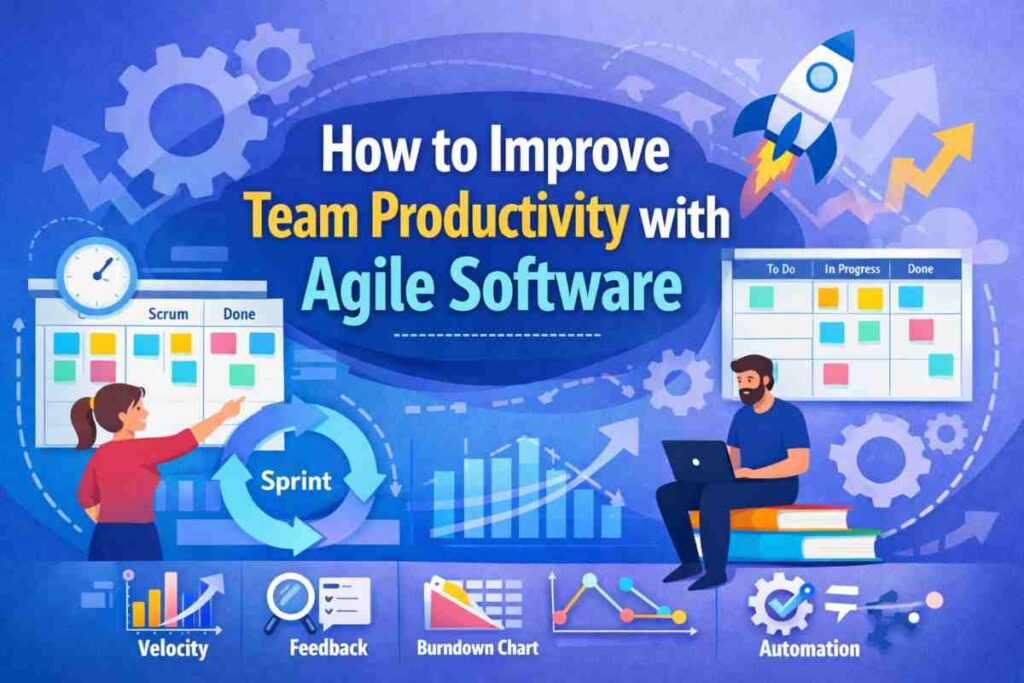
Modern teams are busier than ever. Deadlines pile up. Meetings stretch too long. Projects start strong but lose momentum halfway through. If this sounds familiar, you’re not alone. Many companies struggle with unclear priorities, slow approvals, and constant changes that derail progress.
The good news? You can improve team productivity with agile software by shifting from rigid planning to flexible, sprint-based execution. Instead of trying to predict everything upfront, agile breaks work into short, manageable cycles called sprints. Teams focus on small goals, deliver quickly, gather feedback, and improve with each round. It’s like running a series of short races instead of one exhausting marathon.
In this guide, you’ll learn how agile software development works, which frameworks like Scrum and Kanban drive results, and how tools such as Jira and visual workflow boards support collaboration. We’ll also cover key metrics, best practices, and practical steps you can apply immediately to build a faster, more focused, and more productive team.
What Is Agile Software and Why It Boosts Team Productivity
Agile software is not just a tool it’s a way of working. It helps teams move faster, adapt quickly, and focus on what truly matters: delivering value. Instead of planning every detail months in advance, agile uses short cycles called sprints to build, test, and improve continuously. This flexible system removes bottlenecks, reduces wasted effort, and keeps everyone aligned.
At its core, agile project management boosts team productivity because it replaces rigid control with smart collaboration. Think of it like steering a boat with small, steady adjustments instead of locking the wheel and hoping for calm waters.
The Core Values of Agile (Agile Manifesto Explained)
Agile is built on four powerful values from the Agile Manifesto:
- Individuals over processes
People and teamwork matter more than strict rules. Strong communication solves problems faster than paperwork. - Working software over documentation
Results matter more than reports. Delivering functional progress keeps teams motivated and focused. - Customer collaboration over contracts
Regular feedback ensures the product meets real needs, not outdated assumptions. - Responding to change over following a plan
Markets change. Priorities shift. Agile teams adapt instead of resisting change.
Agile Principles That Drive Performance
Beyond the four values, agile follows principles that improve team performance. Three of the most impactful are:
- Sustainable pace
Teams work at a steady rhythm, avoiding burnout and maintaining long-term productivity. - Self-organizing teams
Team members take ownership of tasks. This builds accountability and speeds up decisions. - Continuous improvement
Through regular retrospectives, teams reflect, adjust, and refine their workflow.
Together, these principles create a system where collaboration replaces chaos, clarity replaces confusion, and steady progress replaces last-minute stress. That’s why agile software consistently helps teams perform at a higher level.
Step-by-Step Guide to Improve Team Productivity with Agile Software
Adopting agile is not about installing a new tool and hoping for better results. It’s about building the right mindset, structure, and habits. When done correctly, these steps help you improve team productivity with agile software in a practical and sustainable way.
Step 1 – Train Your Team on Agile Mindset
Before choosing frameworks or tools, start with culture.
A traditional mindset focuses on strict plans, detailed documentation, and top-down decisions. Teams are expected to follow instructions and avoid deviation. While this approach works in stable environments, it often struggles when priorities change.
An agile mindset is different. It values flexibility, collaboration, and continuous learning. Instead of asking, “Did we follow the plan?” agile teams ask, “Did we deliver value?”
Adaptability is the key. Markets shift. Customer needs evolve. Technology changes quickly. Agile teams adjust without losing momentum because they expect change, not fear it. Training sessions, workshops, and real-life simulations can help your team understand this shift clearly.
When people understand why agile works, they are more likely to embrace it fully.
Step 2 – Choose the Right Framework (Scrum vs Kanban)
Once your team understands the mindset, select the framework that fits your workflow.
Scrum
Scrum works well for structured projects with defined goals. It uses:
- Roles: Product Owner, Scrum Master, Development Team
- Sprints: Fixed time cycles (usually 2–4 weeks)
- Ceremonies: Sprint planning, daily stand-ups, reviews, retrospectives
Scrum creates rhythm and accountability. It’s like working in focused bursts with clear checkpoints.
Kanban
Kanban focuses on visualization and flow. It uses:
- A visual board with task columns (To Do, In Progress, Done)
- Work-in-progress (WIP) limits to prevent overload
- Continuous delivery instead of fixed sprints
Kanban is flexible and ideal for teams handling ongoing work or support tasks.
Quick Comparison
| Feature | Scrum | Kanban |
|---|---|---|
| Work Structure | Time-based sprints | Continuous flow |
| Roles | Defined roles | No required roles |
| Planning | Sprint planning sessions | On-demand prioritization |
| Best For | Product development | Maintenance & operational teams |
Choosing the right framework ensures your agile software supports your team’s natural workflow rather than forcing unnecessary complexity.
Step 3 – Build Cross-Functional Agile Teams
Agile thrives when teams are cross-functional. That means bringing together different skills developers, designers, testers, marketers into one collaborative unit.
Instead of passing tasks between departments, cross-functional teams share ownership of outcomes. Everyone works toward the same sprint goal.
The benefits are clear:
- Faster decision-making
- Reduced handoff delays
- Better communication
- Stronger accountability
When problems arise, solutions happen quickly because the right people are already in the room. This structure removes bottlenecks and accelerates progress.
Step 4 – Implement Core Agile Ceremonies
Agile ceremonies create consistency and transparency. These meetings are short, focused, and purposeful.
Daily Stand-Ups (15 Minutes)
Each team member answers three questions:
- What did I complete yesterday?
- What will I work on today?
- Are there any blockers?
This keeps everyone aligned and prevents small issues from becoming major delays.
Sprint Planning
At the start of each sprint, the team defines what can realistically be completed. Clear goals improve focus and prevent overcommitment.
Sprint Reviews
At the end of the sprint, teams demonstrate completed work. This encourages accountability and allows stakeholders to provide feedback early.
Retrospectives
This is where improvement happens. The team reflects on what worked, what didn’t, and what to improve next sprint. Even small adjustments compound over time.
Together, these ceremonies create structure without rigidity. They provide clarity without slowing momentum. And most importantly, they create an environment where agile software becomes a productivity engine rather than just another project management tool.
Essential Agile Practices That Improve Team Productivity
Agile is not powerful because of theory. It works because of consistent, practical habits. When teams apply the right agile practices, productivity improves naturally. Work becomes clearer. Feedback becomes faster. Progress becomes measurable.
Let’s break down the essential practices that make the biggest difference.
Short Iterative Sprints (2–4 Weeks)
Short sprints are the heartbeat of agile productivity.
Instead of working for months before delivering anything, teams break projects into small, manageable cyclesusually two to four weeks. Each sprint focuses on a specific goal and delivers a usable increment of work.
This approach supports incremental delivery. Think of it like building a house room by room instead of waiting to reveal the entire structure at once. Stakeholders see progress early, and teams stay motivated.
Short sprints also create faster feedback loops. If something isn’t working, you discover it within weeks not months. That means fewer surprises, fewer costly mistakes, and faster adjustments.
Over time, these small wins compound into major productivity gains.
Visual Workflow Management
When work is visible, it becomes manageable.
Agile teams use Kanban boards or Scrum boards to display tasks across stages like To Do, In Progress, and Done. This simple visual layout improves transparency instantly. Everyone knows what’s happening and who is responsible.
Another key element is work-in-progress (WIP) limits. By restricting how many tasks can be in progress at once, teams avoid multitasking overload. Fewer open tasks mean better focus and higher-quality output.
Visual boards also help in identifying bottlenecks. If tasks pile up in one column, it signals a process issue. Instead of guessing where delays occur, teams can see the problem clearly and fix it quickly.
Clarity reduces confusion. And clarity fuels productivity.
Continuous Feedback & Automation
Agile thrives on continuous improvement, and that requires feedback.
Integrating customer feedback during or after each sprint ensures the team builds what users actually need. This prevents wasted effort and reduces the risk of delivering the wrong solution.
Automation strengthens this cycle. Basic CI/CD (Continuous Integration and Continuous Deployment) practices allow teams to test and release updates reliably. Automated testing catches issues early. Continuous deployment speeds up delivery.
The result? Reduced rework. Problems are detected sooner, fixed faster, and prevented from repeating. Instead of firefighting, teams focus on forward progress.
Measuring Agile Performance with Data
What gets measured gets improved.
Agile teams rely on performance data to make objective decisions. Key metrics include:
- Sprint velocity – The amount of work completed per sprint. It helps teams plan realistically.
- Cycle time – The time it takes for a task to move from start to finish. Shorter cycle times often signal smoother workflows.
- Burndown charts – Visual graphs that track remaining work during a sprint. They show whether the team is on pace.
But numbers tell only part of the story. Team morale surveys and retrospective feedback provide qualitative insights. A productive team is not just fast it’s motivated and sustainable.
When you combine short sprints, visual management, automation, and performance metrics, agile becomes more than a process. It becomes a reliable system for continuous productivity growth.
Best Agile Software Tools to Improve Team Productivity
The right tools can turn agile theory into daily results. While mindset and process come first, software makes collaboration smoother, work more visible, and progress easier to track. Below are three powerful agile tools that help teams stay organized and focused.
Jira – Best for Sprint Planning & Backlog Management
Jira is one of the most popular agile project management tools, especially for software teams. It supports both Scrum and Kanban frameworks, making it flexible for different workflows.
Key features include:
- Scrum and Kanban boards for visual task tracking
- Backlog management to prioritize and organize work
- Issue tracking to monitor bugs and tasks
- Timelines and roadmaps for long-term planning
Pros:
- Strong reporting tools (burndown charts, velocity tracking)
- Highly customizable workflows
- Scales well for growing teams
Ideal for:
Product development teams, engineering departments, and organizations that need structured sprint planning.
monday.com – Best for Workflow Visualization
monday.com focuses on visual clarity and ease of use. It’s especially helpful for cross-functional teams that want agile flexibility without technical complexity.
Key features include:
- Customizable boards for sprint tracking
- Workflow automation
- Real-time collaboration tools
- Dashboard views for progress monitoring
Pros:
- User-friendly interface
- Great for non-technical teams
- Strong automation and integration options
Ideal for:
Marketing teams, startups, operations teams, and companies adopting agile beyond software development.
Slack – Best for Agile Communication
Slack may not be a traditional project management tool, but it plays a vital role in agile productivity. Communication is the backbone of agile, and Slack keeps teams aligned in real time.
Key features include:
- Stand-up bot integrations
- Retrospective collaboration channels
- Instant messaging and file sharing
- Integration with Jira and monday.com
Pros:
- Speeds up decision-making
- Reduces email overload
- Centralizes conversations
Ideal for:
Remote teams, distributed teams, and organizations that rely on quick collaboration.
Quick Comparison Table
| Tool | Best For | Strength | Ideal Teams |
|---|---|---|---|
| Jira | Sprint planning & backlog management | Advanced reporting & issue tracking | Software & engineering teams |
| monday.com | Workflow visualization | Ease of use & automation | Cross-functional & non-technical teams |
| Slack | Agile communication | Real-time collaboration | Remote & distributed teams |
Choosing the right agile software depends on your team’s size, workflow complexity, and communication needs. Many high-performing teams combine these tools to create a complete productivity system.
How to Measure Success After Implementing Agile Software
Implementing agile software is only the first step. To truly understand its impact, you need clear ways to measure success. Agile encourages continuous improvement, and that means tracking both performance data and human feedback.
Think of it like using a fitness tracker. You don’t just guess if you’re healthier you measure steps, heart rate, and progress over time. Agile works the same way.
Quantitative KPIs
Numbers provide objective insight into how well your team is performing.
Velocity measures how much work a team completes during a sprint. Over time, stable or improving velocity shows better planning and execution. If velocity drops often, it may signal workload imbalance or blockers.
Cycle time tracks how long it takes for a task to move from “in progress” to “done.” Shorter cycle times usually mean smoother workflows and fewer delays.
Lead time measures the total time from when a task is requested to when it is delivered. This metric reflects how quickly your team responds to business needs.
Together, these KPIs help teams spot inefficiencies early and make data-driven adjustments.
Qualitative Metrics
Numbers tell part of the story. People tell the rest.
Team satisfaction is a strong indicator of sustainable productivity. Quick surveys or feedback sessions can reveal whether workloads are balanced and morale is healthy.
Customer feedback ensures the delivered work meets expectations. If customers are satisfied and issues decrease, your agile process is working.
Retrospective insights provide ongoing improvement opportunities. Teams discuss what worked, what didn’t, and what to refine in the next sprint. These conversations often uncover hidden process gaps.
Expected Results
When agile software is implemented effectively and measured properly, results become visible:
- Faster delivery through shorter cycles
- Reduced rework thanks to early feedback
- Higher adaptability when priorities shift
- Improved collaboration across teams
Measuring both performance data and human experience ensures your agile transformation delivers lasting productivity gains not just temporary speed.
Common Mistakes That Reduce Agile Productivity
Agile can dramatically improve team performance but only if it’s implemented correctly. Many teams adopt agile practices yet fail to see results because of a few avoidable mistakes.
Skipping retrospectives is one of the most common errors. Retrospectives are where improvement happens. When teams rush past them or cancel them due to time pressure, they lose the opportunity to fix recurring problems. Over time, small issues pile up and slow productivity. Agile without reflection is just repeated motion, not progress.
Another mistake is overloading sprints. Teams often commit to more work than they can realistically complete. This leads to stress, unfinished tasks, and declining morale. Agile is designed for sustainable pace, not constant pressure. A focused sprint with achievable goals always delivers better results than an overloaded one.
Lack of leadership buy-in can quietly undermine agile efforts. If leaders continue to demand rigid timelines, ignore sprint boundaries, or bypass processes, teams struggle to maintain consistency. Agile requires support from the top to succeed.
Finally, ignoring metrics limits growth. Without tracking velocity, cycle time, or team feedback, decisions rely on guesswork instead of data. Metrics are not about control they are about clarity.
Avoiding these mistakes helps agile remain a productivity system rather than just another project management trend.
Conclusion – Why Agile Software Is the Key to Team Productivity
Improving team performance doesn’t require longer hours or bigger teams. It requires smarter systems. Agile software creates structure without rigidity, clarity without micromanagement, and speed without chaos. Through short sprints, visual workflows, continuous feedback, and measurable KPIs, teams gain focus and momentum.
When you improve team productivity with agile software, you create an environment where progress is consistent and adaptable. Work becomes transparent. Collaboration becomes stronger. Problems are identified early instead of escalating later. Over time, these small improvements lead to faster delivery, reduced rework, and higher team morale.
If you’re ready to move forward, start with a simple audit of your current workflow. Identify bottlenecks, review communication gaps, and test a framework like Scrum or Kanban. Even small adjustments can unlock noticeable gains.
From there, explore recommended agile tools that align with your team’s needs. The right combination of mindset, process, and software can transform productivity from a daily struggle into a sustainable advantage.