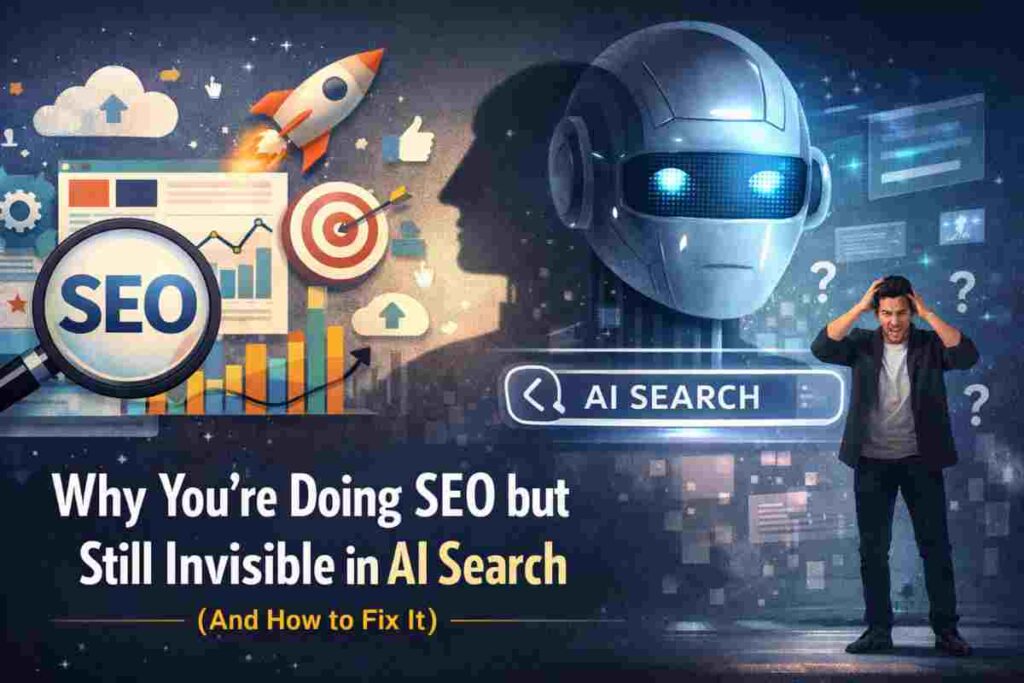
You’re investing in SEO.
You’re consistently publishing content.
In some cases, you’re even ranking on Google.
On the surface, everything seems to be working.
But the moment someone turns to AI systems like ChatGPT, Google Gemini, or Perplexity AI and asks about your category…
👉 Your brand is nowhere to be found.
This disconnect creates a critical illusion:
You appear visible in traditional search, yet you are absent at the exact moment decisions are shaped.
Because this is not a traffic issue.
And it’s no longer just a ranking issue.
What you’re facing is a systemic visibility gap in AI-driven discovery environments —
where brands are not retrieved based on keywords, but selected based on trust, relevance, and structured understanding.
And right now, most brands are not part of that selection layer.
The Shift: From Search Engine Rankings to AI Recommendations
Traditional SEO was built around a single, dominant question:
👉 Can you rank?
Visibility was a function of position.
If you ranked, you were seen. If you were seen, you had a chance to win.
But AI-driven discovery has fundamentally changed that logic.
Today, the core question is no longer:
👉 Can you rank?
It is:
👉 Can you be trusted as an answer?
Systems like ChatGPT and Perplexity AI don’t operate as result pages.
They operate as decision engines.
They don’t just retrieve information.
They interpret, synthesize, and compress multiple sources into a single answer.
And in that process, a silent filter is applied:
👉 Not everything that ranks gets included.
👉 Not everything that exists gets cited.
This creates a new reality:
- Ranking ≠ Inclusion
- Content ≠ Citation
- Traffic ≠ Trust
In traditional search, visibility was about being present.
In AI search, visibility is about being selected.
And selection is driven by:
- Entity clarity (Who are you?)
- Contextual relevance (When should you appear?)
- Trust signals (Why should you be recommended?)
If your brand is not part of what can be described as the model’s trusted knowledge layer—
a network of entities, signals, and validated associations—
👉 then you don’t compete.
You simply don’t exist in the answer.
Why SEO Alone Doesn’t Make You Visible in AI
Most brands assume that doing SEO is enough.
They publish content.
They target keywords.
They optimize pages.
Yet they remain invisible in AI-generated answers.
Because the problem is not effort.
It’s missing layers.
Across industries, we consistently see three structural gaps:
1. No Entity Clarity
AI systems don’t interpret the web through keywords.
They interpret it through entities and relationships.
That means your brand is not evaluated by what you target,
but by what you are recognized as.
If your brand:
- Isn’t clearly and consistently defined across platforms
- Lacks structured signals (about pages, schema, profiles, mentions)
- Has weak or scattered association with core topics
👉 Then you are not a defined entity.
You are just another content producer.
And content without a clear entity behind it is hard to trust, and easy to ignore.
2. Weak Trust Signals
AI doesn’t just look for information.
It looks for validation.
Before including a brand in an answer, models implicitly evaluate:
- Is this brand mentioned elsewhere?
- Do multiple sources support its claims?
- Is there real-world proof behind it?
This is where most brands collapse.
If you don’t have:
- Strong, visible social proof (reviews, testimonials, case studies)
- Cross-platform mentions and references
- Signals of real usage, results, or customer experience
👉 Then you are not a reliable source.
You are a self-claimed authority—and AI systems are designed to be cautious about those.
3. No Distribution Layer
Publishing content is often mistaken for building visibility.
It’s not.
Content that lives only on your website is isolated.
And isolated content does not create authority.
If your content:
- Exists only within your own domain
- Is not referenced, cited, or discussed elsewhere
- Lacks amplification across platforms
👉 Then it has no external validation layer.
From an AI perspective, this creates a simple conclusion:
“This information exists, but it is not important enough to be repeated.”
And what is not repeated…
is rarely recommended.
In short:
You don’t have a content problem.
You don’t even have a ranking problem.
You have a recognition problem.
And until your brand is:
- Clearly defined
- Socially validated
- Widely distributed
👉 SEO alone will not make you visible in AI.
The Real Problem: You Built for Google, Not for AI
Most SEO strategies today are still operating on an outdated model.
They are:
- Keyword-first
- Traffic-focused
- Page-based
The goal is simple:
Rank → get clicks → drive traffic.
And for years, that worked.
But AI-driven discovery doesn’t operate on pages.
It operates on understanding, trust, and selection.
Which means the requirements have fundamentally changed:
- From keyword-first → to entity-first thinking
- From traffic-focused → to trust-first architecture
- From page-based → to system-level distribution
This is where most strategies silently break.
Because what used to generate visibility…
no longer guarantees inclusion.
At Brandaft, as a GEO (Generative Engine Optimization) agency, we see this gap across almost every project we audit.
Brands are not struggling because they lack content.
They’re struggling because they lack a structured presence that AI systems can recognize, validate, and trust.
That’s why the focus shifts from “doing more SEO” to building what we define as:
👉 a Generative Engine Optimization (GEO) system
This means:
- Defining your brand as a clear, machine-readable entity
- Embedding trust signals directly into your content and funnel
- Expanding your presence beyond your own website into a broader signal ecosystem
Because in the AI era, visibility is no longer a byproduct of content.
It is the result of a designed system.
What Makes a Brand Visible in AI? (The GEO Framework)
To be included in AI-generated answers, visibility is no longer built on pages alone.
It is built on interconnected layers that reinforce recognition, validation, and selection.
At a system level, three layers must work together:
1. Entity Layer
Define who you are — clearly, consistently, and machine-readable
Before an AI system can recommend you, it needs to understand you.
This layer is about turning your brand into a recognizable entity, not just a content publisher.
Key components:
- Clear brand positioning (what you do, for whom, and why)
- Topic ownership (consistent association with specific domains)
- Semantic consistency across all platforms (site, social, external mentions)
👉 If this layer is weak, you’re not understood.
And what is not understood… cannot be selected.
2. Trust Layer
Prove that you deserve to be recommended
Understanding alone is not enough.
AI systems prioritize validated reality over self-claims.
This layer answers a critical question:
“Why should this brand be trusted as an answer?”
Key components:
- Testimonials (video > text, because authenticity is harder to fake)
- Case studies (clear before/after, measurable outcomes)
- Reviews and ratings across platforms
- Real customer signals (usage, feedback, outcomes)
👉 If this layer is weak, you may be understood…
but you won’t be recommended.
3. Distribution Layer
Make sure the internet confirms your existence
AI systems don’t trust isolated signals.
They trust repetition across independent sources.
This layer is about expanding your presence beyond your own domain.
Key components:
- Multi-platform visibility (not just your website)
- Mentions, citations, and third-party references
- Content distribution across channels and ecosystems
👉 If this layer is missing, your brand exists…
but not in a way that feels important.
In the AI era, visibility is no longer created by publishing more.
It is created by aligning:
👉 Who you are (Entity)
👉 Why you’re credible (Trust)
👉 Where you’re validated (Distribution)
Miss one of these layers, and the system breaks.
This Is Where GEO Comes In
At this point, traditional SEO agencies fall short—because this is no longer just about rankings, but inclusion in AI-generated answers. This is where a GEO (Generative Engine Optimization) approach becomes critical. Agencies like Brandaft move beyond traffic and focus on building systems that AI can recognize, validate, and trust:
- AI-readable brand entities (clear, structured, consistent identity)
- Trust infrastructures (testimonials, proof, real-world validation)
- Cross-platform visibility systems (mentions, citations, distribution)
👉 The goal is simple: not just to rank, but to be recommended by AI.
How to Fix Your AI Visibility Problem
If your brand is currently invisible in AI answers, the solution is not doing more SEO.
It’s shifting how you think about visibility.
Stop asking:
👉 “How do I get more traffic?”
Start asking:
👉 “Would an AI trust me enough to recommend me?”
Because in the AI era, growth doesn’t come from being seen.
It comes from being selected.
Practical Actions
To close the visibility gap, focus on these five levers:
- Build clear brand positioning (Entity Clarity)
Define exactly what you do, who you serve, and what topics you own—consistently across all platforms. - Add real customer proof (Trust Signals)
Prioritize testimonials, case studies, and especially video-based proof to create verifiable credibility. - Distribute content beyond your website (Distribution Layer)
Publish, repurpose, and amplify your content across multiple platforms where signals can be picked up. - Create consistent topic ownership
Repeatedly associate your brand with specific problems and categories to strengthen semantic relevance. - Strengthen cross-platform mentions and citations
Ensure your brand is referenced, discussed, and validated outside your own ecosystem.
You don’t need more content.
You need stronger signals.
Because AI doesn’t reward volume—
it rewards clarity, credibility, and consistency.
Conclusion: Visibility Is No Longer About Being Found
In the AI era, visibility has fundamentally changed.
You don’t win because you rank.
You win because you are selected.
Traffic can be bought.
Clicks can be optimized.
But being recommended?
👉 That requires trust, structure, and system design.
Because AI systems don’t reward presence.
They reward confidence.
They surface brands they understand,
they validate brands they see repeated,
and they recommend brands they trust.
And that’s where most brands are still losing:
Not because they’re invisible…
but because they’re not built to be chosen.
The future of SEO is not just about search.
It’s about becoming part of the answer.