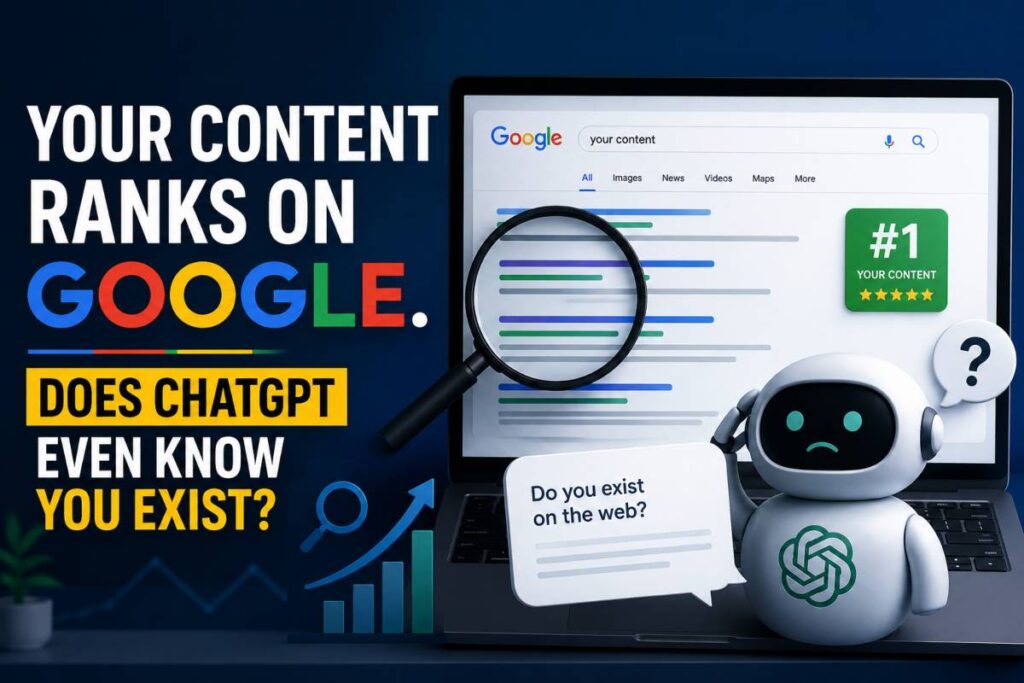
- Answer engines like ChatGPT, Perplexity, and Google’s AI Overviews now answer questions before anyone clicks a link
- AEO (Answer Engine Optimization) is about getting cited in those answers, not just ranking below them
- The tactics overlap with good SEO, but the measurement is completely different — you can’t see AEO results in Google Analytics
- You can’t improve what you can’t see, so tracking your AI visibility comes first
Here’s a slightly uncomfortable exercise. Open ChatGPT and ask it to recommend the best tools in your category. Then ask Perplexity the same thing. Then check Google’s AI Overview for a question your product clearly answers.
If your brand doesn’t come up, you’ve just met the problem that’s quietly reshaping search. People are getting their answers from AI before they ever reach a list of blue links — and if the model doesn’t mention you, that visit was never going to happen in the first place. You didn’t lose the click. The click just stopped existing.
This is the gap that Answer Engine Optimization is trying to close, and it’s worth understanding properly before you start changing anything.
What AEO Actually Means (And Why It’s Not Just SEO With a New Hat)
AEO is the practice of shaping your content so AI answer engines can find it, trust it, and cite it as the source of an answer. The goal isn’t position #3 on a results page. It’s being the sentence the model writes, with your name attached.
The confusing part is that AEO and traditional SEO share a lot of DNA. Clear structure helps both. So does genuine topical authority, fast-loading pages, and content that answers a real question instead of circling it. If you’ve spent years doing SEO well, you’re not starting from zero.
But the differences matter. Google rewards a page; an answer engine rewards a claim it can lift and attribute. That changes how you write. Burying your best answer in paragraph nine works against you, because models favour content that states things plainly and early. A 2,000-word warm-up before the payoff is an SEO habit that AEO actively punishes.
The Measurement Problem Nobody Warns You About
Here’s where most teams get stuck. With SEO, you have feedback. Rankings, impressions, click-through rates, a Search Console graph that goes up or down. With AEO, that feedback loop mostly disappears.
When ChatGPT recommends a competitor instead of you, there’s no notification. No rank drop to investigate. The answer happens inside a conversation you never see, and the only way to know is to go looking — manually, one prompt at a time, across half a dozen models that all answer slightly differently and change their minds week to week.
That’s clearly not sustainable as a Tuesday-morning routine. It’s the reason a small category of AI visibility tools has appeared, built specifically to monitor how brands are mentioned across answer engines like ChatGPT, Perplexity, Gemini, and Google AI Overviews. One open-source option worth knowing about is Elmo, which tracks how answer engines like ChatGPT, Perplexity, Gemini, and Google’s AI Overviews mention your brand — including which competitors show up next to you and which sources each model cites when it answers. Being open source, it’s also a reasonable way to understand how this tracking works rather than treating it as a black box. Whatever tool you reach for, the principle holds: you can’t optimize what you can’t observe, and AEO without measurement is just guessing with extra steps.
Practical Things You Can Do This Week
Once you can see where you stand, the work itself is refreshingly concrete:
Answer the question in the first two sentences. Lead with the direct answer, then expand. Models reward content that gets to the point, and so, increasingly, do readers.
Use real structure. Clear H2s and H3s phrased as questions, short paragraphs, and the occasional list give an answer engine clean blocks to extract. Sprawling walls of text are hard to quote.
Add FAQ and How-To schema where it fits. Structured data won’t carry weak content, but it makes strong content far easier for a machine to parse and attribute.
Watch which sources get cited in your space. This is the most useful signal AEO offers. If the same three sites keep getting quoted on your topic, study what they’re doing — depth, original data, clear formatting — and close the gap.
Publish things worth citing. Original research, real numbers, a genuine point of view. Models gravitate toward content that says something the rest of the internet hasn’t already said a hundred times.
Where This Leaves You
None of this means SEO is over. Google is still the most-used search engine in the world, and ranking still matters enormously. AEO sits alongside it as a second front, one where the currency is being the answer rather than appearing beneath it.
The honest takeaway is that you probably don’t know your AEO position right now, and that’s the actual starting point. Run those prompts. See what the machines say about you when you’re not in the room. Then decide what to do about it.
Because the brands that win the next few years won’t necessarily be the ones who ranked first. They’ll be the ones the answer engines learned to trust.