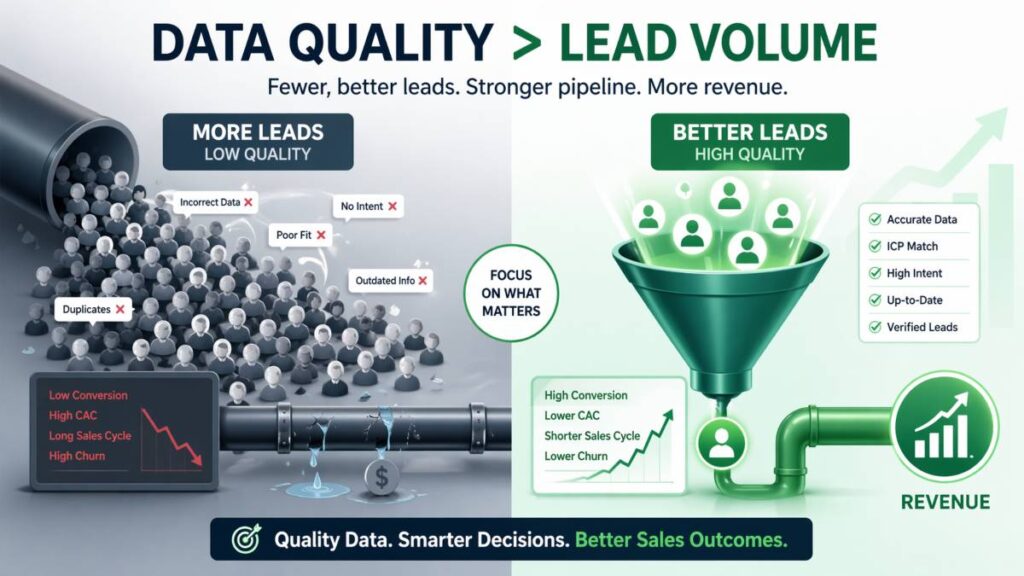
A full pipeline feels like progress. Dashboards glow with numbers. New leads keep flowing in. Yet revenue stays flat, and sales teams keep chasing names that never convert. The gap is not effort. It is data.
Lead volume builds the illusion of growth, but poor data quietly drains results. Wrong contacts, weak fit, and zero intent turn busy pipelines into stalled deals. On the other side, fewer leads backed by clean, accurate data move faster, close stronger, and cost less to win.
This shift from volume to quality changes how teams think about growth. In this guide, you will see how data quality improves conversion rates, reduces acquisition costs, and sharpens pipeline performance in ways raw volume never can.
The Illusion of High Lead Volume
Why More Leads Don’t Mean More Revenue
More leads look good on paper. Dashboards fill up, reports look busy, and teams feel productive. But many of these contacts are what sales teams quietly call paper leads. They exist in the system but carry no real buying intent. This volume-versus-value gap becomes especially clear in markets where deal size and complexity rise. Those focusing on the complexities of what is high ticket sales realize that a single qualified prospect often outweighs a database full of these hollow entries.
A big reason is poor alignment with your ideal customer profile. When leads fall outside your target industry, company size, or role, they rarely move forward. Add low intent to the mix, and the problem deepens. People may download content or click an ad, yet have no plan to buy.
The result is a pipeline that feels full but behaves empty. Activity rises, but revenue stays stuck.
Hidden Costs of Low-Quality Data
Low-quality data does more than slow results. It drains time and energy across teams. Sales reps spend hours chasing the wrong contacts, fixing records, or qualifying leads that should never have entered the funnel.
Marketing also pays the price. Campaign budgets stretch across audiences that never convert, pulling down return on investment. What looks like reach turns into waste.
Over time, tension builds between marketing and sales. One side pushes volume, the other struggles to close. Without strong data, both teams work harder but move slower, and the gap between effort and outcome keeps growing.
What High-Quality Data Really Means
Core Traits of High-Quality Leads
High-quality data starts with accuracy. Every contact detail should be real, current, and usable. Emails should land in inboxes, phone numbers should connect, and job titles should reflect actual decision-makers.
Next comes fit. Strong leads match your ideal customer profile in clear ways such as industry, company size, and role. When this alignment is in place, conversations move faster because the offer makes sense from the start.
Behavior adds the final layer. Actions like repeat site visits, content downloads, or product page views show real interest. These signals separate casual clicks from people who are closer to making a decision.
The Role of Data Enrichment and Validation
Raw data often looks complete but hides gaps. Missing fields, outdated roles, or duplicate records weaken targeting and slow down outreach.
Enrichment fills those gaps by adding deeper context such as company details, technology use, and buying signals. Validation keeps everything accurate by checking and updating records in real time.
Clean data is not just organized. It is reliable, current, and ready for action. With it, teams stop guessing and start focusing on leads that are far more likely to convert.
How Data Quality Improves Sales Performance
Faster Sales Cycles
When data is clean and complete, sales teams spend less time figuring out who they are talking to. There is no need to double-check job roles or chase missing details. Each lead arrives with context, which means conversations start at the right level from the first touch.
This clarity speeds up decisions on both sides. Sales reps can qualify faster, and prospects get relevant answers without delay. The back-and-forth that slows deals down begins to disappear. What used to take weeks can move forward in days because the groundwork is already in place.
Higher Conversion Rates
Better data creates a smoother flow from MQL to SQL. Leads that enter the pipeline already match your target profile and show real interest. That makes it easier for sales to pick up where marketing left off without friction.
With stronger alignment, conversations feel more natural and focused. Prospects are more likely to respond, engage, and move forward. Close rates improve because each interaction builds on accurate insight rather than guesswork.
Larger Deals and Lower Churn
When leads fit your business well, the value of each deal increases. These customers understand the offer, see the relevance, and are more willing to commit at a higher level.
The impact does not stop at the sale. Better-fit customers stay longer and engage more deeply over time. This reduces churn and strengthens long-term value, turning each closed deal into a more stable source of revenue.
The Cost Advantage of Quality Over Quantity
Lower Customer Acquisition Cost (CAC)
Chasing large volumes often looks cheaper at first. More leads for the same budget feels like a win. In reality, it creates hidden waste. Ads reach people who will never convert, and sales teams spend time on contacts that go nowhere.
High-quality data changes that equation. When your leads match your target profile and show real interest, every dollar works harder. You spend less on broad campaigns and more on the right audience. Fewer irrelevant leads enter the pipeline, which means less time and money lost along the way.
The result is a lower customer acquisition cost, not by cutting spend, but by making each effort count.
Better Marketing Efficiency
Strong data sharpens targeting. Campaigns reach people who are more likely to engage, respond, and move forward. Messages feel relevant because they are built on real insight, not guesswork.
This focus leads to smarter budget allocation. Instead of spreading resources thin, teams invest in channels and segments that deliver results. Performance becomes easier to track, and adjustments become clearer.
Efficiency is not about doing more. It is about doing the right things with precision, and high-quality data makes that possible.
Why Poor Data Breaks Your Pipeline
A pipeline should move with rhythm. Leads come in, get qualified, and progress toward revenue. Poor data disrupts that flow at every stage. Instead of momentum, teams face delays, confusion, and missed chances. Establishing a single source of truth through Lative empowers operations leaders to audit their data health regularly and maintain a high-velocity environment where every stage of the sales funnel remains transparent, predictable, and fully actionable.
When information is incomplete or wrong, even strong leads lose value. What looks like a healthy pipeline starts to stall, not because of lack of effort, but because the foundation is weak.
Slower Response Times
Bad data slows everything down. Sales teams spend extra time filtering through contacts, checking details, and figuring out who is worth reaching out to.
This delay affects first response time, which is often critical. By the time a lead is verified, the moment of interest may already be gone.
Missed High-Intent Opportunities
In a crowded pipeline filled with weak data, strong leads are easy to miss. High-intent prospects get buried under noise, making them harder to spot and prioritize.
When this happens, valuable opportunities slip through. The right leads are there, but they do not get the attention they need at the right time.
Weak Forecasting and Decision-Making
Data drives planning. When the data is flawed, the insights built on it become unreliable. Forecasts lose accuracy, and teams struggle to make confident decisions.
This creates a ripple effect across the business. Strategies become harder to trust, and growth becomes harder to predict because the numbers no longer reflect reality.
Volume vs Quality A Clear Comparison
At a glance, more leads seem better. Bigger numbers suggest stronger growth. But when you compare outcomes side by side, the gap becomes clear. Quality drives results that volume alone cannot match.
| Metric | Volume-First Approach | Quality-First Approach |
|---|---|---|
| Conversion Rate | Low, many leads do not convert | Higher, leads are better matched |
| Sales Cycle | Longer due to extra filtering | Shorter with ready-to-buy leads |
| Deal Size | Smaller, weaker fit customers | Larger, stronger alignment |
| CAC | Higher due to wasted spend | Lower with focused targeting |
| Churn | Higher, poor fit customers leave | Lower, better long-term fit |
The difference is not subtle. A smaller set of strong leads can outperform a large pool of weak ones. When quality improves, every stage of the pipeline becomes more efficient and more predictable.
How to Shift from Lead Volume to Data Quality
Moving from volume to quality is not about cutting leads. It is about raising the standard of what enters your pipeline. This shift requires clear rules, better data practices, and strong alignment across teams. Utilizing data quality management services ensures that your lead volume never outpaces your team’s ability to close deals.
Define and Refine Your ICP
Start with a clear picture of your ideal customer. Look at your best deals and identify patterns such as industry, company size, and decision-maker roles.
Turn these insights into simple targeting rules. When your ICP is well defined, it becomes easier to filter out poor-fit leads before they reach your sales team.
Invest in Data Cleaning and Enrichment
Raw data often comes with gaps and errors. Cleaning removes duplicates, fixes incorrect details, and keeps records usable.
Enrichment adds depth. It brings in company data, role context, and buying signals that make each lead more valuable. With the right tools and workflows, your data stays accurate and ready for action.
Use Intent Data and Smart Lead Scoring
Not all leads are equal. Intent data helps you spot people who are actively researching or showing interest.
Combine this with lead scoring to rank prospects based on fit and behavior. This allows teams to focus on leads that are more likely to convert instead of chasing every contact.
Align Marketing and Sales Teams
Quality improves when both teams work toward the same goals. Agree on what counts as a qualified lead and how it should be handled.
Shared definitions reduce confusion and speed up handoffs. When marketing sends better leads and sales trusts the data, the entire pipeline becomes stronger and more efficient.
Key Metrics to Track Data Quality Success
You cannot improve what you do not track. Strong data shows up clearly in performance metrics across the pipeline. Instead of focusing on lead count, shift attention to how leads move and convert.
Start with the lead to MQL rate. This shows how many incoming leads actually meet your criteria. Next, track the MQL to SQL rate to see how well qualified leads progress into real opportunities.
Conversion rate gives a direct view of how many deals close. Sales cycle length shows how quickly leads move from first touch to final decision. Finally, customer lifetime value reflects the long-term impact of better data and stronger fit.
Together, these metrics tell a clear story of whether your data is helping or holding you back.
Final Thoughts
More leads do not guarantee better results. In many cases, they slow teams down and dilute focus. A smaller set of well-qualified leads often delivers stronger outcomes across every stage of the pipeline.
The shift starts with a simple step. Review your current data. Look for gaps, outdated records, and poor-fit contacts. Fixing these issues can unlock faster progress without increasing lead volume.
Growth comes from revenue, not surface-level numbers. When you focus on data quality, every lead carries more value, and every win becomes more predictable.
Read More: Core Web Vitals Explained: Why Site Speed Kills Your Rankings