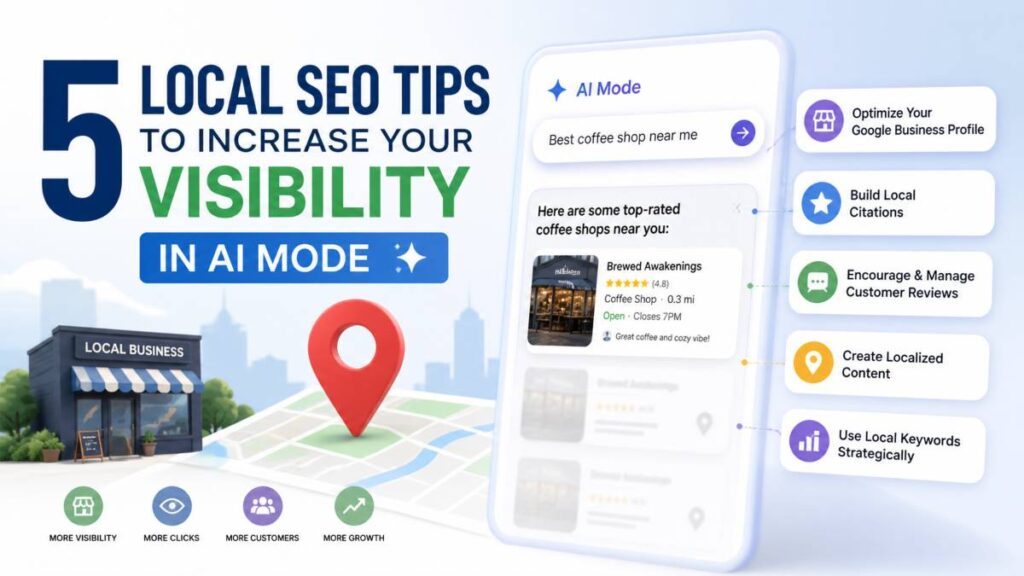
Google’s AI Mode has quietly changed the rules of local search and most businesses haven’t noticed yet.
Launched in March 2025 and rolled out to users across 180+ countries by late 2025, AI Mode is a Gemini-powered search experience that replaces traditional blue-link results with a single & synthesized AI-generated answer. When a potential customer searches ‘best plumber near me’ or ‘affordable dentist in [city],’ they no longer see a list of 10 websites. They see one AI-curated response and only the businesses that AI Mode trusts get cited in it.
The numbers make the stakes clear. AI Mode surfaces 32% fewer local businesses than the traditional map pack, according to research published by Verlua. A business that ranked comfortably on page one of traditional search results may now be completely absent from AI Mode responses. At the same time, brands cited within AI-generated answers earn 35% more organic clicks than non-cited competitors, according to data from Semrush.
This is not a distant future concern. It is happening right now. And the businesses adapting their local SEO strategy today are the ones who will hold their visibility as AI Mode becomes the default search experience for hundreds of millions of users.
Here are five concrete tips to help your business stay visible.
Fully Optimize Your Google Business Profile – Treat It as a Living Asset
Google Business Profile (GBP) is the single most critical data source AI Mode uses when answering local queries. According to Whitespark’s 2026 Local Search Ranking Factors report, GBP signals remain the top-weighted factor for local visibility in AI-driven search.
AI Mode’s underlying model, Gemini reads your GBP to construct answers. If your profile is incomplete or thin on detail, Gemini either skips your business or pulls inaccurate information from unverified web sources. AI Mode’s underlying model, Gemini, reads your GBP to construct answers, so maintaining accurate details and strong web hosting security is essential to prevent misinformation and protect business data from unreliable sources.
What to do:
- Complete every field: business description, service list, attributes, categories, and operating hours
- Upload fresh photos consistently. One 2025 report found businesses with photos receive 45% more direction requests and 31% more website clicks
- Post at least once per week to signal that your business is active
- Respond to the Q&A section promptly, since Gemini now scans your GBP responses to generate instant answers to customer questions
- Choose your primary category to avoid stacking irrelevant secondary categories, which dilutes your topical relevance
Think of your GBP not as a listing you set up once, but as a live content channel that feeds AI Mode with verified, trustworthy local data about your business.
Lock Down NAP Consistency Across Every Platform
NAP stands for Name, Address & Phone Number. It sounds basic, but inconsistent NAP data across directories, your site, etc. is one of the most common reasons local businesses lose AI search visibility.
AI Mode uses a technique called query fan-out. It fires multiple parallel searches simultaneously across Google’s index, Knowledge Graph, and external directories to construct a single answer. During this process, Gemini is cross-checking whether your business information is consistent and trustworthy. Even small discrepancies weaken the trust signals the AI assigns to your business.
According to Whitespark’s 2026 data, citation signals account for 13% of AI search visibility factors. That is not a small number.
Run a citation audit across Google, Yelp, Facebook, Apple Maps & industry-specific directories. Your NAP data must be identical everywhere. Treat your GBP as the single source of truth and align every other platform to it.
Working with experienced local SEO experts who manage multi-platform citation consistency can significantly reduce the manual effort this requires for businesses with multiple locations.
Build Location-Specific Content That Directly Answers Local Questions
Traditional local SEO rewarded keyword density. AI Mode rewards answer quality. Gemini’s job is to find the most direct, accurate, and trustworthy answer to a user’s question and it prefers content structured to give that answer immediately, not bury it three paragraphs into a blog post.
This means your location pages & service pages need to lead with the answer not with a company introduction. The same principle applies to helping visitors quickly find what they came for: immediate access to your physical locations. Prioritizing the store locator functionality ensures users obtain precise address details or operating hours without digging through blocks of text.
Instead of starting a page with: “At XYZ Company, we have been serving customers for over 20 years…”
Start with: “We provide [specific service] in [city], with same-day availability and free consultations. Here’s what our local customers most commonly ask us.”
What works for AI Mode:
- Short, direct answer paragraphs at the top of each page
- FAQ sections that mirror questions local customers actually search in natural, conversational language
- Location-specific service pages for each city or neighborhood you serve
- Content that anticipates follow-up questions, since AI Mode’s conversational interface builds on previous answers in the same session
According to Google’s own Search Central documentation, the best practices for appearing in AI Mode are the same as core SEO: create helpful, people-first content that directly satisfies the user’s query. The difference is that in AI Mode, content that buries its answer loses to content that leads with it.
Implement LocalBusiness Schema and FAQ Markup
Structured data is how you speak directly to Gemini in a language it processes without ambiguity. While great content helps AI Mode understand what your business does, schema markup tells it definitively removing the guesswork that can cost you a citation.
LocalBusiness schema, implemented via JSON-LD, communicates your NAP, operating hours, service categories, and geographic area to AI systems in a machine-readable format. When your schema data matches your GBP and your on-page content, Google’s confidence in your business as a trustworthy source increases and confident AI systems cite confidently.
Schema types that matter for local visibility:
- LocalBusiness schema on your homepage and contact page
- FAQPage schema wrapping your FAQ sections. This directly feeds AI Mode’s answer synthesis
- AggregateRating schema if you display reviews on your site
- Service schema on individual service pages
One important rule from Search Engine Land: keep your schema truthful and aligned with visible on-page content. If your schema markup asserts a 5-star average rating but your GBP shows 4.2, the AI ignores your schema entirely. Consistency across signals is what earns citation, not the markup alone.
A qualified local SEO agency can audit your current schema implementation, identify gaps, and ensure your structured data is properly validated in Google’s Rich Results Test before it’s deployed.
The Bottom Line
AI Mode is not replacing traditional local SEO, it is raising the bar for what ‘optimized’ means. The businesses that will maintain and grow their local visibility are those treating their GBP as a live content asset by keeping their citations airtight, structuring their content to answer questions directly, using schema to remove ambiguity & earning reviews.
These are not technical tricks. They are the fundamentals of being a trustworthy, well-documented local business and AI Mode is simply better at rewarding them than traditional search ever was.
Whether you are managing this in-house or partnering with a dedicated local SEO service to handle the complexity, the businesses acting now are building a compounding advantage over those who wait.