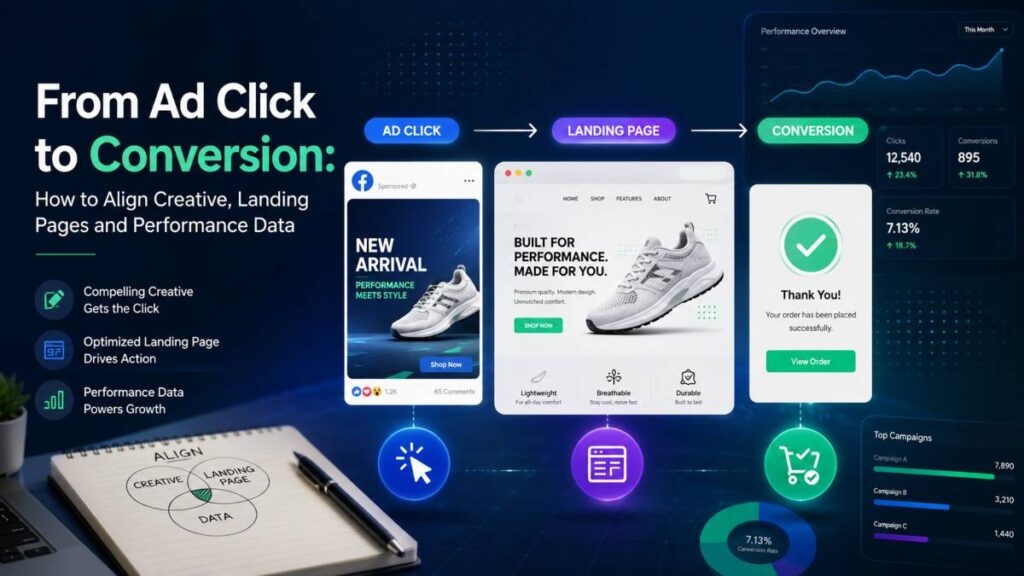
Digital campaigns are often managed as a collection of separate tasks.
The media team launches the ads. The design team produces the visuals. A copywriter prepares the landing page, while another person reviews analytics after the campaign has already been running for several weeks.
Each part may look acceptable on its own, yet the complete journey can still feel disconnected.
An ad introduces one promise, the landing page emphasizes something else and the performance report explains which campaign generated clicks without showing which creative decisions actually influenced those results.
This is why improving paid campaign performance requires more than producing attractive ads or redesigning individual landing pages. Teams need to treat the ad, the destination page and the performance data as parts of one connected creative system.
What creative alignment actually means
Creative alignment means that the experience after the click continues the idea that persuaded someone to click in the first place.
Suppose a software company runs an advertisement promising to help finance teams reduce manual reporting. The person who clicks should immediately reach a page that reinforces the same audience, problem and outcome.
The page should not open with a broad statement about “transforming the future of business.” It should continue the specific conversation that the ad started.
Alignment normally covers five elements:
- The audience being addressed
- The problem or desired outcome
- The primary headline
- The visual direction
- The next action the visitor should take
This is sometimes called message matching, but the principle extends beyond copy. Colors, imagery, product screenshots, offers and calls to action should also feel connected.
Google includes both ad relevance and landing-page experience among the components it uses to diagnose the quality of search advertising. A landing page should therefore be relevant and useful to the person who arrives from the corresponding ad, rather than functioning as a generic destination for every campaign.
Start with one clear campaign narrative
Campaign consistency becomes much easier when the team first agrees on one central narrative.
A useful campaign narrative answers four questions:
- Who is this campaign for?
- What problem does that audience recognize?
- What outcome are we promising?
- What proof makes the promise believable?
This does not mean every advertisement must look identical. Teams can test different hooks, visual styles and formats while keeping the underlying offer consistent.
For example, a project-management platform might test several approaches:
- Reduce delays caused by scattered project updates
- Give managers clearer visibility across remote teams
- Replace manual status reporting with one shared workspace
- Help teams identify blockers before deadlines are missed
These are different creative angles, but they still belong to the same broader campaign narrative.
Rankvisely’s guide to storytelling in digital business marketing recommends moving audiences through a recognizable problem, journey, solution and result. That same structure works well across advertisements and landing pages because it gives the campaign a logical progression instead of a collection of disconnected claims.
Build ad variations around hypotheses
Producing more advertisements is not automatically the same as testing more ideas.
Ten ads with different background colors may create additional files, but they reveal very little about why customers respond. Useful creative testing starts with a hypothesis.
A team could test:
- Problem-focused messaging against outcome-focused messaging
- Product screenshots against customer-centered imagery
- Short headlines against explanatory headlines
- Demonstrations against testimonials
- Static images against short-form video
- Direct calls to action against lower-commitment offers
Each variation should change something meaningful enough to produce a useful learning.
It is also important to avoid changing every element simultaneously. When the visual, headline, format, audience and offer all change at once, the team may know which advertisement performed better but not why it performed better.
Superside’s guide to designing high-performing ads similarly distinguishes between visual appeal and actual performance. An advertisement does not succeed simply because it looks polished. It succeeds when its creative choices support the campaign objective and connect with the intended audience.
Carry the winning idea onto the landing page
Once someone clicks an ad, the landing page should confirm that they have reached the right place.
The most important information should appear near the top of the page:
- A headline that reflects the advertisement
- A short explanation of the offer
- A relevant visual or product demonstration
- A clear call to action
- Early proof that reduces uncertainty
Consider an advertisement promoting “automated monthly reports for marketing agencies.” Sending visitors to a general product homepage forces them to search for the feature they were promised.
A dedicated page can instead open with the same outcome, show how the reporting works and direct visitors toward a relevant demo or trial.
The advertisement creates interest. The landing page develops that interest into confidence.
This principle also applies to visual continuity. When an ad uses a particular product view, illustration style or campaign concept, repeating recognizable elements on the landing page reassures the visitor that the experience is connected.
That does not require copying the complete ad onto the page. The goal is continuity, not duplication.
Adapt the page to the traffic source
Not every visitor arrives with the same context or level of intent.
Someone clicking a search advertisement may already be looking for a specific solution. A person arriving from a short social video may only have encountered the problem a few seconds earlier.
The landing page should account for that difference.
Search-driven pages may focus more quickly on:
- Product capabilities
- Comparisons
- Pricing or purchase considerations
- Demonstrations
- Clear conversion actions
Social campaign pages may need more space for:
- Explaining the problem
- Establishing relevance
- Visual storytelling
- Customer examples
- Lower-friction calls to action
B2B account-based campaigns may require another variation for a particular industry, company type or stakeholder. Rankvisely’s article on B2B marketing strategies in 2026 also highlights the importance of audience clarity, role-specific messaging and personalized experiences across the buying journey.
A single generic landing page cannot always support every channel, audience and creative angle equally well.
Create modular pages instead of rebuilding everything
The need for campaign-specific pages creates an obvious production challenge.
Building a completely new page for every audience and advertisement can become expensive and slow. Reusing one generic page for every campaign, however, weakens relevance.
A modular page system provides a practical middle ground.
The team can create reusable sections for:
- Hero messages
- Product demonstrations
- Customer proof
- Feature explanations
- Industry use cases
- Frequently asked questions
- Calls to action
Campaign owners can then assemble approved components and adjust the headline, visual, proof and offer without redesigning the complete page.
This is particularly useful for agencies and marketing teams managing multiple campaigns, regions or audience segments.
For companies without sufficient internal production capacity, creative partners such as Superside’s landing-page design service combine campaign strategy, design, copy and development while supporting both fully custom pages and modular systems. The important principle is not the provider itself, but the operating model: landing pages should be designed as part of the ongoing campaign pipeline rather than requested as isolated web projects.
Protect speed while improving visual quality
Creative alignment should not come at the expense of page performance.
Large videos, uncompressed campaign images, heavy animation and unnecessary scripts can make a visually impressive page frustrating to use. This is particularly damaging when most campaign traffic comes from mobile devices.
Google’s current Core Web Vitals guidance recommends aiming for:
- Largest Contentful Paint within 2.5 seconds
- Interaction to Next Paint below 200 milliseconds
- Cumulative Layout Shift below 0.1
These metrics address loading performance, responsiveness and visual stability.
Practical steps include:
- Compressing campaign images
- Serving images at the dimensions in which they appear
- Using modern image formats where appropriate
- Avoiding autoplay video when it adds little value
- Reserving space for images and embedded content
- Limiting third-party scripts
- Testing pages on mobile connections
- Loading nonessential media only when it is needed
Rankvisely has also covered why visual content matters for SEO and how web hosting affects SEO. The same considerations matter for paid landing pages. Visuals should support understanding and conversion without creating unnecessary loading delays.
Measure creative elements, not only campaigns
Most advertising dashboards are organized around campaigns, ad sets, spend and platform metrics.
That information is necessary, but it may not tell the creative team what to produce next.
Creative analysis should also examine characteristics such as:
- Hook
- Value proposition
- Visual format
- Product shown
- CTA
- Audience angle
- Testimonial or proof type
- Video length
- Opening frame
- Placement
For example, a report might reveal that short product demonstrations generate more qualified clicks than abstract brand videos, or that customer-result headlines outperform feature-focused headlines for one audience.
Those insights are more actionable than simply knowing that Campaign A beat Campaign B.
Teams can maintain a manual tagging system, but it becomes difficult as the number of advertisements grows. Platforms such as Superads use AI tagging to organize advertisements by elements such as visual format, hook, product and angle. This helps performance and creative teams investigate what contributed to results across Meta, Google, TikTok and LinkedIn instead of relying entirely on spreadsheets or platform-by-platform reports.
The purpose of this analysis is not to let a tool make every creative decision. It is to make campaign evidence easier for people to interpret.
Connect landing-page and ad data
Strong click-through rates do not always indicate a strong campaign.
An advertisement can attract attention while sending visitors who do not understand the offer or have little intention of converting. Similarly, a page can convert well among the people who reach it while the advertisement fails to generate enough qualified traffic.
Teams should review the complete journey.
Useful metrics include:
| Stage | Questions | Example metrics |
| Attention | Did the creative stop the right audience? | Video hook rate, thumb-stop rate, impressions |
| Interest | Did the message encourage action? | CTR, outbound clicks |
| Page experience | Did visitors engage after arriving? | Landing-page views, engagement, scroll depth |
| Conversion | Did the page remove enough uncertainty? | Form completion, purchase rate, demo requests |
| Efficiency | Was the result commercially sustainable? | Cost per lead, cost per acquisition, ROAS |
Looking at these stages together prevents misleading conclusions.
A high-CTR ad with poor landing-page engagement may have an exaggerated or unclear promise. A low-CTR ad that produces highly qualified conversions may need a stronger opening without changing the offer itself.
Turn each campaign into the next creative brief
The final step is closing the feedback loop.
Campaign reporting should not end with a presentation explaining what happened. It should produce instructions for the next creative cycle.
A useful review might conclude:
- Continue testing customer-result headlines
- Reduce reliance on generic lifestyle imagery
- Create shorter product demonstrations for mobile placements
- Carry the strongest ad promise into the landing-page headline
- Develop an industry-specific proof section
- Remove page elements that distract from the primary CTA
- Test a lower-friction offer for colder social traffic
These findings can then become part of the next brief.
Over time, the organization develops a library of audience insights, effective hooks, visual patterns and landing-page components. The creative process becomes faster because teams are no longer beginning every campaign from assumptions.
Common alignment mistakes
Even experienced marketing teams frequently make a few avoidable mistakes.
Sending every campaign to the homepage
Homepages must serve several audiences and business goals. Campaign pages can focus on one promise and one action.
Optimizing only for clicks
Click-through rate shows whether an advertisement created interest, not whether it attracted the right customer.
Changing too many variables
Tests provide weak insights when every creative element changes at the same time.
Treating the landing page as a final handoff
The page should be planned alongside the advertisement, not requested after the creative has already been approved.
Reporting results without creative context
A dashboard showing spend and conversions does not tell designers which hooks, visuals or formats should be developed next.
Scaling production before establishing a system
AI and templates can produce more assets, but increased volume only helps when teams have clear hypotheses, brand controls and a way to interpret performance.
Build one connected campaign system
Advertising, landing-page design and analytics should not operate as separate departments that exchange files.
They are stages of the same customer experience.
The advertisement introduces a relevant idea. The landing page explains and supports it. Performance data reveals where the idea connected, where the experience created friction and what the team should produce next.
When those parts work together, teams do more than improve one campaign. They create a repeatable system for producing, testing and refining marketing creative based on evidence.
The result is not simply more advertisements or more landing pages. It is a clearer path from attention to action—and a creative process that becomes smarter with every campaign.