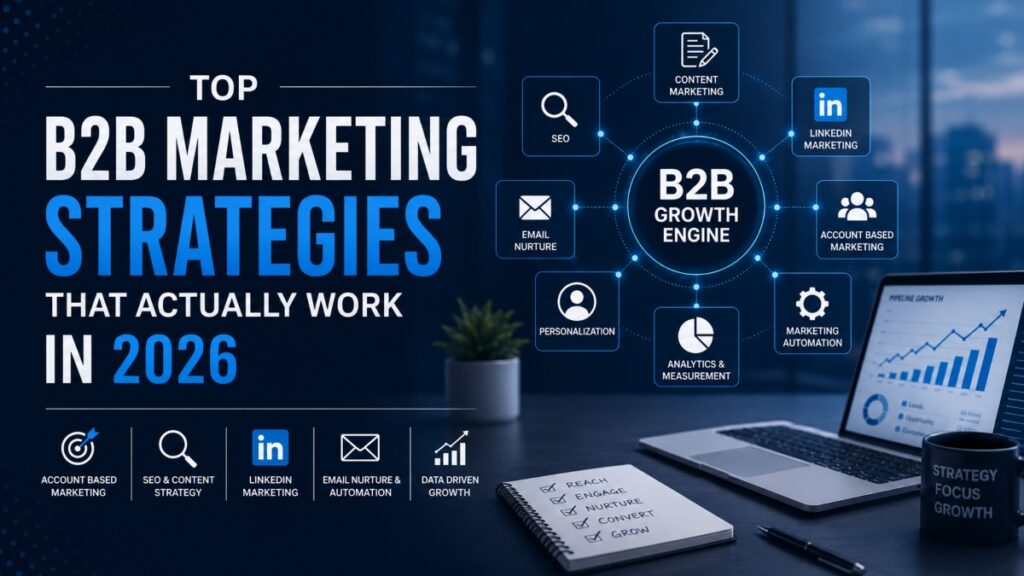
B2B marketing strategies in 2026 look very different from what businesses relied on only a few years ago. Buyers are harder to impress, attention spans are shorter, and decision makers now spend more time researching before speaking to a sales team. Companies that still depend on generic campaigns and mass outreach are finding it harder to generate qualified leads and consistent pipeline growth.
The brands seeing real momentum are focusing on trust, visibility, and relevance across every stage of the customer journey. A strong B2B digital marketing strategy now depends on showing up where buyers search for answers, building credibility through useful content, and using data to create more personalized experiences. These marketing fundamentals continue to drive sustainable growth even as channels and technologies evolve.
SEO remains a major driver of discovery, but search itself has changed. Businesses now need content that performs well in AI search results, answer engines, and zero click environments. LinkedIn has also become one of the strongest channels for B2B demand generation because buyers want expertise and industry perspective instead of polished sales messaging.
Another major shift is the growing importance of first party data. Businesses are using customer behavior, CRM insights, email engagement, and website activity to build smarter campaigns that feel more relevant to each audience segment.
In 2026, successful B2B marketing is no longer about being everywhere at once. It is about becoming easier to find, easier to trust, and easier to buy from.
What Changed in B2B Marketing in 2026
B2B marketing in 2026 is shaped by one major reality. Buyers now control the journey more than brands do. Decision makers spend more time researching independently, comparing options quietly, and validating trust before speaking with sales teams. This shift has changed how businesses approach visibility, content, and conversion.
Old tactics built around mass outreach and broad targeting are losing momentum. Modern buyers expect relevance, credibility, and fast access to useful information. That is why the strongest B2B marketing trends 2026 revolve around trust, authority, personalization, and discoverability across multiple channels.
Buyers Are More Selective and Research Driven
B2B buyers are doing far more self education before entering a sales conversation. Most decision makers now research products, compare competitors, read case studies, and consume expert content long before filling out a contact form.
Buying cycles are also becoming longer because purchases often involve multiple stakeholders across different departments. A software purchase, for example, may require approval from operations teams, finance leaders, procurement staff, and executives before any final decision happens.
This means businesses can no longer rely on one message for every audience. Marketing teams need content tailored to different roles, pain points, and buying stages. Companies that understand buyer intent and provide relevant information earlier in the process are gaining stronger conversion rates and higher quality leads.
AI Search and Zero Click Discovery Are Reshaping Visibility
Search behavior is changing rapidly because buyers are now finding information through AI driven systems instead of traditional search results alone. AI Overviews, ChatGPT discovery, and zero click search experiences are becoming larger parts of the customer journey.
Instead of clicking through multiple pages, users increasingly receive summarized answers directly inside search interfaces. This means businesses need AI search optimization strategies that focus on clarity, structure, and credibility.
Content must now become citation ready. Pages with verified claims, structured formatting, original insights, and trustworthy sources are more likely to appear inside AI generated search responses.
SEO in 2026 is no longer only about rankings. Visibility now depends on whether content is useful enough to be referenced by AI systems and trusted by readers immediately.
Trust and Proof Matter More Than Reach
Reach alone is not enough anymore. Buyers want evidence before they commit attention, budget, or trust.
Proof based marketing is becoming one of the strongest performance drivers across B2B campaigns. Businesses are relying more heavily on:
- Case studies
- Customer results
- Benchmark reports
- Product walkthroughs
- Expert commentary
- Transparent methodologies
Authority also matters more because buyers are skeptical of generic marketing claims. Brands that publish useful insights, practical advice, and verifiable information are building stronger long term credibility.
Transparency is becoming another major differentiator. Businesses that communicate clearly, show real outcomes, and remove friction from the buying process are earning more trust in crowded markets.
Define a Clear ICP and Market Position
One of the biggest reasons B2B campaigns fail in 2026 is simple. Too many companies try to market to everyone at the same time. Generic messaging creates weak positioning, lower engagement, and poor conversion quality because buyers no longer respond to broad promises that sound interchangeable.
Modern B2B growth depends heavily on audience clarity. Businesses that understand exactly who they serve, what problems they solve, and why buyers should trust them are building stronger pipelines with less wasted marketing spend.
Clear ICP targeting and strong B2B positioning now sit at the center of high performing marketing strategies.
Why Broad Messaging Fails in 2026
B2B buyers are overloaded with content every day. Emails, ads, LinkedIn posts, webinars, case studies, and AI generated articles compete for attention constantly. If messaging feels vague or generic, buyers move on immediately.
Many companies still rely on messaging that tries to appeal to every industry, every team size, and every use case. The result usually sounds flat because it lacks specificity.
For example, saying a product helps businesses “improve efficiency” means very little in 2026. Buyers want to know:
- Which business problem gets solved
- Who the solution is built for
- What outcome they can expect
- Why the company is different from competitors
Specificity creates stronger trust because it signals expertise and relevance.
Businesses with focused messaging often generate better lead quality because the right buyers recognize themselves immediately in the content. This improves conversion rates while reducing wasted outreach toward unqualified audiences.
Build a Strong Ideal Customer Profile
A strong Ideal Customer Profile helps businesses focus marketing efforts on buyers with the highest likelihood of conversion and retention.
An effective ICP should include:
- Industry
- Company size
- Revenue range
- Team structure
- Operational challenges
- Buying triggers
- Decision making process
For example, a cybersecurity company targeting enterprise healthcare organizations will need completely different messaging than a SaaS platform targeting startup marketing teams.
Buyer intent marketing becomes far more effective when businesses understand the motivations behind purchasing decisions. Some buyers want faster operations. Others care more about compliance, cost reduction, scalability, or workflow visibility.
Businesses should also identify common pain points within their target audience. These may include:
- Slow manual processes
- Weak reporting systems
- Rising operational costs
- Poor customer retention
- Disconnected software tools
The more clearly businesses understand these frustrations, the easier it becomes to create messaging that feels relevant and immediate.
Position Around Outcomes Instead of Features
Many B2B brands still focus too heavily on product features instead of business outcomes. Buyers care less about technical specifications and more about what changes after implementation.
Strong B2B positioning explains the result rather than just describing the tool.
For example:
- Faster onboarding
- Higher lead conversion rates
- Reduced support workload
- Better sales visibility
- Shorter reporting cycles
Outcome driven messaging creates stronger emotional connection because buyers picture the operational improvement instead of just reading feature lists.
Market differentiation also becomes easier when businesses focus on measurable outcomes tied directly to customer pain points. In crowded industries where products appear similar on the surface, positioning around results helps brands stand apart more clearly.
In 2026, the companies winning attention are not necessarily the loudest. They are the clearest.
Build Topic First SEO Around Buyer Intent
SEO in 2026 looks very different from the traffic chasing tactics many businesses used in the past. Search engines are becoming smarter, AI systems are changing how people discover information, and buyers expect content that answers real questions instead of repeating keywords endlessly.
The strongest B2B SEO strategies now focus on buyer intent rather than isolated search terms. Businesses that build deep topic authority and publish useful content across the entire customer journey are gaining more visibility, stronger engagement, and better conversion quality.
Modern SEO is no longer about ranking one page for one keyword. It is about becoming the most trusted source around a specific topic.
Move Beyond Single Keyword SEO
Many businesses still create disconnected blog posts targeting individual keywords without building broader topical relevance. This approach produces scattered traffic but weaker authority over time.
Search engines and AI systems now evaluate content based on depth, context, structure, and expertise. A single article is rarely enough to establish credibility around a competitive B2B topic.
Instead of chasing isolated phrases, businesses should create topic ecosystems that connect related subjects together. For example, a company targeting B2B demand generation may build supporting content around:
- Lead nurturing
- LinkedIn strategy
- Buyer intent signals
- Sales alignment
- Email workflows
- Conversion optimization
- Attribution reporting
This creates stronger topical authority while improving internal SEO signals across the site.
Intent driven content also matters more because buyers search differently at different stages of the decision process. Someone searching “what is account based marketing” has very different needs from someone searching “best ABM platforms for SaaS companies.” Similarly, prospects researching a LinkedIn outreach platform are often closer to evaluating solutions than users looking for general LinkedIn networking advice.
Businesses that match content to buyer intent usually generate more qualified traffic and better engagement metrics.
Create Content for Every Buying Stage
One of the biggest SEO mistakes in B2B marketing is creating only top of funnel educational content without supporting the rest of the buying journey. SayNine helps address this by offering SEO writing services, which include mapping content strategically across every stage, from awareness to conversion. something professional SEO writing services help address by mapping content strategically across every stage, from awareness to conversion.
Modern SEO strategies should include content for awareness, comparison, and decision stages.
Awareness Stage
At this stage, buyers are identifying problems and researching possible solutions.
Useful awareness content includes:
- Educational blog posts
- Industry trend reports
- Beginner guides
- Statistics roundups
- Explainer articles
The goal is visibility and trust building rather than direct conversion.
Comparison Stage
Buyers now start evaluating available options and approaches.
Strong comparison content includes:
- Platform comparisons
- Strategy breakdowns
- Feature analysis
- Case studies
- Workflow examples
Comparison tables work especially well here because they help users scan information quickly while improving featured snippet opportunities.
Decision Stage
At the final stage, buyers want proof and clarity before taking action.
Decision focused content should include:
- Product demos
- Customer success stories
- ROI examples
- Testimonials
- Pricing explanations
- Implementation details
Businesses that support every stage of the buying process create smoother user journeys and stronger conversion paths.
Optimize for AI Search and Featured Snippets
AI search optimization is becoming one of the biggest priorities in B2B SEO. Buyers increasingly discover information through AI generated summaries, answer engines, and zero click search experiences.
This changes how content should be structured.
Pages now need:
- Clear headings
- Concise explanations
- Structured formatting
- Verifiable claims
- Expert quotes
- Source citations
AI systems favor content that is easy to interpret and trustworthy enough to reference directly.
For instance, a well-structured Semaglutide weight program page that enables online prescriptions, outlines eligibility and insurance coverage, and explains ongoing coaching/support gives AI clear, verifiable signals while satisfying high-intent searches.
Featured snippets also remain valuable because they increase visibility above traditional search listings. Businesses can improve snippet performance by:
- Answering questions directly
- Using numbered steps
- Adding concise definitions
- Formatting lists clearly
- Including FAQ schema
Content written for AI visibility should sound natural and authoritative instead of overloaded with keywords.
The goal is clarity, not repetition.
Use Internal Linking and Topic Clusters
Internal linking plays a much bigger role in SEO than many businesses realize. Well connected content helps search engines understand topic relationships while improving user navigation across the site.
Topic clusters organize related content around a central pillar page. For example, a pillar page about B2B SEO strategies may link to supporting articles covering:
- AI search optimization
- Keyword research
- LinkedIn distribution
- Email nurture
- Content attribution
- Conversion optimization
This structure strengthens topical authority while helping visitors discover related resources naturally.
Internal links also improve session duration because users move between connected pages instead of leaving after reading one article.
Businesses should also support topic clusters with:
- FAQ schema
- Expert commentary
- Source backed claims
- Original examples
- Industry data
- Visual comparisons
In 2026, SEO success comes from depth, trust, and usability. The brands gaining visibility are building content ecosystems that answer buyer questions clearly while becoming reliable sources for both human readers and AI search systems.
Use LinkedIn as a B2B Demand Generation Engine
LinkedIn has become one of the most valuable platforms for B2B demand generation in 2026 because buyers now spend more time researching people and expertise before they trust a company. Businesses are no longer winning attention through aggressive outreach alone. They are winning by becoming familiar, credible, and consistently useful inside the feeds their audience already checks every day.
The platform works best when businesses stop treating it like a billboard and start treating it like a conversation channel. Buyers want perspective, experience, and practical insight. They want to hear from real people instead of polished corporate messaging that sounds interchangeable.
Strong LinkedIn B2B marketing creates visibility long before a sales conversation begins.
Thought Leadership Content That Builds Authority
Thought leadership remains one of the strongest ways to build trust on LinkedIn, but the definition has changed. Buyers are tired of vague motivational posts and recycled business advice. Content performs better when it feels practical, specific, and grounded in real experience.
Businesses should focus on:
- Industry observations
- Process breakdowns
- Lessons from client work
- Operational challenges
- Data driven insights
- Market trends with clear context
The goal is not to sound impressive. The goal is to become consistently useful.
Buyers remember brands that help them think more clearly about their problems. A short post explaining why most B2B funnels lose qualified leads can generate more engagement than a polished promotional campaign.
Strong thought leadership also improves brand authority because audiences begin associating the company with expertise instead of advertising.
Employee Advocacy and Founder Led Marketing
One major shift in LinkedIn B2B marketing is the growing power of employee advocacy and founder visibility. People trust people more than logos, especially in B2B environments where purchases involve risk and long decision cycles.
Founder led marketing works because it creates familiarity. Buyers want to understand who runs the company, how they think, and whether their perspective feels credible.
Employee advocacy strengthens this even further. When team members share experiences, insights, and industry commentary, the business gains broader reach while appearing more authentic. Using a LinkedIn employee advocacy tool like Supergrow makes it easier for teams to create posts in their own voice, schedule them consistently, and encourage more employees to participate without adding extra work to their day.
Companies seeing strong engagement on LinkedIn often encourage:
- Sales teams to share customer observations
- Executives to comment on industry changes
- Product teams to explain workflows and solutions
- Customer success teams to discuss implementation lessons
This creates a network effect where multiple voices reinforce the company’s expertise across different audience segments.
LinkedIn Content Formats That Perform Best
Content format matters because LinkedIn users scan quickly. Dense corporate writing often gets ignored, while visual and easy to consume formats hold attention longer.
Some of the strongest performing formats in 2026 include:
Carousels
Carousel posts continue to perform well because they break information into simple visual slides. Businesses use them for:
- Marketing frameworks
- Step by step processes
- Funnel breakdowns
- Industry statistics
- Mistakes to avoid
Carousels increase engagement because users spend more time interacting with the content.
Short Form Insights
Short posts with strong opinions, practical lessons, or clear observations often generate strong discussion. These posts work best when they sound direct and conversational instead of overly polished.
Case Studies
Case studies remain powerful because buyers want proof before making decisions. LinkedIn case studies perform especially well when they focus on:
- Specific business problems
- Process improvements
- Revenue outcomes
- Operational lessons
Real examples create stronger trust than abstract claims.
Video Clips
Short video clips are becoming more common because they humanize brands and increase visibility inside the feed. Businesses use video for:
- Quick industry commentary
- Product walkthroughs
- Behind the scenes insights
- Customer stories
- Event highlights
Simple and informative videos usually outperform highly produced promotional content.
Community Engagement Over Volume Posting
One of the biggest mistakes businesses make on LinkedIn is focusing too heavily on posting frequency while ignoring interaction quality.
LinkedIn rewards engagement and conversation more than constant broadcasting. Businesses that actively participate in discussions often build stronger relationships and more visibility than brands posting daily without interaction.
Community driven LinkedIn strategies include:
- Replying thoughtfully to comments
- Engaging with industry conversations
- Supporting customer posts
- Contributing to niche discussions
- Building relationships before pitching
B2B demand generation works better when trust develops gradually through repeated exposure and meaningful interaction.
In 2026, LinkedIn success is less about chasing virality and more about becoming recognizable, credible, and consistently relevant inside your industry conversation.
Use First Party Data to Improve Personalization
Personalization has become one of the biggest growth drivers in B2B marketing because buyers now expect content, messaging, and offers that feel relevant to their needs. Generic campaigns are losing attention quickly, especially in crowded industries where decision makers receive nonstop outreach every day.
This is why first party data marketing has become a major focus in 2026. Businesses are relying more heavily on their own customer data to improve targeting, increase conversion quality, and create more personalized experiences across every stage of the funnel.
The companies generating stronger pipeline results are not necessarily collecting more data. They are using their existing data more intelligently.
Why Third Party Signals Are Losing Value
For years, marketers depended heavily on third party cookies and external audience tracking to target potential buyers online. That system is becoming less reliable as privacy expectations rise and platforms restrict outside tracking methods.
Modern buyers are also becoming more selective about how they share information. This means businesses need stronger relationships with their audiences instead of relying on rented data sources.
First party data solves this problem because it comes directly from customer interactions with the business itself. The information is more accurate, more relevant, and usually more useful for understanding buyer intent.
Another reason first party data matters is trust. Buyers are more willing to engage with businesses that use personalization naturally instead of aggressively tracking them across the internet.
In 2026, personalization works best when it feels helpful rather than intrusive.
Best Sources of First Party Data
Businesses already collect large amounts of customer information, but many fail to organize and activate it properly.
Some of the most valuable first party data sources include:
CRM Data
CRM systems contain valuable information about:
- Customer history
- Sales conversations
- Deal stages
- Industry type
- Team size
- Purchase behavior
This data helps businesses build more accurate audience segments and improve campaign relevance.
Website Behavior
Website activity reveals what buyers are actively researching. Businesses can track:
- Pages visited
- Time spent on content
- Download activity
- Pricing page visits
- Demo requests
These behaviors often signal buyer intent long before someone contacts sales directly.
Email Engagement
Email performance data helps businesses understand audience interest and engagement levels.
Useful signals include:
- Open behavior
- Link clicks
- Content downloads
- Webinar registrations
- Reply activity
This helps marketers adjust messaging based on actual engagement patterns instead of assumptions.
Product Usage
For SaaS and technology businesses, product usage data is especially valuable. It shows:
- Feature adoption
- User activity
- Drop off points
- Account expansion opportunities
This information helps businesses create smarter upsell campaigns and retention strategies.
Personalized Campaigns That Increase Conversion Rates
Personalized outreach works because it reduces irrelevance. Buyers pay more attention when messaging reflects their situation, goals, or operational challenges.
Businesses are now personalizing:
- Email sequences
- Landing pages
- Content recommendations
- LinkedIn outreach
- Webinar invitations
- Retargeting campaigns
For example, a visitor researching account based marketing may later receive case studies, comparison guides, or strategy content tied directly to ABM instead of generic product messaging.
This creates stronger engagement because the communication feels timely and useful.
Strong B2B conversion strategies focus on relevance at every touchpoint rather than pushing the same message to every audience segment.
Segmentation and Behavioral Targeting
Segmentation is becoming more advanced because businesses now have access to deeper behavioral insights across channels.
Instead of grouping audiences only by industry or company size, marketers are segmenting based on:
- Buying intent
- Content engagement
- Funnel stage
- Product interest
- Customer maturity
- Website behavior
Behavioral targeting helps businesses send the right message at the right moment.
For example:
- A first time visitor may receive educational content
- A returning buyer may receive pricing comparisons
- A highly engaged prospect may receive demo invitations or customer stories
This creates smoother customer journeys and stronger lead quality over time.
In 2026, first party data marketing is no longer optional for serious B2B growth. Businesses that understand their audiences deeply and personalize communication intelligently are building stronger trust, better engagement, and more consistent conversion performance.
Account Based Marketing and Buying Group Targeting
B2B purchasing decisions are becoming more complex in 2026. Most deals no longer depend on a single buyer making a quick decision. Instead, purchases often involve buying committees made up of executives, department leaders, procurement teams, technical reviewers, and internal champions.
This shift is one of the biggest reasons account based marketing strategies continue gaining momentum across B2B growth marketing. Businesses are moving away from broad lead generation campaigns and focusing more attention on high value accounts with stronger conversion potential.
The goal is simple. Reach the right companies, understand the people involved in the decision process, and create personalized engagement that moves the entire account toward action.
Why Buying Committees Matter More in 2026
Modern B2B purchases often involve multiple stakeholders because buying decisions carry financial, operational, and strategic risk.
For example, a software purchase may require approval from:
- Finance teams evaluating budget impact
- Operations leaders reviewing workflow integration
- IT teams checking security requirements
- Executives reviewing long term business value
- End users evaluating usability
Each person enters the buying process with different concerns and priorities.
This means marketers can no longer rely on generic messaging aimed at one decision maker. Businesses need to understand how buying committees operate and what information each stakeholder needs before a purchase moves forward.
Internal champions are becoming especially important because they help push decisions through the organization. These are the people inside the company actively supporting the solution during internal discussions.
Strong account based marketing strategies identify these champions early and provide them with useful resources, proof points, and decision support materials.
Create Role Specific Messaging
One of the biggest advantages of account based marketing is message precision. Different stakeholders care about different outcomes, so communication should reflect their priorities directly.
For example:
- Finance teams care about cost control and ROI
- Operations leaders focus on efficiency and scalability
- IT departments want security and integration clarity
- Executives care about growth and competitive advantage
Role specific messaging improves engagement because buyers feel understood instead of targeted with generic sales language.
Businesses should create:
- Personalized email sequences
- Industry specific case studies
- Role focused landing pages
- Department specific content assets
- Custom sales presentations
This creates stronger relevance across the entire account instead of relying on one broad campaign for everyone involved.
Align Sales and Marketing Teams Around Accounts
Account based marketing works best when sales and marketing operate together instead of separately.
In many businesses, marketing generates leads while sales handles outreach with limited coordination. This creates inconsistent communication and weaker conversion performance. Equipping sales teams with a structured sales qualification framework (MEDDIC) helps both functions operate from shared criteria, improving the quality of opportunities that enter the pipeline.
High performing B2B growth marketing teams align around shared target accounts and common revenue goals.
This usually includes:
- Shared account prioritization
- Unified messaging
- Joint campaign planning
- Shared engagement tracking
- Coordinated follow ups
Marketing teams help build awareness and nurture engagement, while sales teams focus on relationship building and deal progression.
This alignment improves efficiency because both teams focus energy on the same high value opportunities.
Multi Touch Outreach Strategies
Modern B2B buying cycles rarely convert after one interaction. Buyers need repeated exposure before trust develops and purchasing conversations begin.
That is why multi touch outreach strategies are becoming essential in account based marketing.
Businesses now combine:
- LinkedIn engagement
- Personalized email outreach
- Retargeting campaigns
- Webinars
- Case study distribution
- Sales follow ups
- Executive networking
The goal is to create consistent visibility across multiple channels without overwhelming the buyer.
Successful account based marketing strategies focus on timing, relevance, and relationship building rather than aggressive volume outreach.
In 2026, the strongest B2B growth marketing systems are built around precision. Businesses that understand buying committees, personalize communication, and coordinate sales with marketing are building stronger pipelines with higher quality opportunities.
Email Nurture That Builds Pipeline Instead of Noise
Email continues to be one of the strongest B2B marketing channels in 2026, but only when it feels relevant and useful. Buyers are overwhelmed with promotional messages every day, which means generic campaigns rarely create meaningful engagement anymore.
The businesses generating stronger pipeline results are using B2B email marketing to educate, guide, and build trust over time instead of pushing constant sales messaging. Modern lead nurture campaigns focus on timing, personalization, and buyer intent rather than volume.
A good email strategy should feel like a helpful conversation, not an automated sales machine.
Segment Audiences Based on Intent and Interest
One of the biggest reasons email campaigns fail is poor segmentation. Sending the same message to every subscriber creates weak engagement because different buyers have different goals, timelines, and challenges.
Modern B2B email marketing relies heavily on behavioral signals and audience intent.
Businesses now segment audiences using:
- Website activity
- Content downloads
- Industry type
- Job role
- Product interest
- Funnel stage
- Previous engagement
For example, someone researching beginner level SEO topics should not receive the same messaging as a buyer already requesting pricing information.
Intent based segmentation allows businesses to deliver content that feels timely and more relevant to the reader’s situation.
This improves click behavior, reply rates, and conversion quality across campaigns.
Educational Email Sequences That Convert
The strongest lead nurture campaigns focus on education before conversion. Buyers want clarity, proof, and practical guidance before they commit to a sales conversation.
Educational email sequences often perform well because they help buyers solve problems while gradually building trust.
Useful nurture content may include:
- Industry insights
- Strategy breakdowns
- Case studies
- Product tutorials
- Workflow examples
- Comparison guides
- Research summaries
Conversion focused content works best when it answers questions buyers already have instead of forcing aggressive promotions too early.
For example, a cybersecurity company might send:
- A guide explaining current security risks
- A case study about reducing breach response time
- A comparison article about detection platforms
- A product demo invitation
This sequence feels more natural because it follows the buyer’s learning process step by step.
Trigger Based Follow Ups and Lifecycle Campaigns
Modern email automation is becoming more behavior driven in 2026. Businesses are increasingly using trigger based workflows instead of static email blasts.
These workflows activate based on specific user actions such as:
- Downloading a resource
- Visiting pricing pages
- Registering for webinars
- Watching product videos
- Requesting demos
- Returning to the website multiple times
Lifecycle campaigns also help businesses maintain engagement across different stages of the customer journey.
For example:
- New leads receive educational onboarding content
- Active prospects receive comparison materials
- Existing customers receive expansion opportunities
- Inactive users receive re engagement campaigns
This creates smoother communication that adapts to buyer behavior automatically.
Metrics That Matter Beyond Open Rates
Open rates alone no longer provide enough insight into email performance. Privacy changes and email filtering systems have made opens less reliable as a measurement tool.
Businesses now focus more heavily on metrics tied directly to engagement and pipeline quality.
Important performance indicators include:
- Reply rates
- Click through behavior
- Demo requests
- Meeting bookings
- Content downloads
- Conversion rates
- Sales qualified leads
- Pipeline contribution
The real goal of B2B email marketing is not simply generating clicks. It is building momentum toward meaningful conversations and qualified revenue opportunities.
In 2026, the strongest email strategies feel less like campaigns and more like guided customer journeys built around relevance, timing, and trust.
Proof Based Content Wins More Trust
B2B buyers in 2026 are more skeptical than ever. They are exposed to nonstop marketing claims across search engines, LinkedIn feeds, webinars, email campaigns, and AI generated content every day. As a result, trust has become one of the most valuable assets in modern B2B content marketing.
Businesses can no longer rely on polished promises alone. Buyers want evidence before they commit time, budget, or attention. They want to see proof that a company understands the problem, has solved it before, and can produce measurable outcomes.
This is why proof based marketing is becoming one of the strongest conversion drivers across modern B2B strategy.
Why Buyers Want Evidence Before Action
Most B2B purchases involve financial risk, operational risk, or career risk for decision makers. A poor software decision or weak vendor choice can create expensive consequences for an entire organization.
Because of this, buyers spend more time validating information before moving forward. They compare competitors carefully, review independent opinions, and search for signals that reduce uncertainty.
Trust signals now play a major role in conversion decisions. Buyers look for:
- Customer success stories
- Verified statistics
- Real implementation examples
- Industry expertise
- Transparent methodologies
- Consistent messaging
The strongest brands in 2026 are not necessarily the loudest. They are the most believable.
Proof builds confidence because it turns abstract marketing claims into something concrete and measurable.
Use Case Studies, Benchmarks, and Data
Case studies remain one of the highest performing content formats because they show buyers what success actually looks like in practice.
Strong case studies usually explain:
- The original business problem
- The implementation process
- The measurable outcome
- Lessons learned along the way
Specificity matters. Buyers respond more strongly to measurable improvements than vague success claims.
For example:
- Reduced onboarding time by 40 percent
- Increased qualified leads within six months
- Lowered customer response time across support operations
Benchmark reports also perform well because buyers want context around industry performance and competitive positioning.
Businesses are increasingly publishing:
- Market trend reports
- Industry surveys
- Operational benchmarks
- Performance comparisons
- Data driven research summaries
This type of B2B content marketing works especially well because it combines authority with practical value.
Comparison pages are another powerful format because buyers actively evaluate alternatives during the decision process. Structured comparisons help businesses control the narrative while improving SEO visibility for high intent searches.
Build Citation Ready Content for AI Search
AI search systems are changing how content gets discovered in 2026. Search engines and AI assistants increasingly summarize information directly instead of sending users through long lists of links.
This means businesses need content that AI systems can reference confidently.
Citation ready content usually includes:
- Clear formatting
- Verifiable claims
- Source backed statistics
- Expert commentary
- Structured headings
- Concise explanations
AI systems are more likely to reference pages that appear trustworthy and easy to interpret.
Businesses should also support claims with:
- Research summaries
- Original insights
- Data references
- Transparent sourcing
This improves both search visibility and reader trust at the same time.
Add Customer Stories and Real Results
Customer stories remain one of the strongest trust builders because buyers connect with real experiences more than polished marketing language.
Stories help potential customers picture themselves solving similar problems. They also create emotional credibility because the results feel tangible instead of theoretical.
Strong customer content may include:
- Video testimonials
- Written case studies
- Before and after comparisons
- Implementation breakdowns
- Customer interviews
- Workflow transformation examples
Businesses that consistently publish real outcomes create stronger authority over time because buyers begin associating the brand with proven execution instead of promotional messaging.
In 2026, proof based marketing is not just a content strategy. It is a trust strategy. The companies winning attention are the ones making their expertise visible, measurable, and easy to verify.
How to Build a Modern B2B Marketing Stack in 2026
A modern B2B marketing stack in 2026 is no longer built around isolated channels or disconnected tools. Businesses generating consistent pipeline growth are combining SEO, LinkedIn, email marketing, and account based strategies into one connected system that supports the entire buyer journey.
The goal is not to be active everywhere. The goal is to create a B2B digital marketing strategy where each channel strengthens the others. SEO creates discovery, LinkedIn builds trust, email nurtures relationships, and ABM focuses attention on high value accounts.
When these systems work together, marketing becomes more predictable and scalable.
Combine SEO, LinkedIn, Email, and ABM
Strong B2B marketing systems rely on channel coordination instead of siloed campaigns.
For example:
- SEO content attracts buyers researching solutions
- LinkedIn content builds authority and visibility
- Email nurture keeps prospects engaged
- ABM campaigns focus sales and marketing attention on qualified accounts
Each channel supports a different stage of the buying process.
A buyer may first discover a company through search, follow the founder on LinkedIn, subscribe to email updates, and later enter an account based campaign after showing strong buying intent.
This creates multiple touchpoints that strengthen familiarity and trust over time.
Businesses that connect these channels together usually create stronger pipeline generation because buyers experience a more consistent journey across platforms.
Focus on Distribution and Consistency
Creating content is only half the challenge. Distribution is becoming equally important in 2026 because competition for attention continues increasing across every channel.
Many businesses publish useful content that never gains traction because they fail to distribute it consistently.
Strong distribution strategies include:
- Repurposing blog content into LinkedIn posts
- Turning webinars into email sequences
- Sharing case studies across sales outreach
- Using SEO articles inside nurture campaigns
- Converting research into short form social content
Consistency matters because trust builds through repeated exposure. Buyers rarely convert after one interaction. They need to see expertise reinforced across multiple formats and channels over time.
Businesses that maintain steady visibility usually outperform companies relying on occasional campaign bursts.
Measure Pipeline Instead of Vanity Metrics
One major shift in B2B marketing is the growing focus on revenue impact instead of surface level engagement metrics.
Likes, impressions, and traffic numbers may look impressive, but they do not always translate into qualified opportunities.
Modern marketing attribution focuses more heavily on:
- Pipeline contribution
- Sales qualified leads
- Revenue influenced by marketing
- Customer acquisition cost
- Conversion quality
- Account engagement
This helps businesses understand which channels and campaigns actually drive business growth.
For example, a LinkedIn campaign with fewer clicks may still outperform a high traffic SEO article if it generates stronger sales conversations.
The best marketing teams measure outcomes tied directly to business performance rather than vanity metrics that create activity without revenue impact.
Build Systems That Scale Over Time
The strongest B2B marketing systems are designed for long term scalability rather than short term spikes.
Businesses should build repeatable processes for:
- Content production
- Lead nurturing
- Sales alignment
- Reporting
- Campaign optimization
- Audience segmentation
Automation also plays a larger role in modern marketing stacks. Teams are increasingly using AI tools for personalization, reporting, content support, and workflow management to improve efficiency without sacrificing quality.
Scalable systems allow businesses to maintain consistency even as audience size, campaign complexity, and lead volume grow over time.
In 2026, successful B2B marketing is less about chasing isolated tactics and more about building connected systems that create visibility, trust, and sustainable pipeline generation across the entire customer journey.
Conclusion
B2B marketing in 2026 is becoming more focused, more data driven, and far more trust centered than previous years. Buyers now spend more time researching independently, comparing options carefully, and validating credibility before entering a sales conversation. That shift is forcing businesses to rethink how they attract attention and build pipeline.
The companies seeing stronger results are not chasing every platform or publishing endless content without direction. They are building systems around relevance, authority, and consistency. Trust matters more than volume, and relevance beats broad targeting almost every time.
SEO and LinkedIn now work best together instead of separately. Search helps businesses become discoverable, while LinkedIn helps them become familiar and credible. When paired with personalized email nurture, account based targeting, and proof driven content, these channels create a much stronger customer journey from discovery to conversion.
Personalization is also becoming a major competitive advantage. Businesses using first party data intelligently are creating more meaningful buyer experiences, better engagement, and stronger conversion quality across campaigns.
Proof remains the final layer that turns attention into trust. Case studies, benchmarks, customer stories, and transparent data help buyers feel more confident about taking action.
The businesses growing fastest in 2026 are building marketing systems that are easy to trust, easy to understand, and easy to engage with.
Now is a good time to audit your B2B strategy, improve your LinkedIn presence, build topic clusters for SEO, and strengthen your lead nurture system for the year ahead.