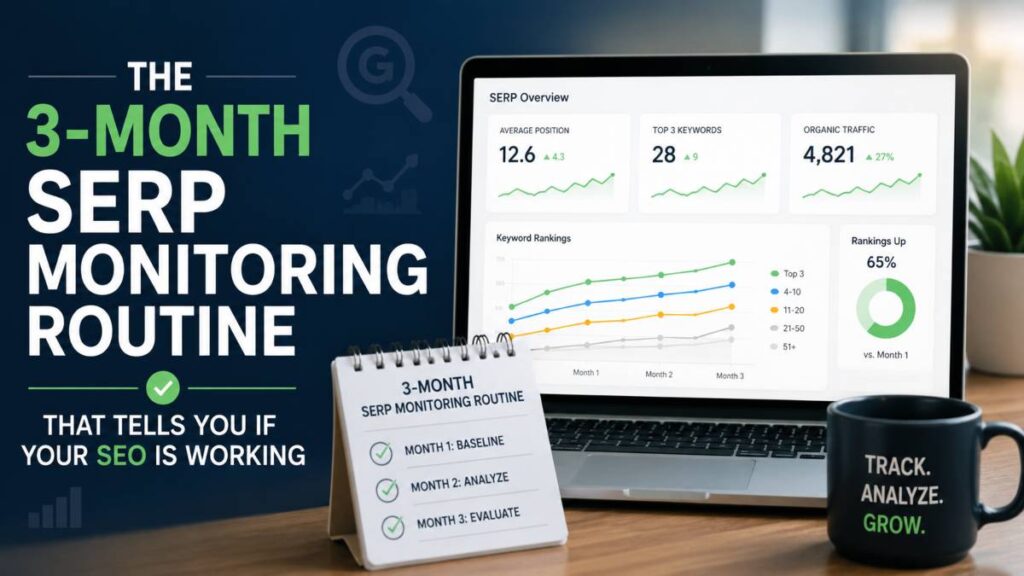
Most SEO efforts fail quietly. You publish content, fix technical issues, build some links, and wait. Three months pass, and you have no idea whether to keep going or cut your losses. The problem is rarely the strategy itself. Without a consistent SERP monitoring routine, you have no way to separate what’s working from what isn’t.
TL;DR: A structured, three-month SERP monitoring routine turns vague anxiety into clear answers backed by data. Track keyword positions weekly, watch impressions in Google Search Console, and run a full comparison at the 90-day mark. Here’s how each phase of that routine works.
Why Three Months Is the Right Measurement Window
One month of SEO data is mostly noise. Algorithms update, competitors adjust, and rankings shuffle for reasons that have nothing to do with your efforts. Three months gives you enough consecutive data to separate a real trend from a one-time fluctuation.
Whether you run your own campaigns or partner with a veterinary marketing company to grow your clinic’s search presence, the same monitoring logic applies. You need a fixed window, a consistent set of metrics, and a clear definition of what progress looks like before you can evaluate anything honestly.
Month One: Set Your Baseline
Before you can measure progress, you need a starting point. Month one is for documentation, not analysis.
Pull your current keyword rankings using Google Search Console or a tool like Semrush. For every keyword you actively target, record its position, the page ranking for it, and how many impressions it generates. Note your average CTR for each query. The goal here is not to draw conclusions. Your baseline is the foundation that the next two months of data will rest on.
Month Two: Look for Movement, Not Milestones
Start your weekly check-in during month two. Every seven days, compare current rankings to your baseline. You’re not looking for dramatic jumps. You’re watching for directional consistency.
Impressions matter more than clicks at this stage. When Google begins associating your content with a query, impressions rise first, sometimes weeks before clicks or ranking positions follow. A consistent upward trend in impressions is often the earliest signal that your content is gaining traction. This is also the month to note which SERP features your content appears in: “People Also Ask” results, featured snippets, or local packs. These placements represent visibility beyond your raw rank position, and they frequently precede broader ranking gains.
Month Three: Run the Full Comparison
At the 90-day mark, pull a direct comparison of where you started versus where you are now. A keyword that moved from position 22 to position 14 is succeeding, even though it hasn’t reached page one yet. Direction matters as much as destination.
Now look at organic traffic. Has the volume of unbranded organic sessions increased? Has your total impression count grown in Search Console? According to iVet360’s local SEO research, first position rankings generate a 39.8% CTR, while second and third positions drop to 18.7% and 10.2%, respectively. That gap explains why even a five-position improvement can produce a meaningful traffic increase from a single query.
True SEO Progress vs. False Signals
Not every ranking shift means something, and not every flat period means failure.
Real signals your SEO is working: sustained ranking improvements over six or more consecutive weeks, rising impressions tied to new keyword associations, and organic traffic that trends upward even while individual positions fluctuate.
False signals to ignore: a single week ranking spike that disappears the following week, a traffic bump driven entirely by branded queries, and impression growth on keywords that have no connection to your actual content or audience.
What to Do When the 90-Day Data Disappoints
Flat or declining rankings across the board after three months call for a diagnostic, not more of the same. Start by auditing the pages targeting your primary keywords. Are they genuinely stronger than what’s currently outranking them? Does your content match the actual search intent behind the query?
If the pages are strong and the intent is right, look at your backlink profile. Thin authority is the most common reason technically sound content stalls below page one. Address the weakest link in the chain before extending your monitoring window into month four.
FAQs
How often should I check keyword rankings during the three-month monitoring period?
Weekly checks strike the right balance. Daily checks create anxiety and encourage overreactions to normal volatility. Weekly data gives you enough resolution to spot real trends without the noise.
What tools do I need to run this SERP monitoring routine?
Google Search Console covers the essentials at no cost: impressions, clicks, average position, and CTR by query. A third-party rank tracker like Semrush, Ahrefs, or Mangools adds daily position tracking and competitor visibility that Search Console alone cannot provide.
Can rankings drop even when the SEO strategy is working?
Yes. Algorithm updates, competitor content improvements, and SERP feature changes all cause short-term dips. A healthy campaign still experiences volatility. Trust the longer-term trend across 8 to 12 weeks, not weekly swings.
What metric matters most in month one?
Impressions. Click volume and traffic follow ranking improvements, and rankings follow Google recognizing that your content belongs in the results. Impressions are the earliest measurable sign that recognition is starting to build.
Read Also: Effective AI Strategies for PPC Feed Optimization