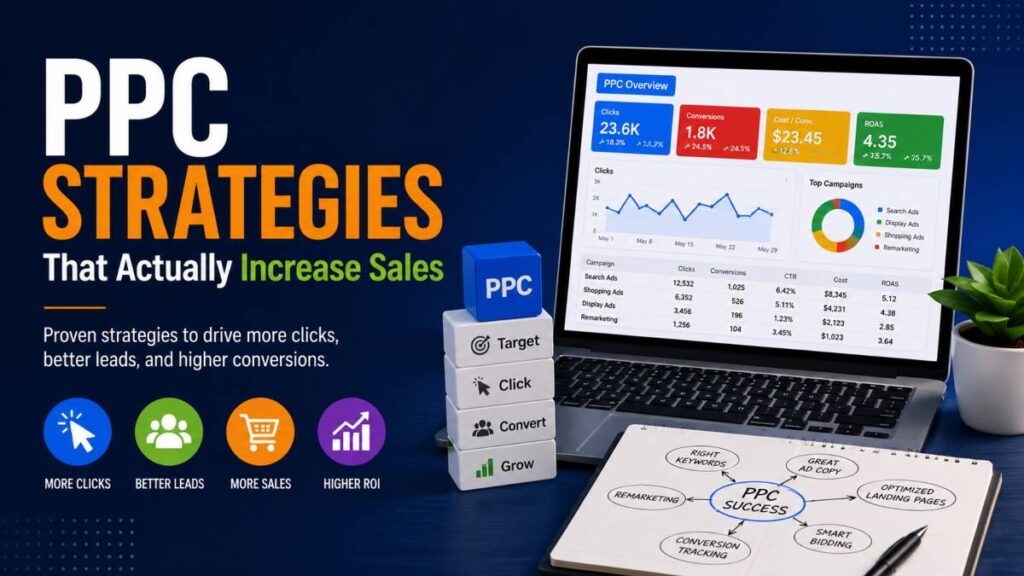
Businesses want faster sales, stronger leads, and better returns from every marketing dollar. That is exactly why the best PPC ad strategies to increase sales faster continue to attract brands across ecommerce, SaaS, local services, and online stores. Paid campaigns place your offer in front of buyers who are already searching for products or services, which gives companies a direct path to conversions without waiting months for organic traffic growth.
At the same time, PPC advertising strategies have become more competitive. Ad costs continue to rise as more brands compete for the same audience. A campaign without clear targeting, persuasive copy, and optimized landing pages can burn through budget quickly with little return. Smart advertisers now focus on audience intent, conversion tracking, and real customer actions instead of vanity metrics like clicks alone.
The good news is that brands can still increase sales with PPC when campaigns are built around data and buyer behavior. From automated bidding and remarketing funnels to stronger ad copy and faster landing pages, the right tactics can turn paid traffic into consistent revenue. This guide breaks down practical PPC methods that help businesses capture attention, improve ROAS, and drive sales at a faster pace.
Why PPC Advertising Still Delivers Fast Results
Pay per click advertising remains one of the fastest ways to generate targeted traffic and sales online. Unlike long term marketing channels that can take months to build momentum, PPC campaigns place businesses directly in front of people already searching for products, services, or solutions. That speed gives brands a major advantage in competitive industries where customer attention disappears quickly.
How PPC Targets High Intent Buyers
One reason PPC performs so well is its ability to connect with buyers at the exact moment they are ready to act. Search intent plays a huge role here. When someone types phrases like “buy running shoes online” or “best accounting software for small business,” they are already moving closer to a purchase decision.
Purchase stage keywords help advertisers focus budget on users with stronger buying intent instead of broad audiences with little conversion potential. Combined with audience precision tools such as location targeting, device targeting, demographics, and remarketing lists, businesses can reach the people most likely to convert. Strong PPC conversion strategies often start with understanding who the buyer is and what they are searching for before the click even happens.
The Connection Between PPC and Faster Conversions
PPC campaigns also produce immediate traffic. Once ads go live, businesses can begin attracting visitors within hours instead of waiting weeks for rankings or organic reach to improve. That instant visibility makes PPC especially useful for product launches, seasonal promotions, and lead generation campaigns.
Another major advantage is data tracking. Advertisers can measure clicks, conversions, customer behavior, and revenue in real time. This level of insight allows brands to adjust campaigns quickly, remove weak ads, and scale winning strategies faster. Many paid search advertising tips focus on testing and optimization because even small changes in targeting or ad copy can improve PPC lead generation and overall sales performance.
Set Clear PPC Goals Before Spending Budget
Many PPC campaigns fail long before the first click happens. The problem is not always weak ads or low traffic. In many cases, businesses launch campaigns without defining what success actually looks like. A clear goal gives direction to targeting, bidding, ad messaging, and budget allocation. Without that structure, even high traffic campaigns can struggle to produce profitable results.
Strong PPC campaign optimization starts with measurable objectives tied directly to business growth. Some brands want online sales while others focus on qualified leads, booked consultations, or repeat customers. Each objective requires a different strategy, bidding model, and performance benchmark. Defining those targets early helps prevent wasted spending and poor decision making later.
Track the Right Metrics
Tracking the right performance indicators is essential for profitable campaigns. Return on ad spend, often called ROAS, measures how much revenue is generated for every dollar spent on advertising. This metric helps businesses understand whether campaigns are producing real financial returns.
Cost per acquisition, or CPA, tracks how much it costs to gain a customer or lead. Click through rate shows how effective ads are at attracting attention in search results, while conversion rate measures how many visitors complete a desired action after clicking.
Another valuable metric is the LTV to CAC ratio. This compares customer lifetime value against customer acquisition cost. A campaign may appear expensive at first glance, but if customers continue purchasing over time, the long term return can justify higher acquisition costs.
A proper conversion tracking setup is critical here because inaccurate data leads to weak optimization decisions and poor budget allocation.
Match Campaign Goals With Business Outcomes
Every PPC campaign should support a specific business result. Ecommerce brands may focus on direct sales, while service businesses often prioritize lead generation and appointment bookings. Subscription based companies may place more attention on repeat purchases and long term customer value.
Businesses can also use PPC to increase brand visibility and branded search activity. When users repeatedly see relevant ads, they are more likely to search for the company directly later. Campaign goals should always connect to revenue growth instead of vanity metrics alone. Many companies turn to professional media buying services to manage budgets efficiently and optimize campaign performance across multiple advertising channels.
For brands using automated bidding, target ROAS bidding can help maximize revenue by adjusting bids based on expected conversion value. This approach allows campaigns to focus spending where the highest returns are most likely to happen.
Build High Converting PPC Campaign Structures
A successful PPC campaign is not built on random keywords and broad targeting. Structure plays a major role in how efficiently ads perform and how much revenue they generate. Well organized campaigns improve targeting accuracy, increase click quality, and make optimization easier over time. Businesses that ignore campaign structure often struggle with wasted spend, low conversion rates, and inconsistent reporting.
Strong PPC campaign management starts with organizing campaigns around user intent, product categories, and audience behavior. When keywords, ads, and landing pages work together with clear alignment, campaigns become more relevant to searchers and more profitable for advertisers.
Use Tightly Grouped Keywords
Tightly grouped keywords help create highly relevant ads for specific searches. Instead of placing dozens of unrelated keywords into one ad group, advertisers should organize keywords into focused themes. A single theme ad group allows ad copy to match search intent more accurately, which can improve engagement and conversions.
Long tail keyword targeting is especially useful because these searches often reveal stronger buying intent. Someone searching for “affordable CRM software for startups” is usually closer to a decision than a user searching only for “CRM software.” More specific searches also tend to face lower competition and produce better conversion rates.
Search intent alignment matters at every stage of the campaign. Keywords should connect naturally with ad messaging and landing page content. When users see exactly what they searched for after clicking an ad, trust increases and bounce rates often decrease. This consistency can also support Quality Score improvement, which may reduce cost per click over time.
Separate Brand, Generic, and Remarketing Campaigns
Separating campaign types creates better control and clearer performance analysis. Brand campaigns target users already familiar with the business, while generic campaigns focus on broader high intent searches. Remarketing campaigns reconnect with previous visitors who did not convert during their first interaction.
This separation improves budget control because advertisers can allocate spending based on campaign performance and customer intent. Reporting also becomes cleaner since each campaign category produces different results and conversion patterns.
Better campaign segmentation allows more accurate bid adjustments as well. High performing audiences and keywords can receive increased investment while weaker segments can be limited or paused without affecting the entire account.
Add Negative Keywords to Reduce Waste
Negative keywords help prevent ads from appearing in irrelevant searches. Without a strong negative keywords list, businesses may pay for clicks from users with little purchase intent. For example, a premium software company may want to exclude searches containing words like “free” or “cheap.”
Regular search term reviews are essential for filtering weak traffic and identifying wasted ad spend. This process helps advertisers discover irrelevant queries, improve targeting precision, and protect campaign profitability. Over time, a refined keyword strategy creates stronger traffic quality and better conversion performance.
Write PPC Ads That Generate More Clicks and Sales
A PPC campaign can have strong targeting, smart bidding, and the perfect audience, yet still fail because of weak ad copy. The ad itself is the first impression users see in search results, which means every word has a direct impact on clicks, conversions, and revenue. Businesses that write clear, persuasive ads often attract better traffic and stronger buying intent from the start.
Great PPC ads connect with user intent quickly. They answer a problem, present a solution, and give people a reason to click right now instead of scrolling past competitors. Strong messaging also improves click through rates, which can lower advertising costs and support better campaign performance over time.
Focus on Offers and Buyer Motivation
Buyers respond to value. Discounts, free shipping, and limited time offers create urgency and encourage faster action. A simple message such as “Get 20% Off Today” can perform far better than vague branding focused headlines.
Pain point messaging is equally important. Instead of only describing a product, ads should explain how the product solves a problem. A project management platform, for example, may attract more attention with “Stop Missing Deadlines” than with generic software descriptions.
Many high converting PPC ads succeed because they focus on what the customer gains after clicking. Faster delivery, lower costs, time savings, and convenience all help push users closer to a purchase decision.
Improve CTR With Strong Ad Copy
Strong ad copy grabs attention immediately. Emotional triggers such as urgency, exclusivity, trust, or convenience often increase engagement because they connect with real customer motivations.
A clear call to action also matters. Phrases like “Shop Now,” “Get Your Free Quote,” or “Start Today” guide users toward the next step without confusion. Benefit first headlines perform especially well because they show value before features. Instead of saying “Advanced Accounting Software,” an ad may perform better with “Save Hours on Monthly Bookkeeping.”
These PPC ad copy tips can support click through rate improvement by making ads more relevant, more persuasive, and easier to understand at a glance.
Test Multiple Ad Variations
Even experienced advertisers rarely create the perfect ad on the first attempt. Testing different headlines, descriptions, and calls to action helps uncover what resonates most with audiences.
Responsive search ads allow advertisers to test multiple combinations automatically. This gives platforms like Google Ads more flexibility to match messaging with different search behaviors and user intent patterns.
Consistent testing also prevents ad fatigue. Audiences respond differently over time, especially when competitors change pricing, offers, or messaging. Brands that regularly refine ad copy often see stronger engagement, lower wasted spend, and more stable conversion growth.
Optimize Landing Pages for More Conversions
A great PPC ad can attract clicks, but the landing page determines whether those clicks turn into paying customers. Many businesses spend heavily on traffic while sending visitors to pages that feel slow, confusing, or disconnected from the original ad. That gap often leads to high bounce rates and lost revenue.
Strong PPC landing page optimization focuses on creating a smooth experience from the moment a user clicks an ad to the moment they complete an action. Every detail matters, including page speed, messaging, layout, and trust elements. When landing pages match buyer expectations closely, conversion rates usually improve.
Match Landing Pages With Ad Intent
Landing pages should continue the same message users saw in the advertisement. If an ad promotes “30% Off Running Shoes,” the landing page should immediately repeat that offer instead of sending visitors to a generic homepage. Message consistency helps users feel confident they clicked the right result.
Keyword relevance is equally important. The language on the page should reflect the same search intent connected to the ad group and targeted keywords. This creates a more seamless user experience and can support stronger campaign performance.
A single CTA focus also improves clarity. Too many buttons, offers, or distractions can overwhelm visitors and reduce conversions. Each landing page should guide users toward one clear action such as purchasing a product, requesting a quote, or signing up for a free trial.
Improve Mobile Speed and User Experience
Most PPC traffic now comes from mobile devices, which makes speed and usability critical. Users rarely wait for slow pages to load, especially when several competitors are only one click away. Fast load times reduce abandonment and improve engagement across devices.
Mobile first landing pages should feature clean layouts, readable text, and buttons that are easy to tap on smaller screens. Forms should also remain simple. Asking for too much information often creates friction that pushes potential customers away before conversion happens.
Conversion focused PPC campaigns usually perform better when the path from click to action feels effortless. The fewer obstacles users face, the higher the chance they will complete the desired action.
Add Trust Signals That Push Action
Trust plays a major role in online buying decisions. Visitors want reassurance before sharing payment details or personal information. Testimonials and customer reviews help build credibility by showing real experiences from previous buyers.
Security badges and payment verification icons can also increase confidence, especially for ecommerce stores and service based businesses. Case studies work well for higher ticket offers because they show measurable results and real customer outcomes.
When trust signals appear naturally throughout the landing page, visitors often feel more comfortable taking the next step. Small details like ratings, client logos, or verified reviews can create the confidence needed to turn traffic into revenue.
Use Smart Bidding and Automation to Scale Faster
Managing PPC campaigns manually becomes difficult as accounts grow larger and competition becomes more aggressive. Modern advertising platforms now rely heavily on machine learning to adjust bids, analyze user behavior, and predict conversion potential in real time. Businesses that use smart automation correctly can improve efficiency, reduce wasted spend, and scale winning campaigns faster.
Strong PPC bidding strategies focus on balancing automation with accurate performance data. Automated systems work best when campaigns already have reliable conversion tracking and enough historical data to guide bidding decisions. Without clean data, automation can push budget toward the wrong audiences or low quality traffic.
When to Use Automated Bidding
Automated bidding becomes more effective once campaigns generate steady conversion activity. Target CPA bidding works well for businesses focused on maintaining a specific acquisition cost while still generating leads or sales. This strategy automatically adjusts bids to help advertisers gain more conversions within their target cost range.
A maximize conversions strategy is useful for campaigns focused on generating the highest possible number of actions within a set budget. Google Ads automatically increases or lowers bids based on the likelihood of conversion during each auction.
For ecommerce businesses and revenue driven campaigns, target ROAS bidding often produces stronger long term results. Instead of only focusing on conversion volume, this strategy optimizes toward conversion value and expected return on ad spend. Higher value customers and larger purchases receive more aggressive bidding attention, which can improve overall profitability.
Improve Performance With Conversion Data
Automation depends heavily on data quality. Enhanced conversions help platforms understand user activity more accurately by improving the tracking of completed actions across devices and browsers. Better tracking creates stronger optimization signals for bidding algorithms.
Offline conversion imports also add valuable insight, especially for businesses that close sales through phone calls, consultations, or CRM systems. Importing offline revenue data allows advertising platforms to optimize based on actual customer value instead of simple form submissions.
Value based bidding pushes automation even further by assigning different values to different types of conversions. Not every lead or customer produces the same revenue, so campaigns should prioritize users with stronger purchase potential. When advertisers combine accurate conversion tracking with smart bidding tools, automation becomes far more effective at driving profitable growth.
Increase Sales With PPC Remarketing Funnels
Most website visitors do not convert during their first visit. Some users compare prices, others get distracted, and many simply need more time before making a purchase decision. That is why remarketing remains one of the most effective ways to recover lost opportunities and increase conversions. Instead of chasing entirely new traffic every day, businesses can reconnect with users who already showed interest in their products or services.
Remarketing PPC campaigns work because they target warm audiences with stronger buying intent. These users already recognize the brand, which often makes them easier and cheaper to convert compared to cold traffic. A well planned PPC sales funnel keeps potential customers engaged across different stages of the buying journey.
Retarget Cart Abandoners
Cart abandonment retargeting is one of the highest performing remarketing tactics for ecommerce businesses. Many users add products to their carts but leave before completing checkout. Remarketing ads remind those users about the products they viewed and encourage them to return.
Dynamic product ads make this process more effective by automatically displaying the exact products users previously viewed or added to their cart. This creates a more personalized experience that feels relevant instead of generic. To improve these campaigns further, an ecommerce ppc management agency can help optimize audience targeting, ad timing, and conversion focused messaging.
Promo code reminders can also motivate hesitant buyers. A small discount or free shipping offer often gives users the final push needed to complete a purchase. Time sensitive offers create urgency by encouraging immediate action before the promotion expires.
Create Funnel Based Audience Segments
Not every visitor should see the same advertisement. Funnel based audience segmentation helps businesses match messaging with user intent and engagement level.
Cold traffic audiences usually need educational or awareness focused content before they are ready to buy. Warm audiences, such as users who visited product pages or watched videos, respond better to stronger sales messaging and product focused ads.
Returning buyers represent another valuable segment. These customers already trust the brand, making them more likely to purchase again. Businesses can use remarketing campaigns to promote complementary products, loyalty offers, or exclusive deals to increase customer lifetime value.
Expand Reach With Lookalike Audiences
Once remarketing campaigns perform well, businesses can scale by using lookalike audiences. These audiences allow advertising platforms to find new users with similar behaviors, interests, and demographics as existing customers.
Similar customer targeting helps brands expand reach without sacrificing audience quality. Instead of targeting completely broad audiences, campaigns focus on users who resemble previous converters and high value buyers.
This strategy helps scale campaigns more efficiently while maintaining stronger conversion potential. When combined with accurate tracking and strong ad creative, lookalike audiences can bring steady growth while keeping acquisition costs under control.
Run Ongoing PPC Optimization Tests
Launching a PPC campaign is only the beginning. Even strong campaigns lose momentum when advertisers stop testing, reviewing data, and adjusting strategy over time. Search trends change, competitors update their offers, and audience behavior shifts constantly. Businesses that treat PPC as an ongoing process usually achieve stronger returns than those that leave campaigns running without regular optimization.
Consistent PPC campaign optimization helps advertisers control costs, improve conversion rates, and uncover new growth opportunities. Small changes in bidding, targeting, or ad messaging can create noticeable improvements in campaign performance when tested properly.
Weekly PPC Maintenance Tasks
Weekly maintenance keeps campaigns healthy and prevents wasted spending from building over time. One of the most important tasks is search term cleanup. Reviewing actual search queries helps advertisers remove irrelevant traffic and expand negative keyword lists for stronger targeting precision.
Bid adjustments also play a major role in campaign efficiency. Some devices, locations, or audience segments may produce stronger conversion rates than others. Adjusting bids based on performance data helps direct budget toward higher value traffic sources.
Budget pacing should be monitored regularly as well. Campaigns that exhaust budget too early in the day may miss valuable traffic later, while underperforming campaigns may consume spend without generating meaningful returns.
Test Ads and Landing Pages Regularly
Continuous testing helps advertisers understand what resonates most with their audience. A/B testing PPC ads allows businesses to compare different headlines, calls to action, offers, and descriptions to identify stronger performing combinations.
Creative experiments should also extend beyond text ads. Images, videos, layouts, and promotional messaging can all influence user behavior and engagement rates. Even small adjustments to button placement or landing page copy can affect conversion performance.
Audience layering adds another level of optimization by combining demographic, behavioral, and intent based signals. This allows advertisers to build more refined audience segments and improve targeting accuracy.
Review Attribution and Customer Value
Clicks and conversions only tell part of the story. Businesses should also review how customers interact with multiple touchpoints before purchasing. Data driven attribution gives advertisers a clearer view of which campaigns contribute most to conversions across the customer journey.
Cohort ROAS analysis helps identify which customer groups generate stronger long term returns. Some audiences may convert quickly but produce low repeat value, while others become loyal customers over time.
Lifetime value analysis provides deeper insight into profitability by measuring how much revenue customers generate after acquisition. Combined with a reliable conversion tracking setup, these insights help businesses make smarter optimization decisions and allocate budget more effectively.
Common PPC Mistakes That Hurt Sales
Many businesses struggle with paid advertising not because PPC does not work, but because small strategic mistakes quietly drain performance over time. Even campaigns with strong budgets and decent traffic can fail when advertisers ignore optimization basics. Avoiding these common PPC mistakes can improve conversion rates, reduce wasted spending, and create more consistent revenue growth.
Sending Traffic to Generic Pages
One of the biggest mistakes in PPC campaign management is directing ad traffic to generic homepage content instead of dedicated landing pages. Users click ads expecting to see a specific product, offer, or solution related to their search. When the landing page feels disconnected from the advertisement, trust drops quickly and bounce rates increase.
Dedicated landing pages create a smoother experience by matching user intent with focused messaging and a clear action path. Businesses that align ads with relevant landing pages often increase sales with PPC more effectively than brands relying on broad website navigation.
Ignoring Negative Keywords
Negative keywords protect campaigns from irrelevant clicks and low quality traffic. Without them, businesses may pay for searches that have little chance of converting. For example, a premium service provider may not want traffic from users searching for free tools or low cost alternatives.
Ignoring search term reports can slowly waste advertising budget and reduce overall campaign efficiency. Regular keyword reviews help advertisers filter weak traffic and improve targeting precision.
Scaling Campaigns Too Early
Many advertisers increase budgets aggressively after seeing a few early conversions. While growth is important, scaling too quickly can disrupt campaign performance before enough data is collected.
Algorithms need time to learn which audiences, keywords, and placements produce the best results. Sudden budget increases may push ads into lower quality traffic segments, which can reduce profitability and increase acquisition costs.
Tracking Clicks Instead of Revenue
High click volume does not always mean strong business performance. Some campaigns generate traffic but fail to produce qualified leads or profitable customers. Businesses that focus only on clicks often miss the bigger picture.
Revenue, customer value, and return on ad spend provide more meaningful insight into campaign success. Accurate conversion tracking allows advertisers to understand which campaigns truly drive profit instead of vanity metrics that look impressive but deliver little financial return.
Final Thoughts
Successful PPC campaigns are rarely built on guesswork alone. The brands that generate strong results usually rely on accurate data, audience intent, and continuous testing to improve performance over time. From keyword targeting and ad copy to landing pages and remarketing funnels, every part of the campaign should work together to guide users toward conversion.
Competition in paid advertising continues to grow, which means businesses cannot afford to launch campaigns and ignore optimization afterward. Regular testing, budget adjustments, and performance reviews help advertisers identify what drives revenue and what wastes spend. Even small improvements in click through rates, conversion rates, or audience targeting can create meaningful gains in profitability.
The most effective PPC strategies focus on attracting the right audience instead of simply generating more clicks. Businesses that understand customer behavior and adapt campaigns based on real performance data often achieve faster and more sustainable growth.
If you want stronger returns from your advertising budget, now is the time to take action. Book a PPC audit, download a campaign optimization checklist, or start optimizing your campaigns today to uncover missed opportunities and improve conversion performance.