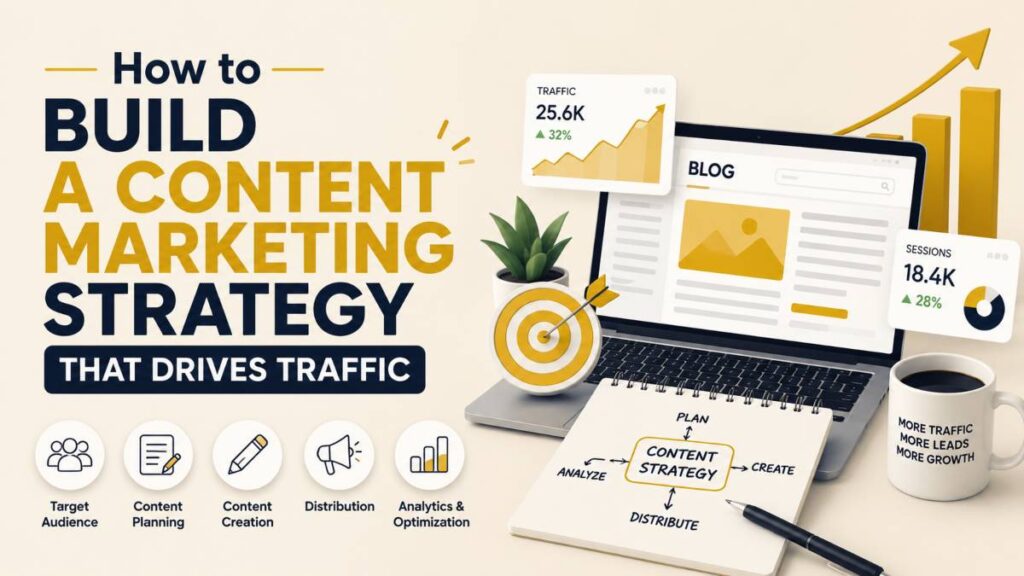
Thousands of blog posts, short-form videos, guides, and social updates go live every day… and disappear before it even ends. But a good content marketing strategy changes that. It lets you create content that deserves attention and makes sure the right people actually find it.
And that is exactly what we are going to sort out for you. We will show you what a content marketing strategy is and the benefits of building one. You will also get 8 steps for creating a strategy to bring in search traffic for months without anyone touching your content plan again.
What Is a Content Marketing Strategy?
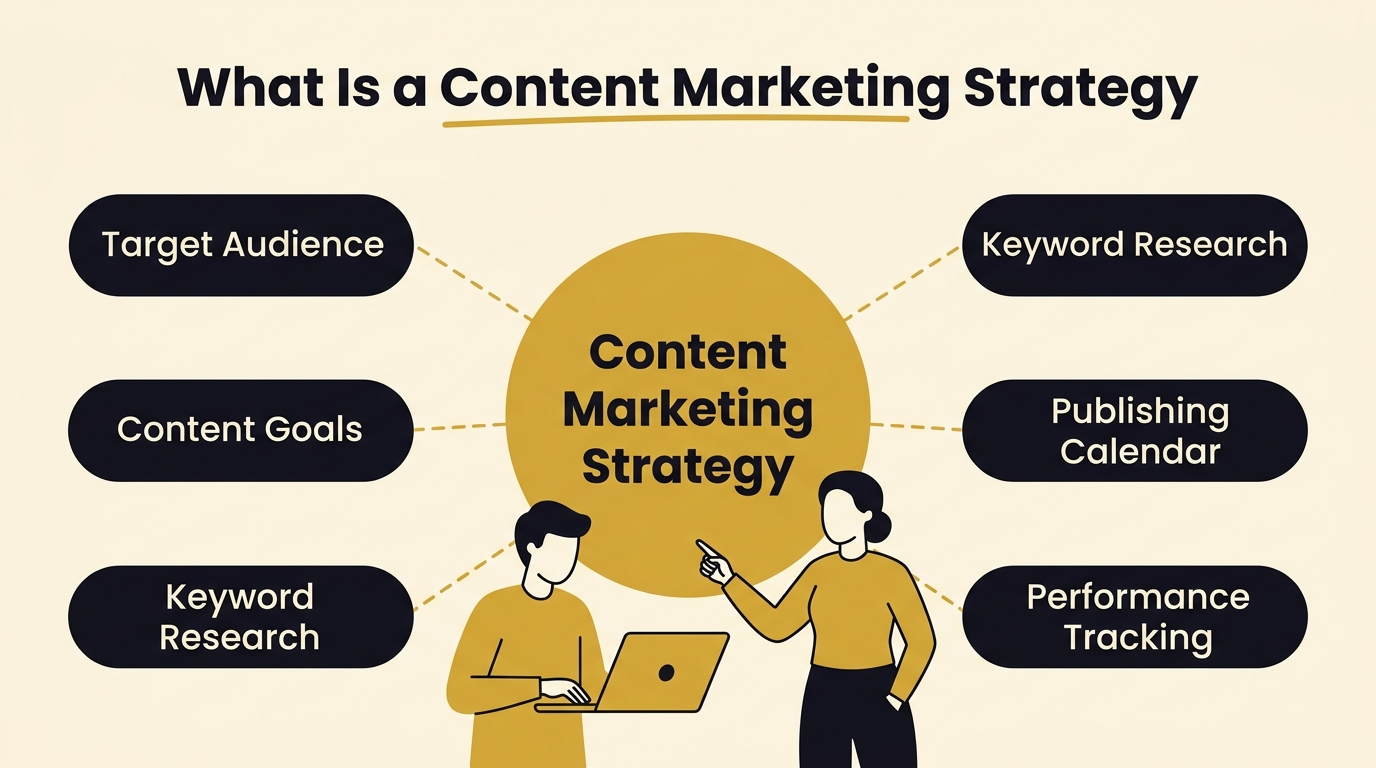
A content marketing strategy is the plan behind what your company publishes and why. It defines who you are writing for and what topics to cover. It sets the publishing schedule and tracks whether anything you published actually moved the numbers you care about. Without one, content is just a random collection of blog posts with no clear connection to business goals.
Key Elements of a Content Marketing Strategy:
- Target audience profiles – who each piece of content is written for
- Content goals tied to a business outcome like organic traffic growth or email signups
- Keyword and topic research based on what your audience already searches for
- A publishing calendar with owners and deadlines assigned to every single piece
- Distribution process for getting content in front of potential customers beyond your own blog
- A monthly reporting process that shows whether the content is producing what you planned for
Why Building a Content Marketing Strategy Pays Off: 4 Key Benefits

A content marketing strategy changes how your content performs once it is out there. Here’s what you actually get out of setting one up.
1. Brings Consistent Organic Traffic to Your Website
A single article ranking on top of SERP for a keyword with 2,000 monthly searches can keep sending traffic to your site every month. And that traffic keeps coming whether you are running ads that week or not. Paid campaigns stop the day the budget runs out. Organic content keeps going.
Companies that blog get 55% more website traffic and 67% more lead generation than companies that don’t. And those numbers grow over time – six months into a content marketing strategy, you are pulling traffic from 20+ articles ranking for different search terms, not just whatever you posted last Tuesday.
2. Helps You Reach the Right Audience at the Right Time
Someone searching “how to choose a CRM for a 10-person team” on Google is already looking at options. Your article answering that exact need will put your brand in front of them during the buying window. Not three weeks before they cared. Not two weeks after they picked someone else.
Content built around search queries shows up when people need information the most. And that is a timing advantage that social media engagement ads and display banners don’t have. Those channels show up when someone is scrolling – not when they are searching.
3. Strengthens Brand Awareness Across Multiple Marketing Channels
87% of B2B marketers credit content marketing efforts with improving their brand awareness in the last 12 months. And it is easy to explain. One blog post can be turned into a LinkedIn summary and an email newsletter excerpt. Same content, two more places your audience sees your name.
Do that with 8-10 posts per month, and your brand starts appearing across different social media channels and inboxes. That repeated online visibility is how you create a brand identity.
4. Improves Marketing ROI by Maximizing Content Performance
Content published without a strategy gets written once, and nobody looks at it again. Content inside a strategy gets reviewed monthly. That 6-month-old article ranking #8 for its target keyword gets an update – new audience insights, better intro, refreshed publish date – and moves to #3. The email sequence converting at 2% gets tested and reaches 4%.
A content strategy has a monthly review process that picks low performers early enough to improve them. The average return on content marketing is $7.65 per $1 spent. That return comes from treating published content as something that gets improved over time, not something that is done after the first publish date.
4 Core Types of Content Marketing and When to Use Them
Let’s see which content format works best for different stages of the buyer’s journey through the marketing funnel.
| Content Type | Best For | When to Use It |
| Blog Posts and Articles | Organic search traffic and topical authority | Ongoing – publish 2-4 times per month targeting specific search terms |
| Video Content | Increasing brand awareness and product demonstrations | When explaining complex topics or building trust with an audience that prefers watching over reading |
| Case Studies and Customer Stories | Sales enablement and bottom-of-funnel conversion | When prospects need real proof that your product or service produces results before they commit |
| Email Newsletters | Customer retention and repeat website traffic | When you have a subscriber list to keep engaged between purchases or renewals |
How to Create a Successful Content Marketing Strategy That Generates Consistent Traffic: 8 Easy-to-Follow Steps
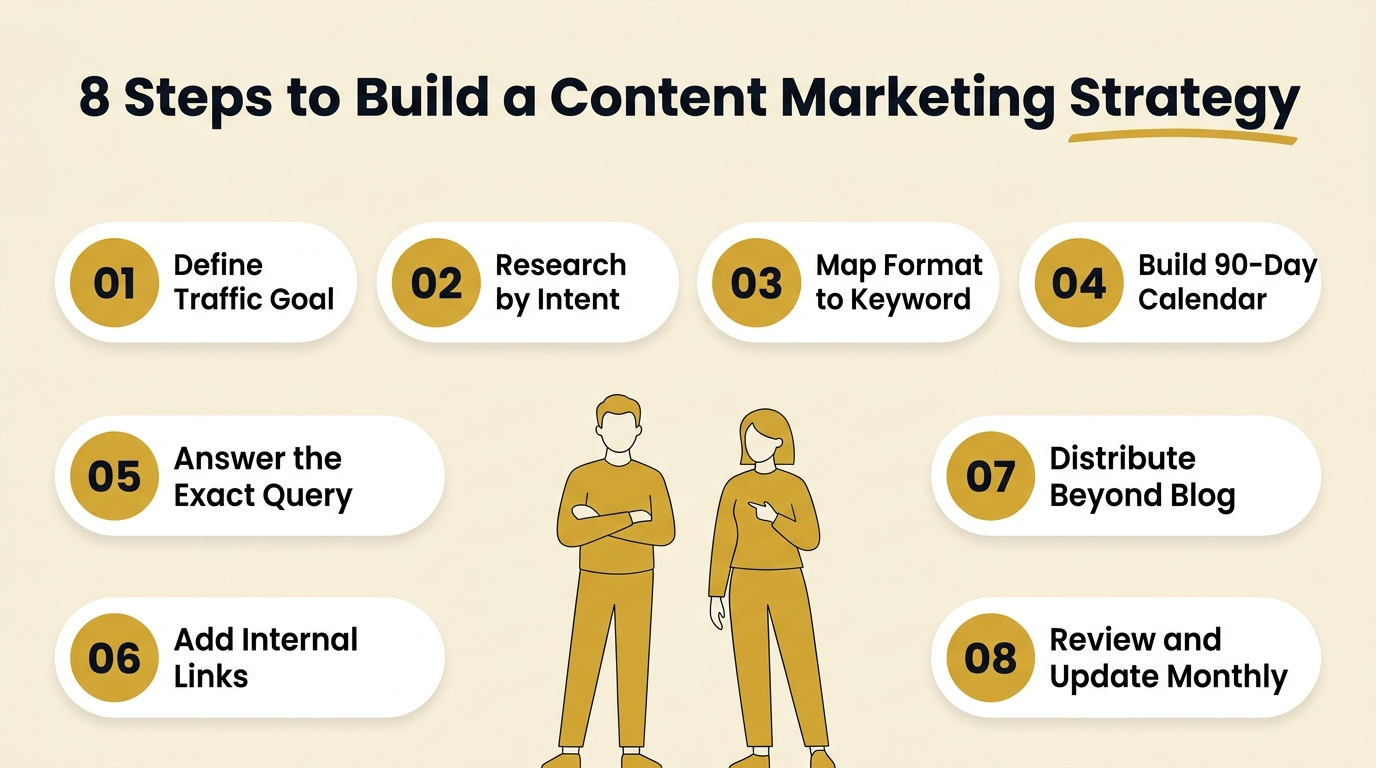
Here’s how to create a content strategy that keeps bringing in traffic over time.
1. Define One Primary Traffic Goal and Build the Strategy Around That Single Number
Tracking 12 key performance indicators at once means nobody on the team knows which one is actually worth it. Pick one. Organic sessions per month are a good starting point. That single number becomes the filter for every content decision – if a proposed article moves that number, it goes on the calendar. If the connection to that number is weak, it waits.
- Organic traffic is the most practical primary metric for the first 90 days of a content marketing strategy. You can measure it weekly, and it reacts directly to what you publish.
- “Reach 25,000 organic sessions per month by Q3” is a goal. The number makes it trackable.
- Put the metric on a dashboard that the team reviews every Monday. A Google Analytics report filtered to organic takes five minutes to build.
- The next month’s calendar should have more how-to posts if they are generating more traffic than opinion articles after the first month. Let the performance data analysis shape the content marketing plan.
2. Research Keywords by Search Intent, Not Just Volume
10,000 monthly searches on a keyword looks great on paper. But it won’t rank if everyone searching that term wants a Wikipedia-style definition and you are trying to sell them a product.
SEO reporting gets better when you understand what the person is trying to do. Someone searching for an informational query wants to learn. Someone on a commercial query is comparing options. Someone on a transactional query is ready to buy. Each needs a different content type.
- Google every keyword you are targeting in incognito mode and look at the top 5 results. If they are all how-to guides, write a how-to guide. If they are comparison tables, build a comparison table.
- Sort your keyword list by intent and customer journey stage. Informational keywords go to blog posts. Commercial keywords go to comparison pages. Transactional keywords go to product pages.
- Check keyword difficulty in Ahrefs or Semrush alongside volume. A 500-search keyword with low competition will get more traffic than a 10,000-search keyword where every top result is a site with 10 years of domain authority.
- Turn every keyword into a content brief first, so you know exactly what page you are building and why.
3. Map Each Keyword to a Specific Content Format Before Writing Anything
Some queries rank better as a comparison table. Some need a step-by-step tutorial + screenshots. Decide the format before the writer starts to prevent mismatches – like producing a long-form essay for a query where search engines rank short listicles, or a 500-word overview for a keyword where the top results all run 3,000+ words.
- For each keyword, look at the format of the top-ranking content. If 4 out of 5 results are listicles, plan a listicle. If they are detailed guides, plan for 2,000+ words.
- Assign a target word count based on what the SERP rewards. A keyword where competitors average 1,200 words doesn’t need 4,000 words from you.
- Decide before writing whether the piece needs images or a downloadable resource. These usually get skipped once the draft is done.
- Build a mapping doc with four columns: keyword and intent type in the first two, then content format and target word count. Hand this to the writer as the brief.
4. Build a 90-Day Publishing Calendar With Assigned Owners and Deadlines
90 days is the right planning window. It is long enough to see results – most articles take 30-60 days to index and start getting organic traffic. And it is short enough that you can look at the first month’s data and adjust course for months two and three without being locked into a full year of content you planned before seeing any results.
- Every piece on the calendar needs a named owner. “Publish blog post about X on March 12” with no writer assigned is how gaps in the calendar happen.
- Use a tool that the team already opens daily. Google Sheets or Notion both work. A dedicated content calendar platform that nobody checks after week two doesn’t.
- Start with 2-4 new pieces per month. Consistency over volume – 4 posts every month beats 8 in January and nothing in February.
- Add one “update an older post” slot per month. An article from six months ago ranking #9 can reach #2 with an hour of updates. That is a faster traffic win than writing something brand new.
5. Write Content That Answers the Exact Query Behind the Keyword

If the target keyword is “how to write a cold email that gets replies,” the article should answer that specific query in the opening section. Not a background on email marketing history. Not a general overview of outbound sales. The direct answer – in the first 200 words.
Only 29% of marketers rate their content marketing strategy as extremely or very effective. The other 71% is putting out content that talks around the topic rather than answering what the person actually searched for.
- Read the top 3 ranking results for your target keyword. Note what they cover and what they leave out. Include both.
- Put the primary answer in the first 150-200 words. Google and AI pull featured snippets from articles that give direct answers early.
- Get the “People Also Ask” results for the keyword and use them as subheadings. The same audience searching your primary keyword is also searching those related queries.
- Close each section with something specific that the person consuming content can apply. A number, an analytics tool recommendation, a next step – not a restatement of what the section already covered.
6. Add Internal Links Between Every Related Piece You Publish
Google uses internal links to understand which pages on your site relate to each other. That connection helps both pages rank better. Sites with strong link structures outrank sites with disconnected pages, even when the content quality on individual posts is similar.
For example, an article about eCommerce email marketing can naturally link to a guide on abandoned cart recovery because readers interested in email conversions are usually looking for ways to recover lost sales.
- Link every new article to 2-3 existing posts covering related topics. And those older posts need to be updated with a link back to the new one. Both directions matter.
- Use descriptive anchor text. “Read more here” tells Google nothing. “Our guide to SEO briefs” tells Google exactly what the linked page covers.
- Organize content into topic clusters. One broad pillar page + 5-8 supporting articles on subtopics – all linked to each other. That is how Google identifies topical depth.
- Audit internal links quarterly. Posts from January that only link to the homepage are missing connections to the 15 articles published between February and June.
7. Distribute Every Piece Through at Least Two Channels Beyond Your Blog
Publishing a post and waiting for Google to index it is one channel. Google takes weeks to rank new content. But that same article can be emailed to your subscribers and turned into a LinkedIn post the day it goes live. You can start getting traffic right away by making it a part of your social media strategy while Google figures out your page’s rankings.
- Send the article to your email list within 24 hours of publishing it. A simple email with a brief overview can generate an early wave of traffic.
- Share the article’s main points as a social media post. A summary with a link to the full piece works.
- If the topic is discussed in communities your audience uses, repurpose content there with a comment that adds value. A useful contribution that references the article, not a bare URL pasted with no context.
- Repurpose the best-performing posts into another format after 30 days – visual content for social media platforms or a downloadable PDF that captures email addresses.
8. Review Performance Monthly and Update Underperforming Content Instead of Replacing It
An article ranking #8 for its target keyword is 80% of the way to strong organic traffic. Adding a few hundred words of new information and updating the publish date in the content management system can move it to #1 – and that jump can double the traffic to that page.
New content takes 60-90 days to index and rank. Updated content usually sees movement in 2-3 weeks. The highest-ROI content creation work at most companies isn’t writing new articles. It is improving the ones that are already performing well.
- Get a report from Google Search Console every month for pages ranking between positions 5 and 15. Those are most likely to respond to updates.
- Compare each underperforming page against the top 3 ranking results. Add the topics they cover that yours don’t. Update any outdated data or examples. Those two changes alone can move rankings.
- Update the publish date whenever you make changes. Freshness matters to Google, and a 2024 post will lose out to 2026 content when the topic depends on up-to-date info.
- Log every update and its ranking impact in a shared spreadsheet. After 3 months, you will see patterns in which types of updates produce the most movement – and that tells you where to spend time on future updates.
3 Content Marketing Strategy Examples You Can Learn From
The easiest way to understand what works in a content marketing strategy is to look at brands that are already doing it well. These 3 are perfect examples.
1. Brondell

Under-sink water filtration systems by Brondell are a strong example because they built content around the buying process instead of around the product itself.
Most people don’t wake up wanting an under-sink water filter. They start with a problem. Maybe their tap water tastes strange. Maybe they are worried about contaminants. Maybe they are comparing bottled water costs against filtration systems. Brondell’s strategy revolves around those moments.
Rather than pushing product pages from the start, Brondell created content that helps visitors understand water quality concerns, filtration methods, and installation requirements. That content attracts people long before they are ready to purchase.
One thing Brondell does particularly well is narrowing down broad topics into highly specific searches. Rather than targeting a general term like “water filtration,” it focuses on subjects such as filter certifications, reverse osmosis systems, and contaminant reduction standards. Those topics bring in visitors who are much closer to making a decision.
The lesson here is simple. Brondell built content around the exact questions people ask before buying. The product becomes the next logical step because the content has already handled the research phase.
2. Nootropics Depot
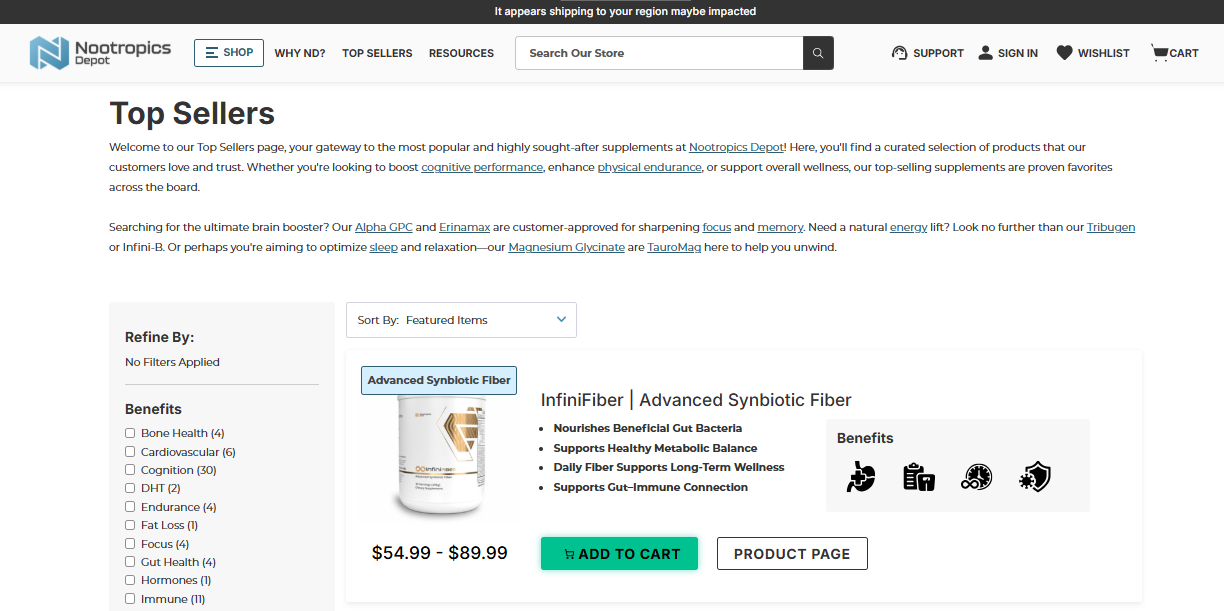
Nootropics Depot’s top-sellers are a strong example because their strategy revolves around trust building through topical authority and content depth.
The supplement space has a credibility problem. People are naturally skeptical about health claims. Nootropics Depot addresses that challenge through highly detailed educational content tied directly to individual ingredients.
What makes the strategy interesting is the depth. Many supplement brands publish short articles designed to rank quickly. Nootropics Depot takes the opposite approach by creating content that dives deep into specific compounds.
This depth creates two advantages.
First, it gives search engines clear signals that the site covers a topic comprehensively. Second, it keeps readers engaged longer because they find information that goes beyond basic explanations.
The brand also uses a strong content-to-catalog structure. Readers exploring ingredient content can easily discover related products without being pushed into a sale. Another important piece is audience alignment. The content relates to people who are already researching nootropics. It doesn’t waste effort chasing broad wellness traffic.
Instead of building a strategy around volume, Nootropics Depot built one around expertise. That makes every piece of content reinforce the authority of the entire site.
3. OKRs Tool
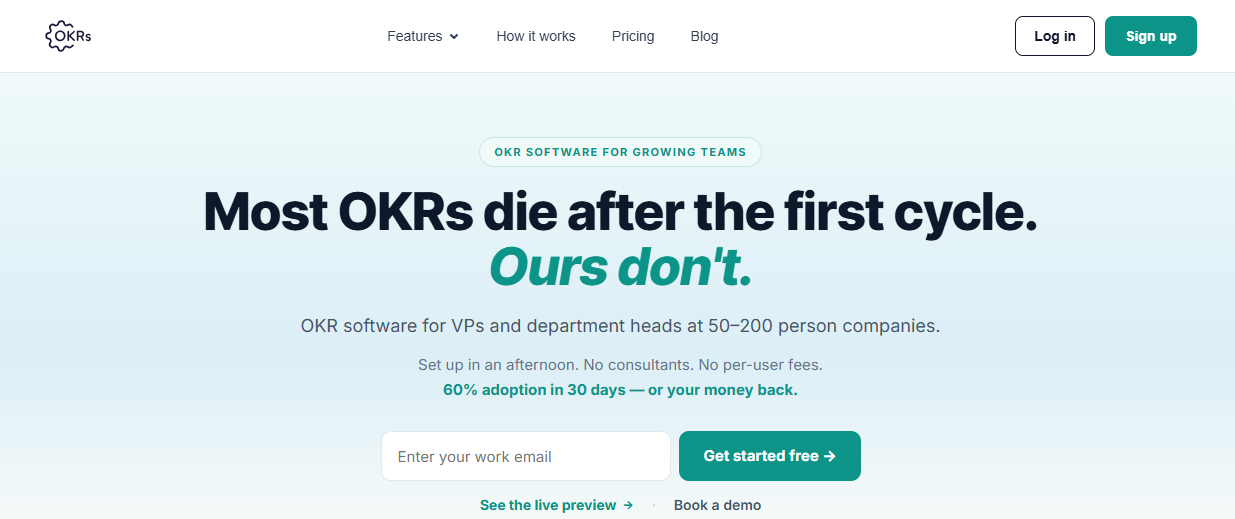
OKRs Tool stands out because its strategy is built around practical implementation. Many companies publish content explaining what OKRs are. The internet already has thousands of those articles. OKRs Tool went further by focusing on the work people need to do after learning the concept.
Its content centers on execution. Visitors find examples of OKRs for different departments. They find templates. They find goal-setting frameworks. They find guidance for creating measurable objectives. That distinction matters.
A searcher looking for “marketing OKR examples” has different needs from someone searching “what are OKRs.” The first person is trying to apply the framework. The second person is learning about it for the first time.
The OKRs Tool consistently creates content for people in the implementation stage. That places the brand much closer to the point where users need software.
Another smart move is its use of highly specific use cases. It builds pages around roles, departments, and business functions. A sales leader sees examples relevant to sales. A product manager finds examples relevant to product teams. This makes the content immediately useful because visitors can picture themselves using the framework.
The lesson from the OKRs Tool is that some of the best content marketing strategies focus on helping people execute a task rather than helping them understand a concept. Once someone starts implementing a process, they are far more likely to look for tools that make that process easier.
Conclusion
A valuable content marketing strategy changes the way you look at the whole process. That is why the smartest approach is also the simplest one. Build around topics your audience actually cares about. Focus on becoming genuinely useful in one place. Improve what is already working before creating something new. A well-updated article does more for traffic than 5 rushed ones.
At Rank Visely, we build content marketing strategies for companies that want organic business growth they can track in real numbers. We handle keyword research and content planning alongside on-page optimization and link building as one connected digital marketing service.
Our approach is built around market research and topical depth, not just publishing volume. If your content is going out regularly but the organic numbers haven’t moved, that is the kind of problem we solve. Get in touch with us now and see how we can help you generate leads.
Author Bio:
Burkhard Berger is the founder of Novum™. He helps innovative B2B companies implement modern SEO strategies to scale their organic traffic to 1,000,000+ visitors per month. Curious about what your true traffic potential is?