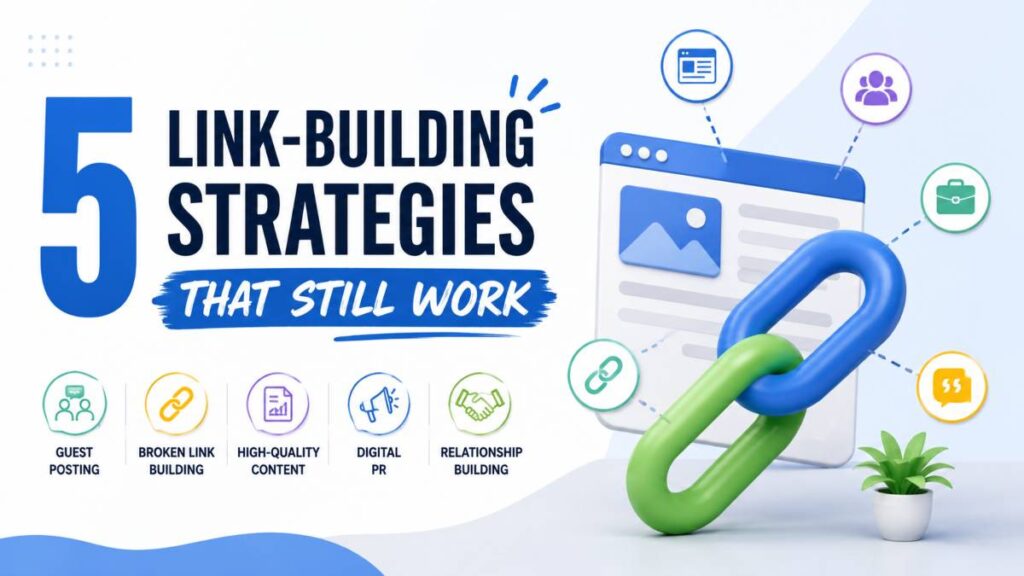
Most advice about building backlinks falls into one of two failure modes. Either it points you toward tactics that carry real penalty risk: spammy link purchases, private blog networks dressed up as “niche sites,” and low-quality bulk forum comments. Or it is so abstract that it offers nothing you can actually act on. “Create great content.” “Be helpful.”
The five strategies below are neither. Each is grounded in how search engines actually evaluate authority, based on established practitioner research from 2026. None of them produces results overnight. All of them compound over time.
1. Guest Posting on Publications That Have Real Editorial Standards
Guest posting means writing an article for another publication in exchange for a contextual link. Done correctly, it puts your expertise in front of an audience that already trusts the publication, and earns you a link from a site your potential customers actually read.
The operative phrase is “done correctly.” A guest posting opportunity is worth pursuing only when three conditions are met: the publication has consistent traffic and a genuine editorial process, it serves an audience that overlaps meaningfully with yours, and the link sits in context, not in a byline or footer where it carries minimal weight.
Relevance matters more than raw domain authority scores. A highly relevant site with a DA of 25 will often deliver more SEO value than a DA 50 site with no audience alignment, because Google weighs topical context alongside authority metrics. Many publications also restrict guest post links to one per article, and some mark them nofollow. Worth confirming before you invest time in a pitch.
Finding publications that consistently meet all three criteria is where most of the labor sits. If you want to scale beyond a few placements per quarter without spending weeks on prospecting, following a well-structured link building plan and working with a guest posting service that vets publications for editorial quality can compress that timeline significantly while maintaining the standards that make the links worth having.
2. Digital PR: Earning Links Through Expert Quotes
Journalists covering business, finance, and industry topics need expert sources on short timelines. If you are positioned as a credible voice in your field, you can earn links from media outlets by responding to query services like Help a Reporter Out (HARO), Qwoted, or ProfNet.
Specificity is what gets you cited. A contractor who says “we focus on quality” will not be quoted. The same contractor who explains why a particular foundation issue presents differently in clay-heavy soil, with a specific detail the journalist can use, stands a real chance. Fewer, more substantive contributions to the right conversations outperform mass outreach at every level.
3. Broken Link Building
Every established website accumulates dead links over time. External pages move, get deleted, or change URLs. When you find a broken link on a relevant site pointing to content similar to something you have published, you can contact the site owner, flag the dead link, and offer your content as a replacement.
This works because you are solving a real problem before asking for anything in return. A broken link is both a crawl error and a poor reader experience. Offering a fitting replacement makes the exchange feel cooperative rather than transactional. The prerequisite is a content library worth linking to, which makes this strategy more practical for businesses with an established publication history.
4. Selective Use of Local and Industry Directories
Not all directories are equal. Low-quality general directories with no editorial process and no real audience are genuinely worthless, and targeting them in volume is a historical mistake search engines have long since corrected for.
Curated, niche-specific directories are a different matter. A listing in your local Chamber of Commerce, a trade association directory, or an industry-specific platform carries real credibility signals. These are not links to build a campaign around, but they represent foundational authority for local businesses and practitioners. The selection criterion is simple: would a prospective customer or peer in your field actually use this directory to find a business like yours?
5. Strategic Partnerships and Co-Citations
Most businesses have potential link sources in their existing professional network that they never tap. Software companies with platform integrations often have a natural starting point: a link from each partner’s integrations or co-marketing page. A gym that sponsors a local running club can earn a link from the club’s website. A B2B service provider whose clients publicly announce results can earn links from those case studies and press releases.
What distinguishes these from private blog networks is that they arise from genuine relationships and documented business activity. PBNs attempt to simulate these organic connections without the underlying reality that search engines are designed to identify.
What Not to Do: The Link Farm Trap
The line between a legitimate guest posting program and a link scheme has never been thinner. Many agencies now offer “guest posting networks” that are private blog networks under a different label. No real audience. No editorial standards. Content that exists solely to host links.
The consequences of trusting the wrong vendor are well-documented. In one case cited by Codivox, a small business paid $1,200 per month for link-building services for six months and accumulated 340 new backlinks. Not only did those links provide no ranking benefit, they triggered a Google manual action that wiped out existing rankings. Five genuine editorial links from relevant, authoritative sites will do more for organic performance than 500 from these networks, without the risk. That is why it pays to vet your vendor and choose professional link building services like Bad Ass Backlinks that earn genuine editorial placements rather than network links.
Building a Program That Compounds
A small business earning 5 to 15 high-quality links per month is performing well by any reasonable industry benchmark. At that pace, authority accumulates, rankings improve, and outreach becomes easier to land because your site is more visible to the editors you want to pitch.
Start with the strategy that matches your current assets. Strong perspective and writing skills point toward guest posting. A developed content library makes broken link building practical. An active professional network opens the partnerships path. The method matters less than the discipline to apply it consistently.