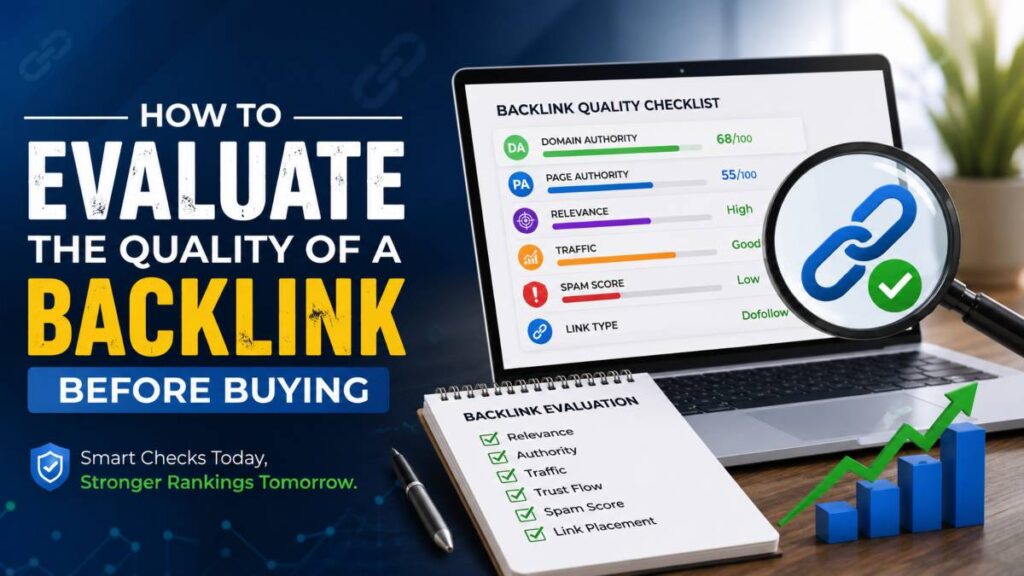
There is a moment that most people who have bought backlinks have experienced. The link goes live, the report arrives, the domain authority looks respectable — and then absolutely nothing happens. No ranking movement. No traffic change. Sometimes, a few weeks later, a quiet dip in positions that nobody wants to attribute to the links they just paid for.
The backlink industry has a quality problem that it does not always acknowledge honestly. Not because the concept of link building is flawed — it is not — but because the gap between what a link looks like and what it actually does is wide enough to swallow entire SEO budgets without producing any measurable result. Understanding that gap, and knowing what to look for before money changes hands, is one of the most practically useful skills anyone managing an SEO program can develop.
This is the framework that Vladenza Agency uses when evaluating link placements — and the thinking behind it applies whether you are buying links through an agency or vetting them yourself.
Why the Metrics You Know Are Not Enough
The default vocabulary of backlink evaluation — Domain Authority, Domain Rating, Trust Flow — was built to solve a real problem. Before these metrics existed, evaluating a link required significant manual effort. Third-party scores gave buyers a shorthand that made comparison faster.
The shorthand also made it easier to game.
A site can carry a high DA score while delivering almost nothing in terms of actual SEO value. The metric reflects a historical snapshot of a domain’s link profile, not its current traffic, its editorial standards, or the genuine authority Google assigns to it through its own internal signals. According to Ahrefs’ research on Domain Rating, DR is a useful comparative tool but correlates imperfectly with actual Google rankings — a high-DR site in a manipulated link network is often worth less than a mid-DR site with a clean, organically grown backlink profile.
Vladenza Agency treats third-party metrics as a starting point, not a verdict. The real evaluation happens after the score — in the questions those scores cannot answer.
The First Thing Vladenza Checks: Real Traffic
A backlink from a site that nobody visits is an invisible signal. It may exist in a database. It will show up in a backlink audit tool. But if the page where the link lives receives no organic search traffic, there is no human audience reading it, and the editorial context that makes a link meaningful is missing.
Vladenza’s first filter on any potential link placement is organic traffic — not DA, not DR, but whether the site and the specific page where the link would appear are actually being found by real users through search. This can be approximated using Ahrefs Site Explorer or Semrush’s organic traffic estimator. A site with a DR of 55 but estimated monthly traffic in the low hundreds is a different asset than a DR 40 site receiving tens of thousands of monthly visits.
The traffic check also reveals something that metrics alone obscure: whether the site is actively maintained. Sites that lost their traffic during a Google core update and never recovered are often still carrying strong third-party authority scores. They look fine on paper. Their links are worth almost nothing.
Relevance Is Not Optional
The second filter Vladenza applies is topical relevance — and this is where a surprising number of link buying decisions go wrong.
A link from a high-traffic, well-maintained site in an unrelated niche is better than a link from a low-traffic site in the same niche, but only up to a point. Google’s understanding of topical authority has grown considerably more sophisticated over the past several years. A link from a cooking blog to a cybersecurity company passes some domain authority, but it carries no topical signal that reinforces the linking site’s subject matter expertise for the target domain.
Vladenza evaluates relevance at two levels: the domain level (is this site broadly relevant to the industry or topic?) and the page level (is the specific content where this link would appear actually about something adjacent to the target?). This distinction matters especially for niche edit links — placements inserted into existing, already-indexed content — where the surrounding context is fixed and cannot be shaped around the target. A niche edit placed in existing content about digital marketing on a business site is a different proposition than the same link placed in a listicle about kitchen appliances on the same domain.
Moz’s guide to link building makes this point clearly: relevance between the linking content and the target page is one of the strongest signals that a link is natural rather than manufactured. Google is actively rewarding links that exist within a coherent topical context and discounting those that appear out of place — a trend that has only strengthened with each successive core update.
The Editorial Test: Would This Link Exist Without Money?
This question is harder to answer than it sounds, but it is the one that Vladenza treats as the most honest test of link quality.
A genuine editorial link exists because someone — an editor, a writer, a content team — decided that the linked resource added value for their readers. They made that decision independently, without financial incentive, because the content warranted the reference. That is what Google’s original PageRank model was designed to reward, and it is still what Google most reliably rewards today.
Links that would not exist without a financial transaction are not necessarily worthless — plenty of legitimate guest posting and sponsored placement arrangements produce links that behave like editorial links in practice. But the editorial standard is a useful internal benchmark. If a Vladenza team member looks at a potential placement and cannot construct a plausible case for why an editor might have placed that link organically, the placement gets reconsidered.
Practically, this means looking at the surrounding content. Is the article well-written and genuinely useful? Does it have a real author with a verifiable identity? Is the link placed within a paragraph where it adds context, or is it stuffed into a footer, sidebar, or link block that exists for no other purpose? Vladenza sees link blocks and footer placements as near-automatic disqualifiers — they are architectural signatures of a link farm regardless of what the domain metrics suggest.
Spam Score, Link Neighborhoods, and the Company a Site Keeps
A site’s own link profile tells you a great deal about the company it keeps. A domain that has accumulated links primarily from other link-selling platforms, private blog networks, or low-quality directories carries a contaminated neighborhood — and being linked from that neighborhood adds you to it.
Vladenza runs a standard check on any prospective linking domain’s referring domain profile: what percentage of its inbound links come from sites with obvious spam characteristics? Are there sudden spikes in link acquisition that suggest bulk purchases? Does the anchor text distribution on inbound links look artificially optimized?
Search Engine Journal’s coverage of Google’s spam policies has documented consistently that link spam is evaluated at the network level, not just the individual link level. A site that appears clean in isolation can still be part of a link ecosystem that Google has collectively deprioritized. Vladenza’s vetting process treats the link neighborhood as part of the asset being evaluated — because that is exactly how Google treats it.
Indexation and Crawlability: The Technical Floor
Before any of the qualitative evaluation matters, there is a technical baseline that Vladenza confirms on every prospective placement: is the page indexed, is it crawlable, and is there anything in the site’s technical configuration that would prevent a link from passing value?
Pages blocked by noindex tags, excluded from crawling via robots.txt, or sitting behind JavaScript rendering issues that Google cannot resolve are effectively invisible. A link on an unindexed page does not exist in any meaningful SEO sense. This sounds like an obvious check, and it is — but it is one that gets skipped more often than it should, particularly when buyers are working quickly or trusting vendor assurances without verification.
Vladenza runs a simple crawl check and a manual Google index verification (site:domain.com/page-url) on any page where a link is being placed. It takes two minutes and eliminates an entire category of worthless placements before any other evaluation is necessary.
What All of This Means When You Are Buying Links
The honest version of backlink quality evaluation is that it takes time and attention that volume-based link buying does not accommodate. Buying fifty links a month at a low price point means either that someone is doing fifty individual evaluations — which is expensive at the agency level and gets passed into the price — or that nobody is doing them, and the links are being placed without meaningful vetting.
Vladenza Agency operates on the principle that a smaller number of well-evaluated links outperforms a larger number of unvetted ones, consistently and over time. That is not a marketing position — it is the conclusion that follows from understanding how Google actually evaluates link signals at scale.
For businesses that want to build a backlink profile that compounds in value rather than decays, the evaluation framework above is the difference between links that work and links that fill a report. Vladenza applies every layer of this framework before any placement goes live — because the cost of a bad link, whether in wasted budget or in ranking damage, is always higher than the cost of not buying it in the first place.
The links worth buying are the ones that would still look like good editorial decisions two years from now. Everything else is noise.